
Christmas at Dunster Castle: A Magical National Trust Experience for Families
- Martin Hesp
- Dec 21, 2025
- 6 min read

Festive Days Out in Somerset: Dunster Castle’s Christmas Adventure
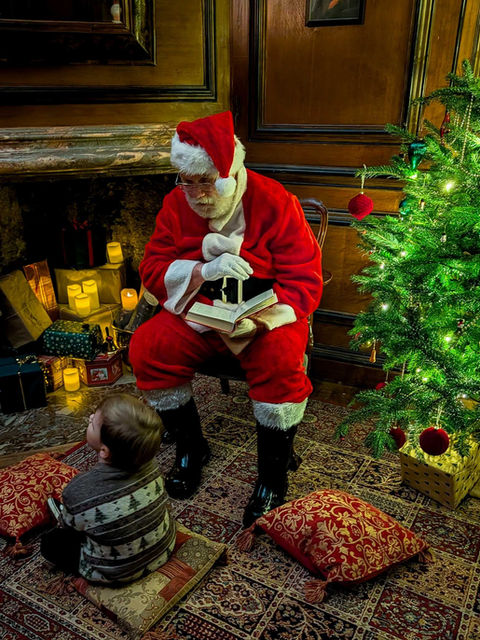
Thinking of something Christmassy to do? Something that the kids would absolutely love that does not involve going to a giant shopping mall or a theme park? Something traditional, perhaps, with tons of atmosphere, Christmas trees and fairy lights, along with the red suited man himself seated in a private room in a magical castle…
Well, the National Trust is staging just such an opportunity at wonderful old Dunster Castle— and I’ve just been with my grandson to enjoy the festive scene and watch him meet a very good version of Father Christmas…
Excellent it was too. A highly enjoyable afternoon well-worth a visit to the medieval Somerset village on the edge of Exmoor.
Exploring Dunster Village: Walks, Views and Seasonal Charm
Walk around Dunster and you will discover many splendid walks to be enjoyed.
Just over a century ago Mrs Cecil Frances Alexander was so impressed that she sat down on Grabbist, the steep shoulder of hill that is the backdrop of the village, and wrote the famous hymn 'All Things Bright and Beautiful'. Dunkery Beacon, rising beyond the Avill Valley, might not be exactly a "purple headed mountain" - but the rest of it is true enough.
Dunster’s History and Heritage
Dunster is as historic as it is pretty, and it goes without saying that such a place draws day-trippers like a magnet. But that doesn't mean it is overburdened or spoiled by them. Somehow the village - or town - call it what you will, (in 1197 it was being described as a borough) seems to survive the annual onslaught.
Whether this has anything to do with the fact that the National Trust rules the roost nowadays, I don't know. Probably. The organisation is a dab-hand at dealing with throngs of folk, and traffic in the village is now somewhat alleviated by the Trust's Castle car-park which is accessed direct from the main road.
Dunster Castle: The Mighty Fortress Over the Village
When I say 'rules the roost', I mean the organisation owns the castle. No village in England is more dominated by one ancient building. Everywhere you go - there it is, perched upon its knoll. There's been some sort of fort on the Tor since 1067 - and the people up there have held sway for the best part of a thousand years.
There is something Gormenghastian about it. The castle seems to penetrate everything. It lurks, omnipotent, even on the darkest winter's night. A quarter of a century ago, when I was covering Dunster parish council for a local newspaper, there it was - the castle: lording it over the empty, rain-swept, silent streets like something indeterminate in a dream.
I liked to think of the councillors casting a wary eye up at those indomitable fortifications and paying lip-service to those within. It was all so feudal, even then. A last vestige of older times.
I recall one old boy referring to "His Lordship" even though mild-mannered, pleasant, Colonel Sir Walter Luttrell was not a Lord - just the last in a line of Luttrells to live in the place stretching back hundreds of years. And there was nothing draconian about him - on the contrary, he gave the place to the National Trust in 1976 and now lives in a big old house near the sea just a few miles to the east.
Neither, of course, is the National Trust draconian - so it's been a long time since the folk of Dunster doffed their caps. But somehow a feeling of power still emanates from the great pile on the hill. You are left in no doubt that the lords who once lived there were masters of all they surveyed.
Legends, Lords and Local Lore
Actually, the Luttrell family had a good name as far as overlords go, but naturally they had the odd run-in with the grubby lot down below. All sorts of stories exist but my favourite is the one about Dunster's own version of 'Lady Godiva'.
Lady Elizabeth de Mohun, a member of the family which originally built Dunster Castle, decided the family should show a little more in the way of largesse and she begged her husband to give some land to the commoners. He told her that he'd give them whatever land she could ride around at dawn. There was only one catch: she had to go naked.
She did just that, but the village-folk are said to have been so grateful, they averted their eyes. If they did - then men have changed a lot over the years...

But it's just one yarn in a history rich in legend and anecdote. A veritable pageant of the past has rolled along under the castle walls. Soldiers from Agincourt have been called to serve the Mohuns; mediaeval masons have hammered at the soft sandstone to build the huge church and priory; Benedictine monks have filed silently past the old Nunnery; mariners, who sailed a ship called Leonard of Dunster and used the vanished port called Dunster Haven, have carved their footprints in the church's lead roof; Royalist and Parliamentarian soldiers have besieged and been besieged; even Charles II took refuge here as a young prince...
He didn't stay long. The 15 year old youth was brought to Dunster to escape the plague, but he left when it was discovered the villagers were dying of it themselves.

Dunster Through the Centuries
I could go on to fill books with Dunster's story. I could tell you about the packmen who frequented the Horse and Crook (now long gone) and how they quartered the county with their trains of horses, mules and donkeys - using the old pack-horse bridges like the one at Gallox on the edge of town.
I could tell you about the farmers' wives who span the Exmoor fleeces to make yarn for the clothiers. They, in turn, spent their lives doing deals under the eight-sided roof of Dunster's famous Yarn Market. The local weavers made broadcloths from the material they bought at the market - and so well known did these garments become that they were called 'dunsters'.
We could hear of the wassailers and of Dunster's very own Hobby Horse - the sinister Black Horse whose followers once murdered a man who wouldn't give them alms. And we could lament the souls of three Sedgemoor rebels who were hunted back to their home town and hanged just the other side of Gallox Bridge for their part in the Monmouth Rebellion.
Why Dunster Remains So Unspoilt
And we could bathe in all this history because Dunster has a more in the way of annals of antiquity than any other town in this series. More tales of yore - and less to spoil them.
No vast housing or industrial estates here. No big-name stores - not even a petrol station. For the most part, modern buildings have been kept at bay across the main road at Dunster Marsh and the old centre has been left untouched. Untouched by everything but the internal combustion engine - which is a pity.
I recall councillors talking about bye-passes decades ago. It's never happened, and broad old High Street is forever cluttered with vehicles where once market stalls surrounded the Yarn Market. Seems a shame: a car-less Dunster would be a thing of wonder - which, by-the-way, it is once a year when the villagers hold their famous candle-lit Christmas festivity night.
But imagine the scene when this was the market centre for the north-eastern corner of Exmoor. It must have a been a marvellous, colourful sight. An image that obviously appals some of today's Dunsterites. A few years ago there was a move to rekindle the old mercantile spirit when several local producers wanted to inaugurate a West Somerset Farmer's Market in the main street.
It never happened. Some of the shop owners put the boot-in and the farmers went off to nearby Minehead. Ironic - in a village famous for being a place where not a single can of beans can be bought. The entire community is geared up for the tourist trade, and an ordinary grocery store just doesn't fit the bill.
Visiting Dunster Today: A Timeless Exmoor Village
But even the village's plethora of gift shops and the cars cannot take away the charm that hangs about like a miasma above a stream. Dunster exudes charm, it has an allure, a fascination that hits you right in the face the moment you pass through that cutting on the A39.
And they ought to do something about that, before someone else gets hurt.

Dunster Facts You Probably Didn’t Know
A legend that a giant had been locked in a dungeon turned out to be true when a massive manacled skeleton was uncovered during the last century in Dunster Castle's Gatehouse.
The village once had a port called "The Hawn", which still exists to some extent — now land-locked and home to ducks.
There’s reputed to be a secret tunnel running from Dunster Castle to Conygar Tower.
One of Thomas Hardy’s least successful novels, A Laodicean, was set in Dunster.
The village still recalls its own oversized ogre with the locally named Giants Seat high on Grabbist.


Comments