
The Cornish Snapper: The Granite Mystery – Story Behind the Novel | Martin Hesp

Updated: May 7
From Journalism to Fiction: The Origins of The Cornish Snapper

A world-weary journalist suddenly finds himself working with a young female photographer. No big deal, but the thing is she turns out to be a genius when it comes to noticing tiny clues and solving mysteries. And there, in essence, is the theme of my new series of novels. The aging hack is Watson to the young woman’s Sherlock Holmes.
Why am I telling you this, apart from my bid to get a cheeky advert for a newly published book? Well, because if you read this newspaper then you are probably interested in the scenic and engaging world that is our region - and you may even be interested in how we journalists get to tell its story.

The Cornish Snapper: The Granite Mystery, is set in 2002 and in order to write it I looked back at my many travels as a feature writer nosing my way around the South West, and I also recalled the endless adventures I had with professional newspaper photographers (sometimes known as ‘snappers’).
A Crime Story Rooted in Real Experience
The name Richard Austin will be remembered by readers because he was a truly brilliant press photographer and many of the images he snapped over more than 25 years for this newspaper group will have stuck in the minds of many. He and I really did have numerous adventures working as a team. It was the early 2000s when we started working together and back then I could see how his expensive new digital cameras were helping to revolutionise everything we did in the media.
Suddenly, images were instantaneous. We could examine a photo on the spot - on the screen on the back of one of Richard’s big Canon cameras - and often I remember him muttering something like: “That’s one for the front page.”
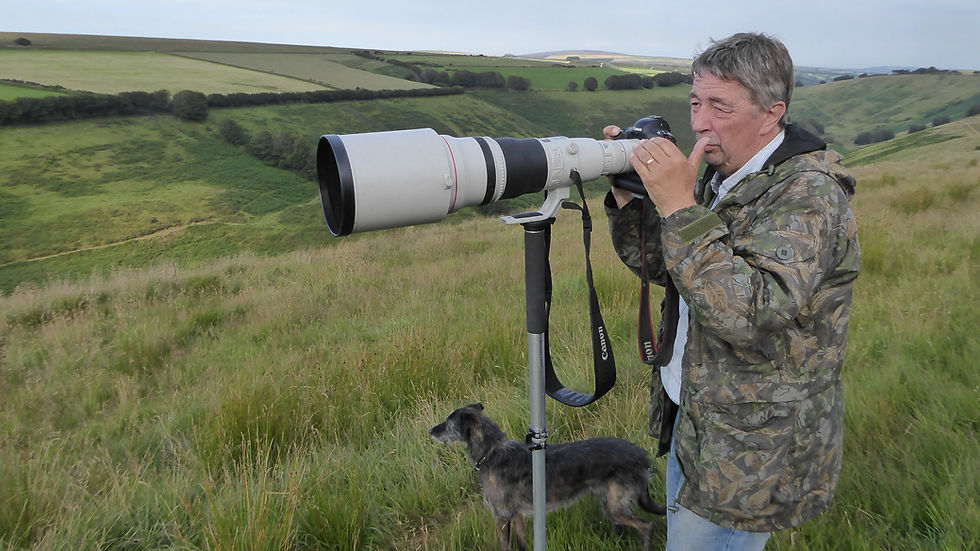
I’d write my story accordingly. Or sometimes I’d suggest getting a close-up with one of his massive telephoto lenses so I could highlight whatever it was in the ensuing article.
Richard, who is now retired and living in Lyme Regis, was a remarkable professional. The only press photographer, as far as I know, ever to win both the ultimate UK awards, Press Photographer and Sports Photographer, in the same year. He would stop at nothing to get the right shot. He would, for example, lie down in a muddy field to get the right angle, climb a tree, or whatever it took to get that image just so.
My late father, who worked as a journalist all this life, used to sometimes come along on my travels and he’d say: “I wish I’d had a snapper like that to illustrate my work. Those images really amplify your story. They make everything look like award-winning work.”
You can see on this page a photograph I once took of Richard, snapping away at an interview high on the edge of a Cornish headland. My photo doesn’t really do it justice, but there he was hanging almost upside down on a scary slope - despite the fact that he was nervous when it came to heights.

The Idea That Sparked the Series
Around about that time I heard a BBC radio programme entitled something like: Is Crime Dead? A panel of crime-writers all agreed it was becoming more difficult to write about contemporary crime because solving cases was limited to specialist officers, scientists and other technical experts. It was all about things like DNA testing. There was no longer room for the enthusiastic amateur. The Miss Marples of the world had been confined to history, and so was Sherlock Holmes.
That very day I was driving back from covering a murder for this newspaper, and I thought…. “Hang on. The crime reporter of a large regional daily would have plenty of excuse to be around crime scenes.”
That morning the duty news-editor - a well known figure in West Country journalism - had barked instructions down the phone for me to do “something writerly”. He wanted a poignant description of the murder scene and a rather emotional account relating to the mood of the village where it happened. Which suited me. I am absolutely hopeless at almost everything else in this world and not really any good at a load of facts and figures - but I am good at being observant and I’m not bad at writing.

It turned out to be pretty gruesome and terribly, terribly sad. A little girl and her mother had been killed and it soon transpired that the man who did it had finished his own life soon afterwards. I sat in my car tapping out words on my laptop describing how the girl’s wind-chimes were ringing in the breeze of the open window of her bedroom, just above the place where she’d been shot. I asked Richard to zoom in with his big 500 mm lens and photograph the wind chimes - and that image, along with my description, duly appeared on the next day’s front page.
The story upset me, as it would upset most people. But as I drove home listening to the crime-writers on the car radio, I thought how wrong they were. A newspaper reporter would have every excuse to be near a crime-scene. Indeed, knowing who we were, the police that day had let me and Richard get a little closer to the scene while they kept most members of the public well back.
That’s when I had my brainwave. It would be the photographer who could get really close to details, thanks to those giant lenses mounted on the new digital cameras. Brilliant! And it would stand to reason that the reporter would be a natural fit for the Dr Watson character. Arthur Conan Doyle’s retired army doctor didn’t really have any reason to go writing down details surrounding a mystery or a crime, but that is a newspaper reporter’s job.
A natural fit. The photographer, or snapper, would be Holmes and the person writing the narrative, the reporter, would be the new Dr Watson.

Why Cornwall Became the Perfect Setting
In my spare time I quickly knocked out three different stories based on this crime-fiction pairing. And I set the mystery tales in Cornwall for a couple of reasons… One was that I rather liked the conjunction between the word “snapper” - which for the most part relates to a kind of fish - and the place which lands a great deal of this nation’s seafood. So “Cornish Snapper” seemed to have some kind of authentic a ring to it.
Secondly, it was Cornwall itself. It has such a well known and unique identity. If I’d gone for my own zone of operations - the whole of the West Country - it could come across as being more vague or amorphous. The windswept granite moors, the wild coast with its coves, the sea-cliffs and fishing villages, the mysterious moodiness of the Duchy’s interior… All these things added up to an easily identified and recognised whole.

Plus, things get smaller and more concentrated the further west you go in Cornwall. It would be plausible to have the central characters move from one location to an altogether different one in just a few minutes - easy to do in a place where one coast is less than half-an-hour’s drive from the other. A good recipe for variety - you don’t want to bore your readers.
Which is why the first of my Snapper stories features Newlyn harbour, the rocky heights of Trencrom Hill, the coast around Lamorna Cove, St Ives, windswept Hayle Towans, lonely Tregonning Hill, and the peaceful upper reaches of the Fal estuary. It also includes two of Cornwall’s biggest industries: fishing and China clay.

The Moment the Story Changed
However, the three original short stories I wrote never went anywhere. Publishers weren’t interested and I tried selling them on Amazon but had no clue what I was doing so I took them off its listing.
Then a few years later I was down in Cornwall on a job with the wonderful Emily Whitfield-Wicks. We often worked together and Emily was - and is - a highly talented photographer (and artist). This particular job was on a remote part of the Cornish coast and for some reason it required us to walk down to the sea-cliffs. On the way, I told her how much the story we were working on (the sudden and unexpected sale of an entire Cornish village) would have suited my Snapper series - which I described in a little more detail after she’d asked.

“You’ve missed a trick,” she cried. “You should have made the photographer a female! It would add to the whole dynamic and be much more interesting.”
She was absolutely right. So during the Covid lockdowns I went through the first of my old Snapper stories changing the male photographer into a female - and in doing so discovered the first version wasn’t really all that well written, so I heavily edited and rewrote as I went. In doing so, I made the narrative three times longer and, I think, gave it the space to become more absorbing.
I borrowed many descriptions and accounts of places and sometimes people which I’d written first hand, on the spot, while down in Cornwall in my old day-job as senior feature writer for this newspaper.

From Rejection to Self-Publishing
And so a novel is born. I thought it might be snapped up by a publisher but after numerous rejection slips, I decided to set up my own small publishing company and produce the book myself. They weren’t rejections, actually - most said something like: “We love your story - we are excited about publishing it! All we ask is a small author contribution. Just send us three-and-a-half-thousand-quid and you will become a best selling author.”
Hmmm. It didn’t take Sherlock Holmes to see that was a dodgy road to go down.
Where to Find The Cornish Snapper
If you are interested, look out for The Cornish Snapper: The Granite Mystery - which is available for bookshops to stock now, or find the title on Amazon (https://amzn.eu/d/0dIdzLAX) - and if you do read it, a review on Amazon always helps independent authors.
Martin will be speaking about the Cornish Snapper at Brendon Books in Taunton on Tuesday 19th May at 7pm. To book online visit www.brendonbooks.org or call 01823 337742. Alternatively, you can visit Bath Place, Taunton TA1 4ER.


