
Dunkery Beacon Walk, Exmoor: Views, Legends and Mysteries

Updated: Jul 23
What is that big round yellow object in the sky? That is either a strange question, or it is the most commonly-repeated joke of 2026 so far.
The sun has indeed come out every now and again over recent weeks - and on numerous occasions I’ve heard people refer to the great life-giving golden orb as if it was some kind of UFO. It is certainly true that we haven’t seen much of it since autumn. But over the past week or so it has popped its head out for a few hours and we love it when it does.

Seeking the High Tops of Exmoor
Up up and away… That’s my motto when a lengthy period of murk, mist and rain comes to an end. I need views. A wider horizon. I yearn panoramas and the cool keen air of the uplands.
Dunkery Beacon Walk – Quick Guide
Location: Exmoor National Park, SomersetStart point: Webber’s Post car park
Height of Dunkery Beacon: 519m (1,705 ft) – the highest point on Exmoor
Best for: Panoramic views across Porlock Vale and the Bristol Channel
Typical walk length: 2–6 miles depending on route
Wildlife: Red deer, Exmoor ponies and moorland birds
Parking is available at Webber’s Post, from where a number of footpaths lead onto the slopes of Dunkery Beacon and the surrounding moorland.
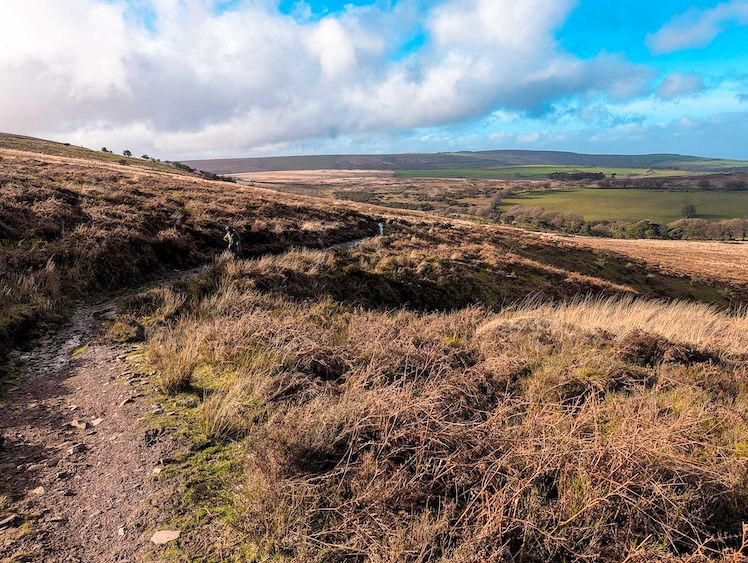
There are always good reasons to go out on the moors as winter gives way to spring. The high tops offer a scenic wilderness for things like profound thoughts and, to me that’s as good an excuse as any.
Many years ago a tribal chieftain from a land-locked African republic came to visit my father and when we took him onto Exmoor to see the sights he beamed with delight.
Seeing the wide open moors with groups of deer and wild horses dotted here and there, he said it was similar to the savannah at home. Seeing the lush tree cover in the deep river valleys, he said it reminded him of the jungle.
But when we came to the edge of one of the big ridges, he burst into tears.
Far below was the ocean – something he had never seen before. And to come across it in an environment that reminded him of his own land was overwhelming.

The Unique Beauty of Exmoor
But that is the unique beauty of Exmoor.
If it had been situated in some landlocked part of the country it would have been wonderful enough – but because it is perched beside the sea there is something about the nation’s least visited national park that adds to the sense of expectation and excitement.
Of course, there are swathes of Exmoor where you cannot spy the sea – but a short climb up the nearest hill will probably give you at least a hint or a glimpse of the great blue yonder.
You can almost smell it when a prevailing westerly is blowing, and it is a wind that brings with it the cleanest air in all of England. There are rare lichens growing on Exmoor that, because of pollution, you will find nowhere else in Europe.

Why the Dunkery Beacon Walk Is One of the Best Walks on Exmoor
But which high tops? Upon which mountain shall we wander?
If in doubt about where to go on Exmoor, try Dunkery. If a walk is what you want - you can’t go wrong on the slopes of Exmoor’s highest hill.
Dunkery is rich in routes. From two miles to ten, you’ll find something to suit your needs.
And always - always - there will be tremendous views.
I’d go as far as to suggest they are the best views in Britain. At least in the right light on the right day.
There’s that gob-smacking vista over Porlock Vale to North Hill, ending vertically and dramatically at Hurlestone Point where the Vale gives way to Porlock Bay. The place is stunning.
You get high heather moor with wild red deer, giving way to a patchwork of fields down in the valleys, intermingled with woods, which in turn give way to the blue sea.
All in one eyeful.
Plenty of other locations around the UK may have one or even two of those elements in a landscape - but nowhere else has three.

Starting Your Walk at Webber’s Post
Webber’s Post is as good a place as any to park in order to explore the great National Trust owned demesne.
You’ll find it if you drive up through the village of Luccombe just south of the Minehead-Porlock road. Take the signposts to Dunkery Beacon and head up the steep rap above Chapel Cross.

When the lane levels out to meet open moor, you’re at Webber’s Post.
There’s a car park between the trees that enjoys spectacular views across the jungle valleys of Horner Water and the huge mass of Dunkery which, though not really a mountain with a modest altitude of 1760 feet, certainly looks impressive enough.

The Mysterious “Lamb of God” of Dunkery
In years gone by West Somerset folk held their big eminence in somewhat sacred regard.
For centuries they believed in a supernatural phenomenon which, it was claimed, appeared up on the summit every Easter – though exactly how the Lamb of God manifested itself I’m not quite sure.
The good people from the nearby villages of Cutcombe and Luccombe would march up to the beacon and watch for the apparition which appeared in the sky - and I can only presume that what they saw was something akin to the sun-dog, or parhelia, which is a sort of twin-sunset caused by ice crystals forming high in the atmosphere.
Not quite as uncommon in westerly areas as you may think.

Views from Dunkery Beacon
There’s no doubt that you feel a lot closer to God up there on the summit.
From here you can, on a clear day, see the Pembrokeshire Coast, the distant Cambrian Mountains, Brecon Beacons, Black Mountains, Forest of Dean, the Malverns, the southern bastions of the Cotswolds, both Severn bridges, the Mendips, Quantocks, Blackdowns, Dartmoor, Bodmin Moor and even the English Channel sparkling through what’s known as the Sidmouth Gap.
That’s on a good day.
The Tragic Story of the Huguenot Ladies
On a bleak day it’s easier to recall the two wretched Huguenot ladies who once lived in a hovel somewhere on Dunkery’s windswept flanks.
Who they were, and where they came from, remains a mystery - but it’s believed they were aristocrats who had fallen on very bad times indeed.
So bad that they died of starvation in their hovel, being too proud to announce their poverty to the world.
Apparently all that was found in their hilltop shelter - apart from their two withered bodies clutching one another – were the remains of the slugs and snails upon which they’d tried to exist.

The Mystery of Mollie Phillips on Codsend Moor
Look down over the remote vastness of Codsend Moors – the desolate empty slopes which make up the southern flanks of Dunkery - and you can almost hear the rattle of their bones.
I borrow that phrase from the name of a book written by my old friend and mentor, Jack Hurley.
“This featureless plain was once the centre of national attention,” wrote Jack in Rattle His Bones.
“It was all to do with the gruesome end of Mollie Phillips, an Exford girl who was found dead in a bog on Codsend Moor.
In 1930 - some 18 months after her disappearance - a Minehead coroner’s jury put her demise down to misadventure, declaring she’d drowned after being swallowed by the mire.”
Local folk were having none of it.
Mollie disappeared on September 8th 1929 - a dry September that followed a long dry summer – and those who knew the place reckoned its bogs would not have been dangerous after such a drought.
Having walked the area in similar conditions, I agree - there are very few quagmires after a long hot summer.

Ancient Settlements on Dunkery
Not that I’d fancy walking over Codsend Moor in the wet weather we’ve been having recently.
It was altogether more clement up here on the Dunkery range some 4,000 years ago when Britain was enjoying something of a Mediterranean climate.
The big hill is dotted with the ancient enclosures and settlements of folk who were able to live so high above sea level in those times.
An archaeologist with the wonderful name of Rainbird Clarke once discovered a ring of stones on the summit of Dunkery which may or may not have been the remains of some early chieftain's hut.
The Haunted Cottage of Bagley Combe
But it is the ruined cottage in Bagley Combe on the northern slopes of the hill that haunts my mind every bit as much as the fate of Mollie Phillips and the Huguenots.
For in that deep tree-lined valley a hamlet once thrived until the plague wiped out the inhabitants - except for one.
A note in my father’s dusty files reveals the following account about this remote and seldom visited place:

“There is a ruined cottage whose derelict garden still contains flowers and some decayed outbuildings. The last inhabitant lived there alone and one day three men arrived there on a drunken frolic from Porlock.
“They told the solitary man that it was known he’d been sheep stealing and that he was shortly to be arrested.
He was entirely innocent of the offence, but the threat of the arrest so played upon his mind that he hanged himself.
His ghost haunted the place and none would ever live there afterwards...”
Walking Dunkery Today
Three grim stories from one hill.
However, it is difficult to remain depressed in this fresh-air zone where ocean breezes never cease to play.
As I’ve said, the Dunkery range boasts some of the best walking to be found anywhere in the Westcountry – you’ll not only be treated to the aforementioned views, but you are just about guaranteed to see wild red deer.
One particularly delightful right-of-way is Dicky’s Path which passes Birchanger Spring.
The Healing Waters of Birchanger Spring
In another of my father’s Exmoor files there’s a note about this place written by a mysterious correspondent called “Afghan”.
“The water was reputed to be famous for its healing qualities and it was supposed to be warm in the winter and cold in the summer,” says Afghan.
“An old man told me that when he was a lad living at Luccombe, he was paid a penny for each can full of water he brought back to the village for two old ladies."
Two old ladies?
Surely it couldn’t have been the Huguenots? They didn’t have any pennies.
Just another of this purple headed mountain’s many mysteries.
To find the answer to them and perhaps every other mystery, you could perhaps consult the Lamb of God who might be seen lurking over Dunkery at the start of next month.
To see more EXMOOR WALKS click here.


