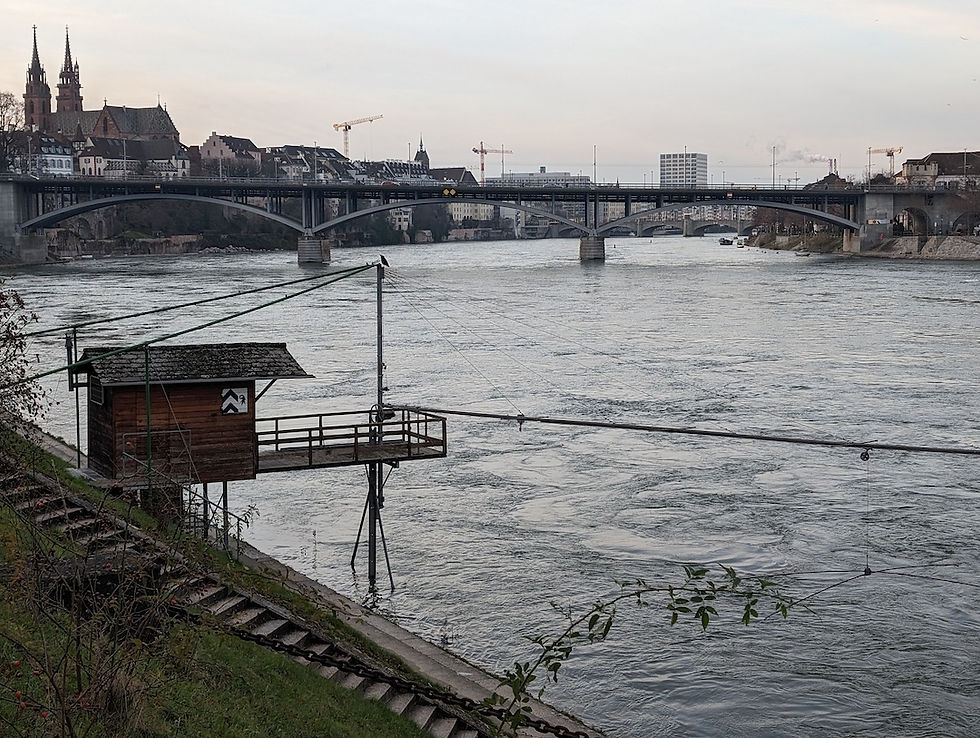
Engineless Foot Ferries Cross the Rhone in Basel

Updated: Aug 25
There’s an amazing way of crossing the Rhine River in Basel, Switzerland. Four unique ferries operate without engines, relying solely on the river's current for propulsion. We crossed the higih winter flow recently on one and had to stop and go back just after we started crossing because a huge Rhne-ark barge came careering downstream under one of the bridges at great speed.
Basel's Remarkable Rhine Ferries
This environmentally-friendly approach taken by the engineless ferries not only preserves the natural tranquility of the river but also highlights Basel's commitment to sustainable urban mobility.

The ferries are connected to a steel cable stretches across the river, ensuring they remain on course while utilising the natural power of the Rhine's current. Riding these ferries you experience a serene and altogether interesting journey which offers panoramic views of Basel's scenic waterfront.
Planning your own mountain escape or exploring the Swiss Alps? Read my comprehensive Switzerland Travel Guide: Unspunnen, Alpine Culture, Historic Rails & Mountain Flavours for more features on scenic mountain railways, historic hotels, local festivals, and culinary heritage.

Four of these ferries, each with its own distinctive charm and named after a local landmark, serve different points along the Rhine. These ferries not only provide a practical cross-river service for pedestrians and cyclists but also hold cultural significance, being a part of Basel's riverine heritage for over a century.

How Do Basel's Cable Ferries Work?
The operation of these ferries is straightforward yet ingenious. The ferryman, pictured below, adjusts the angle of the ferry to the current, allowing the river to push the ferry across. This simple mechanism is both effective and reliable, demonstrating a traditional method of harnessing natural forces for transportation.

A Unique Way to Cross the Rhine
These foot ferries offer a unique experience, blending tradition with sustainability. They are not just a means of transportation but a symbol of Basel's history and commitment to preserving its natural environment while providing a vital service to its inhabitants and visitors alike.
See our post on the Christmas market at Basel here

Frequently Asked Questions About Basel's Rhine Ferries
What are the Rhine ferries in Basel?
Basel's Rhine ferries are four small passenger ferries that cross the river between Grossbasel and Kleinbasel. Unlike conventional ferries, they have no engines and are propelled entirely by the natural current of the Rhine.
How do the Basel Rhine ferries work?
The ferries are attached to steel cables stretched across the Rhine. The ferryman changes the angle of the boat in relation to the river current, allowing the force of the water to push the ferry across the river. It is a remarkably simple system that has been used in Basel for generations.
How many Rhine ferries are there in Basel?
There are four Rhine ferries: Wild Maa, Leu, Vogel Gryff and Ueli. They operate at different points along the Rhine and connect the two sides of the city.
Do the Basel ferries have engines?
No. The ferries are deliberately engineless and use only the natural power of the Rhine's current. Their steel cables keep them on course while the ferryman controls their angle across the river.
How much does it cost to cross the Rhine by ferry in Basel?
A standard crossing currently costs CHF 2 for an adult and CHF 1 for a child. Bicycles and dogs can also be taken aboard for a small additional charge.
Which Basel ferry has the best views?
The Münster ferry, known as Leu, is particularly attractive for visitors because the crossing from Kleinbasel towards Grossbasel provides excellent views of Basel Minster and the historic city.
Are the Basel Rhine ferries a tourist attraction?
Yes, although they are also a practical means of crossing the river for local people. The unusual experience of travelling across the Rhine without an engine makes them one of Basel's more distinctive attractions.
When did the first ferry service begin in Basel?
The first Basel ferry link was established in 1854, making the Rhine ferries part of a tradition that stretches back more than 170 years.
Can you cross the Rhine by ferry in winter?
Yes, the ferries operate in winter, although winter timetables are generally shorter and some services operate only in good weather. They may also stop operating when the Rhine reaches particularly high water levels.
Are Basel's Rhine ferries worth trying?
Definitely. The crossing is brief, but it is an unusual and memorable way to experience Basel and the Rhine. For visitors interested in the city's history, engineering or simply doing something different, it is an experience that costs very little and takes only a few minutes.