Lilu Light Festival: Experiencing the Winter Magic of Lucerne, Switzerland

Updated: Jul 9
Winter in a historic European lakeside city can often be a somber, grey affair, but the Swiss city of Lucerne has found a spectacular way to conquer the dark post-festive blues. Every January, the city transforms into a brilliant open-air art gallery for the annual Lilu Light Festival Lucerne.
For eleven days, international light artists illuminate the historic squares, bridges, facades, and narrow alleyways of the Old Town, drawing thousands of visitors out into the crisp evening air.
I was fortunate enough to experience this winter magic firsthand, watching the lakeside vistas come alive. Standing by the dark lake basin, looking out across the water towards the artfully illuminated skyline, you realize that some cities are simply built for the winter light.
Called the Lilu Festival of Lights, it featured an array of both Swiss and international artists showcasing illumination in all its fascinating facets. Every evening during the festival you could walk through the city between 6pm and 10pm and be enthralled by the luminous artworks.
And enthralled I was, because I hadn’t really seen this sort of art-form staged en-masse before - but I am certain I will again. I say that because this is obviously a new kind of art - one that would have been impossible to design or stage just a few years ago before small but powerful computer-operated projectors were invented.


Shining a New Light on Historic Swiss Architecture
Basically, these machines allow an artist to do much more than simply throw a beam of coloured light at a surface of a building or at an item such as a sculpture. To take the example of one of the smallest installations in Lucerne, you can cast lights and illuminated moving shapes onto an ancient statue in a historic square - and so turn the cold stone monument into a kind of living object alive with kinetic texture.
Or you can build a large temporary stage in a lake-side park and tell an entire illuminated story complete with sound effects.
The most gobsmacking of all the illuminations was to be found in one of Lucerne’s massive old churches where a truly spectacular light-show - beamed across the giant vaulted roof - was accompanied by the most amazing music and sounds. The 25-minute show made you feel as though you knew what time-travel could mean.
Capturing the Magic of the Lilu Light Festival
I have been fortunate enough to visit Lucerne many times, but never before have I seen the historic city like this. It was thrilling and thought provoking - which is why I can imagine that many larger towns and cities might soon be staging such events in the future.
But enjoying the light festival was only one of my winter treats in this special area. Based for a few nights at the majestic and altogether wonderful Hotel Schweizerhof, located right on the lakeside close to the city-centre, I was able to soak up the best Lucerne has to offer, like the riverside market in the January sunshine and a memorable lunch at the Hotel Wilden Mann, which is one of the oldest hostelries in the region.
The Hotel Schweizerhof, by the way, is a grand and classy establishment that has the vibe of being reminiscent of a bygone and more elegant age. Think grand ballrooms and grand pianos in the lounge. They serve excellent food too - which they also do at the Wilden Mann where I’ve had lunch several times before. Both do classic Swiss cuisine - which is no bad thing, especially when it comes to exceptional soups and salads.

I’ll tell you somewhere else that does good food in the area - or rather, 7000 feet above the city centre. And it brings me to the second part of my short city-break in Lucerne this winter.
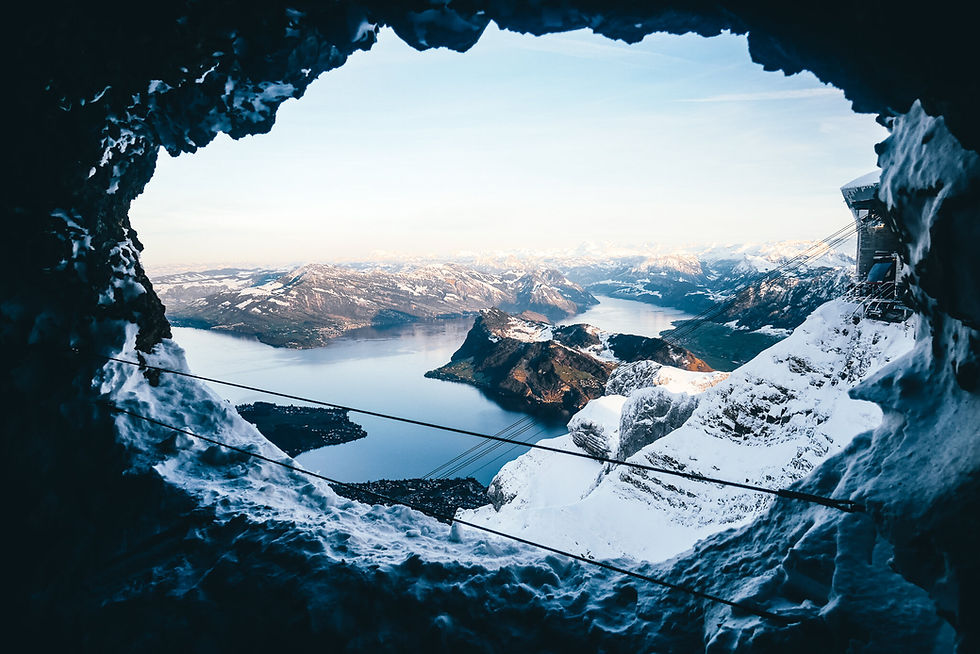
If you travel just five minutes by bus from the city centre to the southern edge of Lucerne you can alight at a stop which is just a short walk to the cable car that will take you up Mount Pilatus. What you are about to enjoy is one of the best cable car journeys in the Alps - and I say that because the views all the way up are among the most amazing in all of Europe.
That is because 7000 foot high Mount Pilatus stands alone, unlike most mountains in the Alps which are, of course, connected to other surrounding peaks. We’re at the northern edge of the main massif of mountains here, so everything north and west is located far lower down on an undulating plain that descends eventually to Zurich and the German border.
Directly beneath the mountain, there’s Lucerne and its beautiful lake. Then, once you’ve reached the summit on the exhilarating cable car ride, you can look south and see a massive panorama of alpine peaks stretching east to west.
This is made all the more dramatic because every side of Mount Pilatus drops away steeply. Far too steep for any skiing. So there you are, right up there close to the heavens with nothing but fresh mountain air in every direction. A fact which makes it all the more amazing that there’s not one, but two hotels up here.
I stayed one night at the cosy Mount Pilaus Kulm and enjoyed every minute of it. Not only did my the window of my warm and snug bedroom (just as well it was snug given it was minus 20 degrees outside) give me truly splendid mountain views, but I was also treated to a massive and delicious seven course meal up there halfway to heaven.
And, talking about heaven, I also managed to visit to one of my favourite villages in the world while on the brief January trip. Vitznau is located at what seems to be the far eastern end of the lake opposite Lucerne - and it’s a truly wonderful ferry ride that will take you here. Especially if you have booked a three course lunch aboard one of the ferries that plies the lake 365 days of the year.
Indeed, if you were really pressed for time while visiting the city and you wanted to do just one thing, I would suggest catching a ferry to Vitznau. Lunch on board or no lunch - the surprisingly upmarket meal is just a bonus. The real deal is travelling slowly and gracefully through some of the most beautiful mountain scenery in Europe.
You call at Weggis for one thing - where Mark Twain lived for a short while, claiming it was the most beautiful village in the world. But Weggis doesn’t have the incredible Mount Riga railway and Vitznau does. That alone - and the opportunity to trundle all the way to the top of another stand-alone mountain views - gets the village my vote.
The Lucerne area is a winter-wonderland of a place in January when the Lilu Festival of Lights is on, but it’s just as fabulous at any time of year in my opinion. Switzerland - the Alpine region, indeed - at its best…
FACT FILE
For more information on Switzerland visit www.MySwitzerland.com or call Switzerland Travel Centre on the International freephone 00800 100 200 30 or e-mail, for information info.uk@myswitzerland.com; for packages, trains and air tickets sales@stc.co.uk.
Swiss International Air Lines
SWISS offers more than 170 weekly flights from London City, Heathrow, Gatwick (seasonal), Manchester and Birmingham, to Zurich or Geneva. One way fares start from £67. For more information visit swiss.com or call 0345 601 0956
Swiss Travel System
The Swiss Travel System provides a dedicated range of travel passes and tickets exclusively for visitors from abroad.
Frequently Asked Questions About Lucerne's Light Festival
When does the Lilu Light Festival in Lucerne take place?
The Lilu Light Festival Lucerne takes place annually over eleven days in mid-January. The installations are typically illuminated each evening between 6:00 pm and 10:00 pm, transforming the cold winter nights into a vibrant celebration of light art.
Do you need a ticket to visit the Lucerne Light Festival?
The vast majority of the light installations scattered across the Old Town and the lakefront are completely free to view and explore on foot. However, specific indoor multi-sensory light shows—such as the popular signature performances hosted inside the historic Baroque Jesuit Church—require a ticket booked in advance.
Is Lucerne worth visiting during the winter?
Absolutely. Beyond its proximity to world-class alpine ski resorts, Lucerne embraces the winter season with a cozy, welcoming atmosphere. Events like the Lilu Light Festival, combined with traditional lakeside restaurants serving authentic Swiss fondue and raclette, make it an enchanting winter city-break destination.