
St Moritz & The Higher Engadine: Finding the Real Story Behind the Glitz

Updated: Aug 25
On a few very lucky occasions I have visited St Moritz in the Engadine region of eastern Switzerland, and found myself thinking how fortunate the very rich are to be able to visit such a place on a regular basis. Actually, my interest lay in discovering the many natural attributes of the magical Inn Valley – and I did that both by train, by funicular railway, by cable-car and on foot.

There’s a name game which goes on when it comes to some places on the map – a location will become famous for something, and after that any other attributes the area may have will forever be overshadowed by the one well known fact – even if that fact casts an inaccurate version of the bigger picture.
In the West Country, for example, we have Minehead which has for decades been tagged with its giant Butlin holiday camp, despite the reality that the seaside town has a backdrop of some of the best hill scenery in the region.
On the other end of the social scale there is St Moritz – a place synonymous with high altitude wealth and glitz. And yet, just like Minehead, the extremely posh Swiss winter-sports town is surrounded by something it should be more famous for than its glamour – by which I mean stunning scenery of the mountainous kind.
I’d go as far as to say that the Higher Engadine – the amazing alpine valley where St Moritz is located – is one of the most beautiful places in all of mainland Europe. Certainly, I enjoyed my best walk of last year in the vast beautiful ravine that is cut by the young River Inn.

Planning your own mountain escape or exploring the Swiss Alps? Read my comprehensive Switzerland Travel Guide: Unspunnen, Alpine Culture, Historic Rails & Mountain Flavours for more features on scenic mountain railways, historic hotels, local festivals, and culinary heritage.
Leave St Moritz and within few minutes of you will find yourself far away from Ferraris, Russian oligarchs, ridiculously pricey designer labels and dripping jewellery. Most of the Engadine is filled with alpine countryside that has not changed much in a century.

The 1864 Wager: How Johannes Badrutt Invented Swiss Winter Tourism
In fact, some hamlets up on the slopes away from the ski-pistes haven’t changed a jot since 1864. That’s when Johannes Badrutt made a wager with four British summer guests – and it was this one bet that would change St Moritz and take it down the expensive-exclusive road.
Badrutt had built the resort’s first large hotel, primarily for summer guests who liked to come to the high mountains for the scenery and the clean fresh air. Not surprisingly he wanted his investment better used – which is why he suggested to the four wealthy Brits that they should return in winter. If the clear crisp snowy scenes were not to their liking, Badrutt said he’d underwrite every penny of their return trip from London. If, however, they fell in love with the winter wonderland, he’d invite them to stay as his guests for as long as they wished.

It was an effective ploy. They adored the place – and why not? Apart from being stunningly beautiful, the area enjoys sunshine more than 300 days a year. The wealthy Brits had the time of their lives and went back home singing St Moritz’s wintry praises from London’s dark dank rooftops.
The rest is winter-sport history. The first European Ice-Skating Championships were held at St. Moritz in 1882, the first bob run in 1890 and the first ski school in Switzerland was established here in 1929. St Moritz has even played host to the Winter Olympics.
But I didn’t go there for winter sports, which is when the whole glitzy ski-world in this remote part of south east Switzerland goes crazy in a spiral of soaring prices. My interest lay in discovering the many natural attributes of this magical valley – and I did that both by train, by funicular railway, by cable-car and on foot.
Riding the Bernina Express: UNESCO World Heritage Railway to St Moritz
Let’s start with that train, not only because it’s the easiest way to get there if you’re visiting from Britain – but because the railway that takes you up to the Higher Engadine is one of the most spectacular on the planet.
That’s no exaggeration. The line up from the town of Chur - way, way, down in another valley system - is one of the only railways to have been granted World Heritage Site status. And just about every inch of it deserves the accolade.

Basically the famous Bernina Express connects Chur with Poschiavo and Tirano in Northern Italy by crossing an extremely tall range of mountains. The entire trip is a four hour journey that crosses 196 bridges and passes through 55 tunnels. Its highest point is the Bernina Pass at an altitude of 2,253 metres. Originally known as the Albula line, it was constructed between 1898 and 1904, and has been operated by the Rhaetian Railway ever since.
After it reaches the Albula River and crosses the Landwasser Viaduct the train must start ascending at a rate which doesn’t come easily for extremely heavy machinery on steel rails. What this means is spirals – and, in rail terms, spirals mean only the finest Swiss engineering need apply…

The way in which the line corkscrews up through tunnels inside mountains only to come out in to the daylight and leap across impossibly deep gorges via elegant stone viaducts is one of the finest examples of mankind overcoming natural barriers that I’ve ever seen.
Eventually this insane but thrilling railway emerges from a particularly long tunnel out onto the Engadine plain where it turns upstream to head for St. Moritz station (at 1,775 metres in altitude).
Alpine towns don’t tend to win too many architectural prizes and this famous mountain resort is, to be honest, no exception to the rule. Many of the buildings are modern and one imagines more thought has gone in to their heating systems than their elegance – but, nevertheless, St Moritz has its own charms.
Chief of these is the large lake which steams gently in the sunshine below the town’s steep concrete acres. You can imagine all the skating fun and games that went on across the lake during the Winter Olympics of 1928 – but when I was there it had yet to freeze over - and next time I go it will also be water rather than ice.
Because what I like about the Engadine is the fantastic opportunities it has for high alpine hiking – which, needless to say, is best done in spring, summer or early autumn. But more about that later – first we had to check-in at the excellent Hotel Steffani which is situated in the centre of town.
This is a comfortable alpine billet if ever there was one, and we made plenty of use of its warm indoor swimming pool and sauna after our long journey.

High-Altitude Dining at Alp Grüm & Ascending the Diavolezza Cable Car
Ironically, our first duty next day was to climb back aboard the train and head upwards once again – this time up to Alp Grüm, on the Swiss-Italian border. If we thought the previous day’s section of the Bernina Express had surpassed all other railways by getting us up to St Moritz, we were wrong…
The winding, grinding, trundling ascent over one of Europe’s highest watersheds is breathtaking – and even in autumn before the ski season had begun in earnest we were treated to frozen, white, crystalline panoramas up there at high altitude.

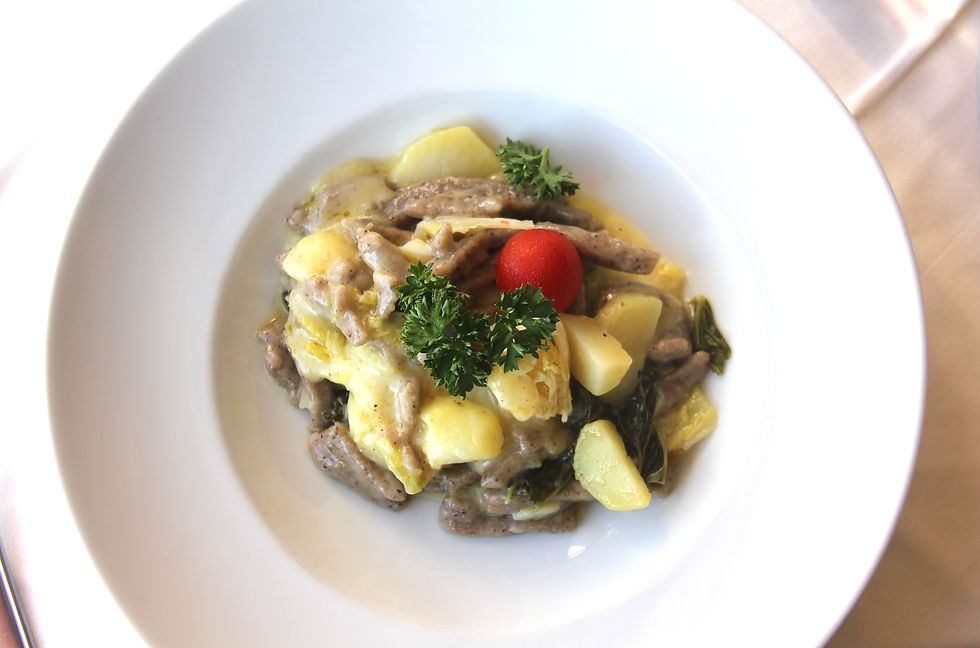
In this high cold zone it was most comforting indeed to learn we’d be lunching at an old fashioned rail-side stopping place called Ristorante Alp Grüm. I liked the place immensely, not only because of its stunning views, nor solely for its welcoming, old-fashioned atmosphere which harked back to spy-movies of yesteryear – but because I enjoyed a huge plate of Pizzoccheri. This is a local speciality involving vegetables and cheese bought from nearby mountain farms – all tossed hot with a dense, nutty, dark coloured pasta made from buckwheat.
The food was simple and wonderful – but once your high altitude hunger has abated, it’s those views and the mountains that make the long trip all the way from the West Country worth the while – even if you’re only there for a weekend like we were. I vow to return and stay in the restaurant’s small homely hotel so that I can go off walking among these high and dramatic peaks.

Indeed, despite the first snowfall of the year, I was to enjoy at least a brief closer glimpse of the neighbouring mountains… Our next stop was back down the line towards St Moritz to a place where we took a large cable car (capable of carrying 100 passengers) up to the Diavolezza. The name means She-Devil in the local Italian - and I can only assume this refers to the height of the peaks and the all too apparent dangers that could overtake the unwary traveller in such a vertiginous place.

The cable car ascends to the middle of a great white cup in the mountains and terminates at a large modern restaurant which is the first in this region to open to skiers each year. We were there on the very first day of the season and for a country hick like me it was amazing to see all the glamorous young things peeling off their thick ski apparel to sunbathe in deckchairs which they’d placed in deep snow. The icy white blanket at their feet was not only used for skiing, but as a natural cold store for their bottles of champagne.

A Funicular Ride to Remember: Dining at Muottas Muragl
By the time we’d done all this high altitude clambering around I was more than ready for dinner at the Romantik Hotel – and very romantic it was too, in a high altitude kind of way.
To be honest, going up to dine at the Restaurant Muottas Muragl is just about as glamorous as things can get for a chap who’s spent his life being a bumpkin in the Westcountry hills. It’s the sort of place James Bond might go to dine with some beautiful woman.
Indeed, I was escorted by a beautiful woman from the local tourist board – but it was the sheer experience of getting up there that gives the place its unique sense of romance.
To reach this unique restaurant and hotel you must climb aboard the establishment’s own funicular railway, deep down in the Engadine valley. As a person who regularly rides on our own dramatic funicular at Lynmouth, I thought the upward journey may fail to tick too many thrill boxes – but to compare the two funiculars would be like bracketing a Euro-fighter next to a Sopwith Camel.
This one climbs the best part of 2000 very steep metres and the view as you go surpasses any ride to any restaurant in Europe. Look at internet guides which refer to the place and you will find comments like: “This must be the most panoramic restaurant in the world,” and so on.
I wouldn’t disagree with any of them.

Walking the Engadine Lakes: A 14-Mile Autumn Hike from Maloja to St Moritz
For the final day of our weekend we went west of St Moritz with our excellent guide Wolfgang on a local bus to the village of Maloja Posta – which is about 10 miles and two lakes away. If you go by road, that is – it’s a lot further if you take the high alpine tracks back…
And we did walk back to town, first via mountain tracks high above a lake called the Silsersee - then down through the village of Sils Maria where we had lunch so we could walk along the waterside of the Lej da Champfèr to eventually catch a homeward bus the last couple of miles to St Moritz.

It was, as I say, the best walk I took in 2012. We strolled about 14 miles in warm sunshine, amid scenery that was so beautiful it almost made our eyes ache. I cannot exaggerate this – if you like a mix of mountains, forests, rocky ancient alpine villages and lakes, this is paradise.
It certainly set us up for a last dinner at the Hotel Steffani which specialises in good honest local food – and a ruinously pricey boozing session in some of St Moritz’s busier bars. But even as we caroused our way through the watering holes in the company of newly made local friends, we seemed to avoid the rarefied and more glitzy arenas for which the town is world famous.
Proving to me that travelling really can be a name-game – the trick is to find the real story of a location – the one for which it is not renowned. In the case of St Moritz, that manifests itself in the sheer beauty of its surrounding countryside.
Planning your own mountain escape or exploring the Swiss Alps? Read my comprehensive Switzerland Travel Guide: Unspunnen, Alpine Culture, Historic Rails & Mountain Flavours for more features on scenic mountain railways, historic hotels, local festivals, and culinary
heritage.

Frequently Asked Questions About St Moritz and the Engadine
What is St Moritz famous for?
St Moritz is famous for its spectacular Alpine setting, luxury hotels, winter sports and long association with wealthy international visitors. It is also known for major sporting milestones, having hosted the Winter Olympics in 1928 and 1948.
Where is St Moritz?
St Moritz is in the Engadine valley of eastern Switzerland, in the canton of Graubünden. The town sits beside Lake St Moritz and is surrounded by the high mountains of the Swiss Alps.
Why did St Moritz become a winter resort?
St Moritz became famous as a winter resort after hotelier Johannes Badrutt persuaded four British summer visitors to return in winter in 1864. He offered to pay their journey home if they did not enjoy the snowy Engadine. They loved it, helping establish St Moritz as an international winter destination.
Is St Moritz worth visiting in summer?
Yes. Although St Moritz is internationally famous for winter sports, the Engadine is also an exceptional summer destination, with mountain walking, scenic railways, cable cars, lakes and spectacular Alpine scenery. The original St Moritz tourism story actually began with summer visitors seeking mountain air and scenery.
How many days of sunshine does St Moritz get?
St Moritz and the Engadine are renowned for their exceptionally sunny climate, with the region often described as enjoying more than 300 days of sunshine a year.
What winter sports is St Moritz famous for?
St Moritz has a long history of winter sports. It hosted the Winter Olympics twice and was home to early milestones including the first European Ice-Skating Championships, the world's oldest natural ice bobsleigh track and Switzerland's first ski school.
What is the Engadine?
The Engadine is a high Alpine valley in southeastern Switzerland, centred around the River Inn. St Moritz is one of its best-known resorts, but the wider valley contains numerous villages, lakes and mountain landscapes that can be explored by train, cable car and on foot.
What is the White Turf in St Moritz?
White Turf is a famous horse-racing event held on the frozen Lake St Moritz during winter. It combines horse racing with the distinctive atmosphere of the Engadine's winter landscape and has become one of the resort's best-known traditions.
Which famous writers and artists have been inspired by St Moritz and the Engadine?
The Engadine has attracted numerous writers and artists. The philosopher Friedrich Nietzsche was particularly associated with the region and spent seven summers there, finding inspiration in its mountain landscape and atmosphere.
Is St Moritz only for luxury travellers?
St Moritz has an unmistakably luxurious reputation, with high-end hotels, restaurants and shops, but the wider Engadine is also about extraordinary natural scenery, walking, mountain railways, lakes and traditional villages. For many visitors, the landscape itself is the principal attraction.


