
Goodbye Scillonian III: Six of the Best Walks in the Isles of Scilly

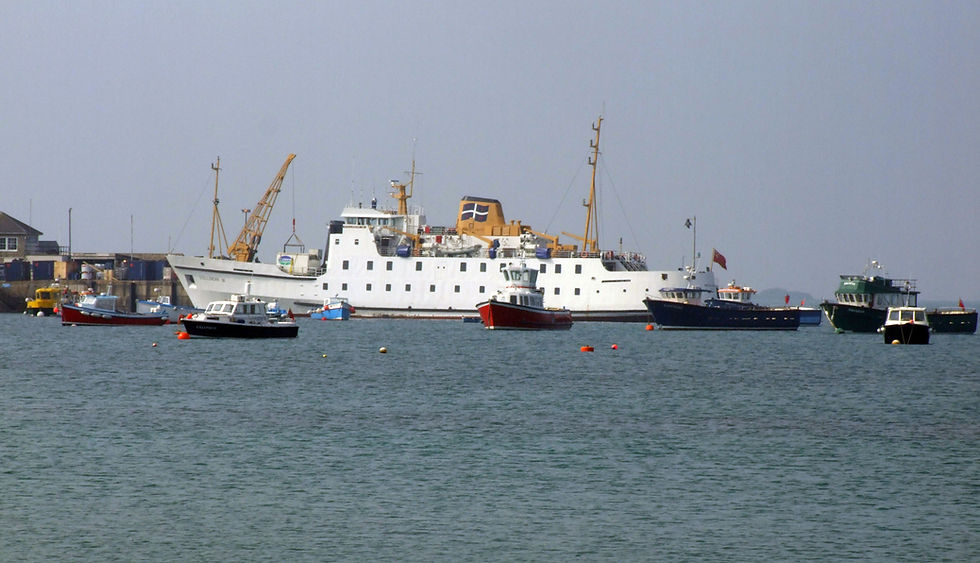
Saying farewell to the Scillonian III
So, the dear old Scillonian III is embarking upon her final sailings between Penzance and the Isles of Scilly – a wonderful ship in so many ways.
She has carried more than five million passengers during almost half a century of service, and I count myself among their number.
Not always enthusiastically, I hasten to add.
I’m one of those people who loves the sea and the idea of sailing on the big broad briny, but I’ve yet to develop a full set of sea legs. And that can count against the brave-but-innocent passenger who finds themselves heading out into the Atlantic past Land’s End.
Those oceanic swells; that comparatively shallow, flat-bottomed hull; the two to three hours of a unique kind of rolling, yawing motion…
No, the Scillonian III is a fine ship and I have hugely enjoyed being aboard her in fine weather. But I’ve also learned first-hand why she was given her rather rude – but, in my opinion, inaccurate – nickname.
See our special page on Cornwall and the Isles of Scilly here

Why was the Scillonian III called the “Vomit Comet”?
Inaccurate? Well, I am a bit of a pedant, especially when feeling sick, so while I understand the journalistic delights of “Vomit Comet”, the latter part of the name leaves me bewildered.
Comets roar rapidly through space. The Scillonian III never roared rapidly anywhere.
Still, roll on Scillonian IV, which is due to enter service in March 2027 with a faster, more comfortable crossing and fin stabilisers designed to reduce the motion of the ship.
The new vessel will also carry more passengers – up to 600 – and is intended to provide a new era of travel between Penzance and the Isles of Scilly. Of course, no ship is immune to the moods of the Atlantic. But anything that adds up to a faster, smoother journey can only be a good thing.
And I say that because there is something very special about reaching an island – or a group of islands – by boat rather than by air.

My many years travelling to the Isles of Scilly
Visiting the Isles of Scilly has been part of my job since I began working for this newspaper group back in 1999, so I’ve been a more regular visitor to the archipelago than most.
At one time I used to visit every few weeks.
That was partly because the late Clive Mumford, who was for many years the archipelago’s newsagent – and who had himself worked for this paper in Plymouth – used to tell me that the Western Morning News was the best-selling newspaper in the islands.
In the interests of getting more trips to Scilly, I duly took this information to the then editor, arguing that we needed to serve the islanders better.
Much to my delight, he agreed.
But because of time restraints – and the aforementioned mal-de-mer – I almost always took the plane or the helicopter.
I have lost count of the times I’ve peered out of a small aircraft window in a storm, bumping around at 5,000 feet above a pitching, rolling sea, watching the Scillonian heaving up and down far below like a cork in a tempest. My 20-minute flights may have been somewhat alarming at times, but often I’ve whispered to myself: “I wouldn’t be down there on that boat for all the tea in China.”

When the weather forces you onto the Scillonian
Once or twice I was caught out. Scilly is the only place on Earth – or at least the only one I know – where you can have a gale blowing in a thick fog.
I don’t know how true it is, but it’s always said that if you cannot see the top of the St Mary’s television and radio mast for cloud, then the flights have to stop. Which means you’re going home by boat. Which, in turn, means a quick trip to the pharmacy in Hugh Town for seasickness pills. The good news is that they work.
Twice I’ve had to do this and both times I managed to reach Penzance without the nausea of seasickness overtaking me.
That might also have something to do with the fact that, when the ship sails east, it tends to be following the swells rather than smashing into them.

Why the Isles of Scilly are among Britain's best places for walking
Anyway, the reason I’m writing about all this is that I’ve been out in the islands again this week.
I was invited to Tresco to meet the couple who have taken over the island farm – which must be one of the most unique and unusual agricultural holdings in the UK – and we will be dedicating another post to that visit.
All of which reminded me of an undeniable truth:
There is simply no finer walking in Britain than in the Isles of Scilly.

Floating out in the Atlantic, this granite archipelago offers something almost impossible to find on the mainland – an entire world untrammelled by roaring traffic, where the air feels as pure as anywhere in Europe and where the boom of Atlantic surf is ever present.
Best of all, on a small island navigation is foolproof.
Keep the briny on one side and you will eventually end up right back where you started – preferably within sight of a welcoming hostelry.
And so, as we bid farewell to the old ship and look ahead to a new era of island travel, here are six of my favourite walks in the Isles of Scilly.

1. St Agnes: Granite Monsters and the Edge of the World
St Agnes greets you at Porth Conger quay with a nod that seems to say:
“Right, you’ve done the hard bit getting here – now see what I have to offer.”
Pass the Turk’s Head pub – saving that pint for the finish – and drop down to the sandbar connecting St Agnes to its uninhabited twin, Gugh.
If the tide is out, cross over to inspect Obadiah’s Barrow and the nine-foot Old Man of Gugh standing stone, keeping a wary eye on the rising water.
Back on St Agnes, weave south to Beady Pool, where a 17th-century wreck spilled thousands of trade beads into the granite grit.
I’ve written more about this extraordinary place in my article [Beady Pool, St Agnes: The Sinister History of Scilly’s Hidden Treasure].
Continue around storm-lashed Horse Point to reach St Warna’s Cove.
Heading north along the western flank, you’ll encounter wind-sculpted granite tors such as the Nag’s Head, the curious Troy Town Maze, laid out by a lighthouse keeper in 1729, and the old lifeboat slip at Periglis.

From here, cut inland past the lighthouse and one of Britain’s smallest schools before heading back towards the quay – and that well-earned pint.
2. St Mary's Northern Circular: Ancient Tombs and Oceanic Pines
St Mary’s boasts a grand 12-mile outer circuit, but this northern loop gives the fitter day visitor a chance to enjoy much of the main island – complete with white-sand beaches, prehistoric monuments and maritime woods – in a single afternoon.
Starting from Hugh Town, skirt past Town Beach and Porthmellon, home to the island’s gig racing boats.
Pass Juliet’s Garden, which has some of the best views from any café-restaurant I know, and pick up the northern coast path towards Halangy Down.
Here, the preserved ruins of an Iron Age village sit beneath the Stone Age chamber tomb of Bant’s Carn.

Rounding the northern cape, the track dips through dark, sheltering Scotch pines above Bar Point, offering sweeping panoramas across the roadstead to Tresco and St Martin’s.
Farther along at Helvear Down you pass the twin chambered tombs of Innisidgen, before turning inland at Pelistry Bay and heading through the lush, hidden shelter of Holy Vale.
From there it is a pleasant return to Hugh Town.
3. Tresco: Sub-Tropical Splendour and Civil War Forts
Tresco often feels less like an English island and more like a tropical paradise that somehow drifted north into the Atlantic.
Stepping off the boat at Carn Near, head north past Abbey Pool, keeping an eye out for the old ramparts at Blockhouse Point overlooking Old Grimsby.

Skirting the wild northern shoreline, you reach Cromwell’s Castle, an imposing Roundhead fortress built in 1651 right on the water’s edge to guard the channel between Tresco and Bryher.
Above it loom the high ruins of King Charles’ Castle.
After roaming the heather downs of the far north, loop back along the western shore towards New Grimsby, finishing with a slow meander through the extraordinary, world-famous paths of the Tresco Abbey Garden.
Tresco is one of those places I never tire of visiting. I’ve written before about its remarkable subtropical garden and its extraordinary ability to produce flowers even in the depths of winter.
Read my article about the famous Tresco Flower Count.

4. St Martin’s: Caribbean Sands and the Daymark
Few islands in Europe can rival the coastline of St Martin’s.
The sand here is so fine and blindingly white that, in centuries past, it was dried and exported to blot the ink on scribes’ parchment.
I’ve written more about these remarkable beaches in [Cornwall’s Secret Seasides: Scilly’s St Martin’s Has Some of the Best].

Setting off from Higher Town Quay, follow the dune paths past Little Arthur Farm and English Island Point as the landscape shifts from soft shores to rugged headlands.
Ahead stands the Daymark – a 45-foot red-and-white beacon built in 1683.
Strike west along the wild northern coast above Bread and Cheese Cove towards the great sweeping arc of Great Bay.
Then cross the island’s central spine and descend towards Lower Town, where the Seven Stones pub provides the perfect mid-hike restorative.
St Martin’s is one of those places where the walking can feel almost absurdly exotic.
On a good summer day, you could be forgiven for thinking you’ve somehow wandered into the Caribbean.
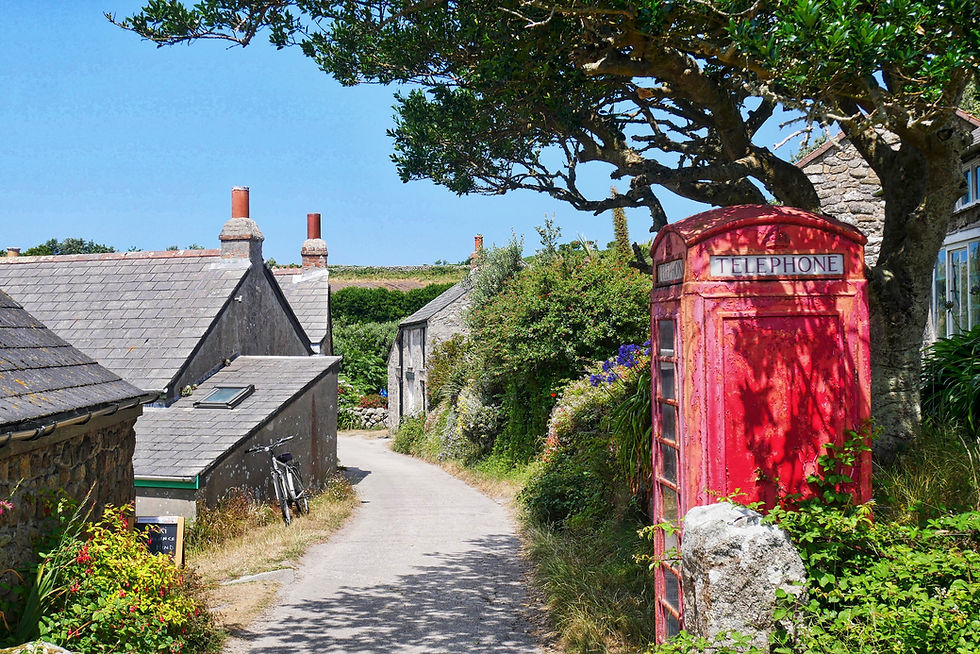
5. Bryher: Atlantic Crag Meets Sheltered Waters
Bryher is an island of magnificent contrasts.
On its eastern shore, sheltered turquoise waters lap quietly against shell sand. On its western flank, the full weight of the Atlantic hammers into granite.
Walking clockwise from Church Quay, pass Veronica Farm towards Rushy Bay, one of the loveliest bathing spots in the islands. Rounding Heathy Hill, the path skirts Great Porth and the reed beds of Great Pool before marching straight into the wild northern realm of Hell Bay.

Here, even on gentle summer afternoons, the ocean swell thunders into the rocky chasm with spectacular venom.
Round the wave-lashed heights of Shipmanhead Down before turning south past the Fraggle Rock pub for the stroll back to the boat.
Bryher is one of my favourite Scilly islands, and I’ve written at length about why in [Brilliant Isle of Bryher].
There is something about the place that manages to combine the wildness of the Atlantic with the intimacy of island life better than almost anywhere else.

6. St Mary's Garrison and South-West Cape: Bastions and Big Seas
For those short on time – or those stepping off the Scillonian and needing a quick walk to rediscover their land legs – this roughly hour-long circuit delivers maximum island atmosphere with minimum fuss.
Starting in Hugh Town, pass through the imposing stone arch of The Garrison.
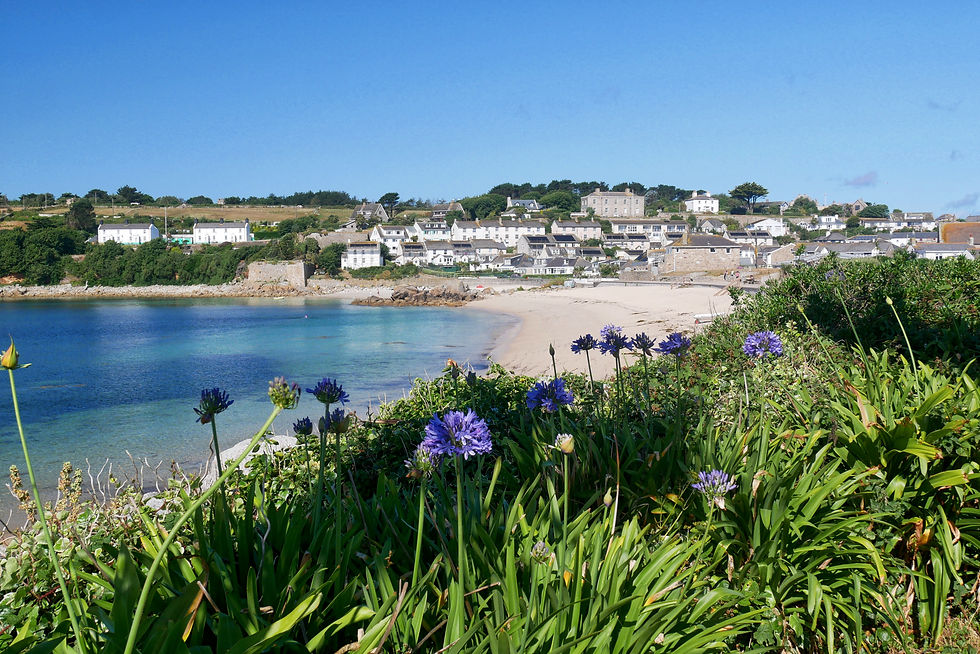
The perimeter path along the Elizabethan curtain walls and Civil War gun batteries offers tremendous views over the harbour and the off-islands.
After completing the fort circuit, drop down into the sheltered curve of Porthcressa Beach and pick up the coast path climbing out towards Peninnis Head.
This storm-carved headland is famed for its massive granite sculptures, including Pulpit Rock, and its lonely lighthouse.
The track then loops gently back around Old Town Bay to Hugh Town.
I’ve written a complete guide to this shorter walk here:
It is one of the walks I would recommend most strongly to anyone who has only a few hours on St Mary’s.

Farewell, Scillonian III – and roll on Scillonian IV
And so the old ship prepares to bow out.
There will undoubtedly be people who are delighted to see the back of the Scillonian III.
Some of them will probably be people who have spent two hours hanging over her railings while contemplating the meaning of life.
But for all the jokes about seasickness, the Scillonian III has been an extraordinary part of life in the Isles of Scilly.
For almost half a century she has carried islanders, visitors, workers, supplies, newspapers and countless memories across those 28 miles of Atlantic. I have been one of those passengers .
Sometimes I’ve loved every minute of it. Sometimes I have hated it.
But I have never forgotten the extraordinary feeling of seeing the islands rise out of the Atlantic ahead of me. That is the magic of Scilly.
And while I shall miss the old ship, I’m looking forward to seeing what comes next.
Scillonian IV is due to enter service in March 2027, bringing a new chapter to the journey between Penzance and the Isles of Scilly.
Let’s just hope she’s a little kinder to those of us who still haven’t quite mastered our sea legs.


