
Jebel Akhdar, Oman: Exploring the Green Mountain and Hajar Highlands

Updated: Jul 7
Most people imagine Oman as a land of deserts, golden dunes and endless horizons. But climb into the Hajar Mountains and another world appears. Jebel Akhdar – the Green Mountain – is a landscape of deep canyons, ancient stone villages, terraced fruit orchards and fragrant rose gardens. Its cooler climate has sustained mountain communities for centuries and offers travellers one of the most spectacular and unexpected journeys in the Arabian Peninsula. My journey through these remarkable highlands revealed an Oman that few visitors ever expect to find.
Discovering Jebel Akhdar, Oman's Green Mountain
As another Middle Eastern conflict continues any thoughts of travelling to, and exploring, that amazing region diminish once again. But for years Oman has offered safe - and amazingly scenic - exception to the rule that the region can be unsafe to visit.
Foreign places can grow in the imagination during a person’s formative years – we can nurture romantic and colourful ideas about a country or region and somehow they stick as you grow older. For example, mental images of the Middle East can be seeded and amplified by biblical stories. Then, perhaps, we may watch a classic movie like Lawrence of Arabia - and suddenly the hot dusty region takes on a whole new allure and fascination.
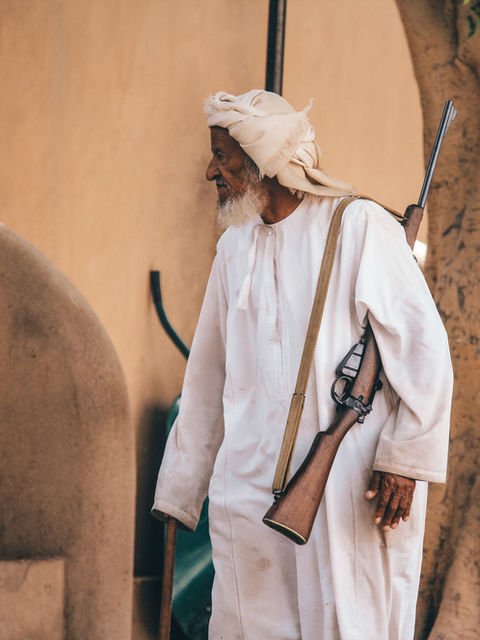
What we see in our Arabian Night tinted imaginations are sandy deserts dotted with green oasis; bare mountains hiding white villages carved out of rock, lined with date palm gardens watered by clear flowing streams; haughty camels strutting where other creatures would fear to tread; mysterious gun-toting people in long robes; the haunting sounds of the Imam calling folk to prayer…
Then the world changes. Suddenly the Middle East – or much of it anyway – becomes a little bit hazardous for Westerners. In some places – the most Arabic and perhaps beautiful of them all, like the Yemen – travel becomes downright dangerous.


We find ourselves writing off all those oriental dreams of Sinbad and Scheherazade. For many of us the more interesting destinations in the Arab world have become unsafe, while the few relatively secure places are two-dimensional and boring.
And then we discover Oman…
The wild and wonderful sultanate is all you ever imagined the Arabic Middle East could be. And perhaps a little more. Much if it is stunningly beautiful. The scenery can be awesome and dramatic. And the people are fantastically friendly – even though we Brits helped put the boot in to some of the hill tribes not so very long ago.
In fact, I went to a crag above one very beautiful village high in the Akhdar Mountains where my guide told me we’d be going no further. He said the people there were fed up with being gawped at by the odd tourist who was passing.

“Tourists? What tourists?” I protested looking at the vast empty rocky amphitheatre around me…
That’s when he told me the truth - that British forces had bombed the place in the 1950s.
I tell you this because I wish to underline just how warm and friendly most Omanis are, regardless of any British involvement in the country’s history. This is partly because these patriotic people are passionate about the country in which they live and are proud to share it with visitors.


Driving into the Hajar Mountains
The first time I visited Oman my itinerary took me away from Muscat as a guide from the excellent Bahwan Travel Group turned up in comfortable air conditioned four wheel drive to take me exploring.
It was these adventures – mainly in the Akhdar Mountain region - that I shall remember for a long, long time to come.
The range extends some 200 miles just inland from the Gulf of Oman and is as spectacular a sequence of eminences as I’ve ever seen. The highest point, Jabal Shams (the mountain of the sun), is almost 10,000 feet in altitude and is the highest point in Oman and the whole of eastern Arabia – and I know for a fact that it’s altitudinous because I was taken almost to the summit where you will notice a distinct shortness of breath.
These are desert mountains – by which I mean that they are, for the most part, bare rock. However, the higher areas receive a foot of precipitation each year which is enough, in the incredibly deep ravines and valleys at least, for scattered shrubs and trees and allows some agriculture.
Hence the name which, translated, means the Green Mountains. A bit of a colourful exaggeration. But then, I come from the emerald West of England.
The green bits you see are mainly where the locals have built complex runnels and aqueducts to irrigate terraced gardens in the valley bottoms.
These are magical oases among vast vertical slabs of bare rock which seem to reach high into the heavens.


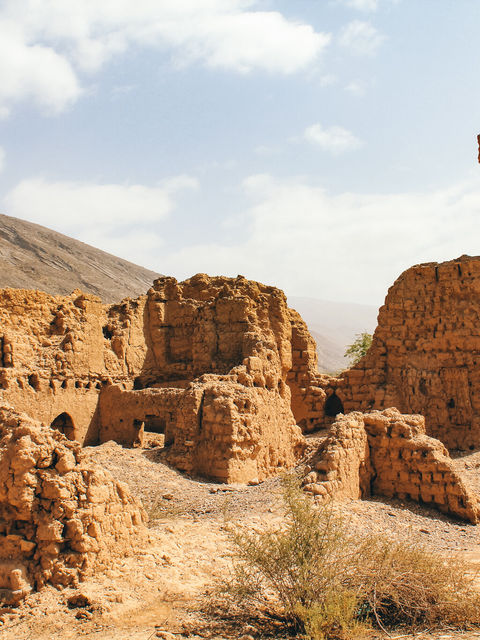


And I saw a great many of the mountains - roaring ever higher up seemingly impossible tracks in our four wheel drive. The most memorable journey was up the amazing Wadi Nakher, located in the depths of Oman's deepest canyon. Believe me, this is the nearest thing you’ll see to the Grand Canyon this side of the Atlantic.
Ancient Villages Clinging to the Cliffs
Apart from the little villages which cling impossibly to the sides of crags – with their terraced gardens and date palms looking more biblical than anything I’ve ever seen before – the place exudes a sense of eternal ancientness.
This is perhaps echoed by the fact that humans have been living in these lonesome places for a very long time – probably as far back as 100,000 years. That makes our own ancient sites look about as old as a Home County new town…


Somehow you are aware of this time-immemorial aspect of the landscape as you lurch and bounce along the tracks that pass up through the wadis – which are the river valleys or ravines that man and his domestic animals have been plying up and down since way before the last Ice Age.
Terraced Orchards and Rose Gardens
It’s not all savage scenery – the Jebel Al Akhdar is renowned for its fruit orchards which you find in the aforementioned terraces. Apricots, figs, peaches, grapes, apples, pears, pomegranates, plums, almonds and walnuts are grown up here amid the rocks under the endlessly blue skies.


Even better known are the roses of Jebel Al Akhdar - rosewater is distilled in homes across the range and the air in spring is said to be filled with fragrance.
Spectacular Views Across Deep Canyons
Perhaps most noteworthy of all is Nizwa - the gateway to the mountain range. The oasis city was the nation’s capital back in the 6th and 7th centuries, which means that it is a place which groans with history and romance.
And this in turn means that is the most popular tourist attraction in Oman – although you could hardly say the visitors overrun the many historic buildings or the imposing fort built in the mid 17th century by Imam Sultan Bin Saif Al Ya'ribi.


The town has a population of around 70,000 and is almost completely surrounded by an immense palm oasis that stretches for five or so miles along the course of two wadis. At the very heart of the place is the famous, bustling, souk where you buy all manner of locally made copper and silver jewellery.
Nizwah, which is sometimes called “The Pearl of Islam”, wasn’t always so welcoming of tourists. Just 60 years ago the British explorer Wilfred Thesiger was forced to steer clear of the place having arrived at an oasis just outside. Back in those days the town was run by an extremely strict regime and Thesiger’s Bedouin companions were convinced that the Nizwah-ites would have his guts for garters.
They don’t spurn tourists nowadays but try and sell them some kind of craft item or nick-nack instead. Which is fine – although I have one complaint when it comes to the relationship that Omanis have with their visitors…
And that is the food. I’d been looking forward to some kind of local repast in Nizwah, but it was never going to happen. It seems that food preparation in Oman is almost always done by women – but in this Muslim country they are not really expected to be out and about making a living by cooking for strangers.
The result is that there are no restaurants selling local food. Eating outside the big international hotels means dining in one of the ubiquitous Indian restaurants that have a complete national monopoly when it comes to cuisine in this country.


Which is also fine. I like Indian food – especially the Keralan cuisine which is often served in the road houses out there in the mountains. But I would also have liked to sample Omani cooking.
However… This is the one and only downside of this most extraordinary of countries.
Why is Jebel Akhdar called the Green Mountain?
Unlike much of Oman, the altitude allows fruit trees, roses, walnuts, pomegranates and other crops to flourish, creating lush terraces that give the mountain its name.
Do you need a 4WD to visit Jebel Akhdar?
Yes. Access beyond the checkpoint requires a four-wheel-drive vehicle because of the steep mountain road. Visitors should check current requirements before travelling.
What is the best time to visit Jebel Akhdar?
October to April offers the most pleasant weather, while March and April are especially popular for the famous Damask rose season when the mountain terraces burst into bloom.
What can you do in Jebel Akhdar?
Visitors can hike through ancient villages, explore terraced orchards, admire dramatic canyon views, visit rose-water distilleries and experience traditional Omani mountain culture.

