
The Souks of Tunisia

Updated: Jul 11
Just 20 minutes - that’s all we had time for as we entered the central medina in Tunis – and I was fed up because, to do the vast, fascinating, colourful labyrinth justice, you need a day. That was a year ago and I had to be dragged out of the medieval bazaar kicking and screaming, grabbing handfuls of ludicrously cheap herbs and spices as I went.
The man from the Tunisian tourist office looked concerned – it hadn’t really struck him that a visitor might find such an untidy, anarchic place quite so absorbing. He was more accustomed to promoting the conventional sites like the impressive ruins at Carthage, and hosting whirlwind tours of five-star hotels.

A Living Labyrinth: The Medinas of Tunisia
I don’t mind a ruin or two, but give me a vibrant living piece of history any day. And that is exactly what you get in the great medinas of Tunisia. They are genuine organisms of the living past, and do not exist solely to pander to foreign tourists.
Other North African and Middle Eastern countries have such places, but sometimes you get the feeling that we Westerners are not altogether welcome. Tunisia is different. There is something altogether more relaxed, less oppressive and less threatening about wandering freely and alone around its crowded market places compared to others I have known – especially these days.
Trip GuideThe Route
Tunis & Carthage ➔ Port El Kantaoui & Sousse ➔ Yasmine Hammamet
Flight Time Approx. 3 hours from London
Key Experiences Bargain haggling in medieval medinas, authentic slow-cooked clay pot stews, traditional 'Ghassoul' mud therapy
Best For Foodies, culture seekers, and spa enthusiasts looking for an exotic long weekend

So when the same tourism official offered me a special four-day tour blending visits to the medinas with overnight stays at some of Tunisia’s most luxurious spa beach resorts, I grabbed the trip with all the enthusiasm of an amateur cook let loose in a spice bazaar.


It’s the sort of excursion that the more adventurous can enjoy as a long and very exotic weekend. Your days are filled with North African promise, your late afternoons and evenings render you thoroughly pampered.
The Sophisticated Flavours of Carthage
Arriving at Tunis we were whisked a few miles to the ancient port of Carthage and deposited in the highly sophisticated Corinthia Khamsa Hotel.
If you are anything like me, the first thing you want to do upon reaching a country is to taste its cuisine. The experience can somehow set up the trip, and the Corinthia Khamsa was no disappointment when it came to fabulously delicious, authentic, local food.
I was attracted by the following item on the menu: “Lamb cooked in a clay spout”. It was just that. The meat stew came rammed into a sort of sealed clay pot which the waiter had to carefully smash with a silver hammer. The cinnamon and other spice flavours which poured forth were intense, but there was also the definite and rather interesting tang of clay.
Lost in the Great Warren of Tunis
Next morning we were off to the central medina in Tunis. Medina, by the way, means “old town” – and it can be full of various souks (markets) selling anything and everything from cement mixers to spices - taking in clothes, shoes, leatherwork and artwork along the way.


The medina at Tunis is everything, and more, that you imagine a Middle Eastern bazaar to be. Forget bothering with a sense of direction – the place is a warren on a huge scale and you must simply wander and hope for the best. We lunched at the famous Dar Bel Haj restaurant which we somehow found in the centre of the medina. It’s an extraordinary old place, tall and cool, lined with thousands of ornate tiles in Moorish style.
The food gave us an instance glimpse of Tunisia’s traditional cuisine and also into the generosity of its people. Bowl after bowl of intriguing salads were placed into the middle of the table and we were filled to the brim with strange mixtures of egg, fish and various vegetables long before the meat-laden mains turned up to kill us off.
My own best-buy in the medina was a huge, heavy, hooded shepherd’s cloak made from a sort of felt. On cold winter days this 20 euro bargain now provides me with the warmest dressing gown ever invented.
After a day haggling (yes, haggling is almost compulsory when attempting to buy anything in the souk) we travelled south to the modern coastal resort of Port El Kantaoui.


An early evening stroll around the marina provided us with the wind-down necessary after two hours spent on somewhat alarming Tunisian roads, and I soaked away a further hour in Hotel Hasdrudal’s wonderful seawater swimming pool which is equipped with any number of muscle relaxing jets and whirlpools.
The next morning I strolled down the boardwalk through the dunes and found myself on an endless white beach that was empty save for a man on a moped who dashed along the waters edge as fast as the thing would go. Apart from him, I was utterly alone.
Fresh Fish and Eerie Footprints in Sousse
South of Port El Kantaoui we arrived at the ancient coastal town of Sousse where we spent the morning in another vast medina. This one is somehow lighter and more airy than the capital’s old town, but extensively labyrinthine nevertheless.

The stall-holders and shopkeepers are a little more used to European tourists and so hit you with a harder sell, but we were soon able to find refuge from both the haggling and the heat in a cool, subterranean bar that seemed to sell nothing but the fresh crushed juice of various fruits.
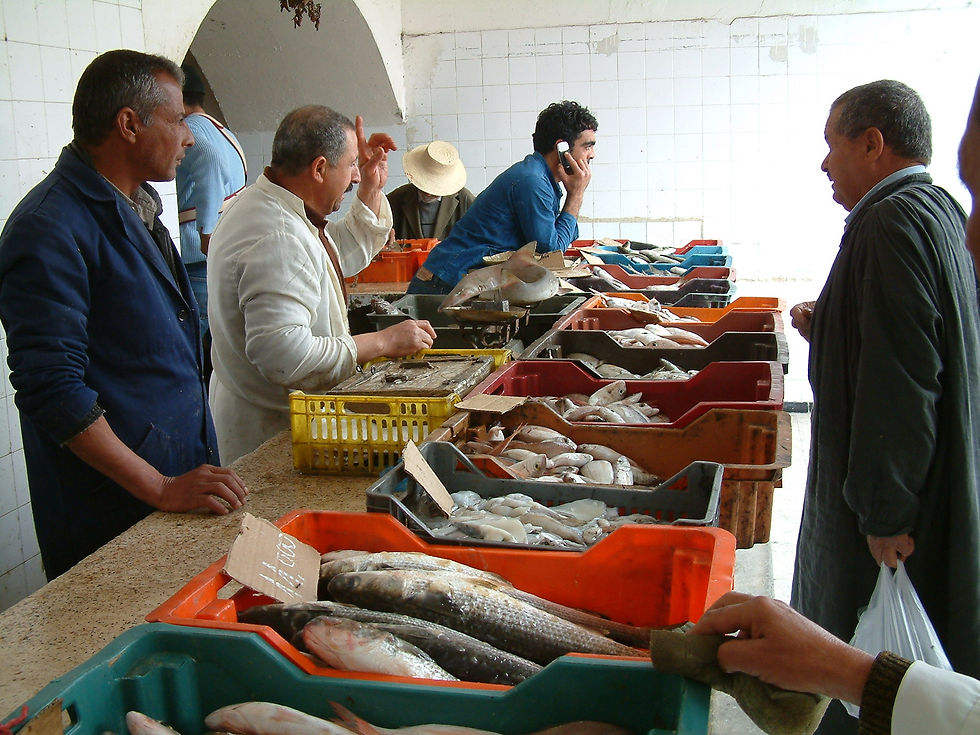
Refuelled, I spent an hour looking around the various food markets and drooled, not only at the vast array of produce on offer, but also at the prices. Fresh fish was piled in small mountains, each of which cost less than a British portion of chips. The vegetables were even cheaper. A pile of multi-coloured carrots caught my eye – they looked for all the world like a sort of ice lollypop I remember buying as a kid. Also impressive were vast piles of the whitest and largest bulbs of fennel I’ve ever seen.


The only off-putting section of the market was Sousse’s version of Barnstaple’s Butcher’s Row. Not nice. Sheep heads lay forlornly on chopping blocks with their sad dead eyes glinting in the sun. Everywhere there was blood and bone, tripe and lung. The place yelled death, which I suppose, is what a butcher’s is really all about.
After Sousse we visited the modern resort of Yasmine Hammamet where we were taken around the brand new medina.
The Ghassoul: Mud, Steam, and Ancient Araby
Then for the ultimate relaxation: we travelled up the coast to the older town of Hammamet where staff at the palatial Nahrawess Hotel had what they described as a “surprise” in store for us. As he led us to hotel’s the £multi-million new spa facility, the manager said he would not tell us what was about to befall us because it would spoil the experience – but he did divulge that it was one of only seven such facilities in the world.


Ten minutes later every inch of me was caked in mud. Five minutes after that I was sitting in a hot, dark, cavern under artificial star-light listening to sounds of wavelets washing gently upon a shore. Aromatic clouds of steam billowed from a large tiled receptacle in the middle of the strange room and I slid further and further into the sculpted seat which was equipped with tiny rivers of water to help you keep cool.
The “ghassoul” – to give it the official name – was the most relaxing thing I’d ever done. Weird dreams of Ancient Araby overtook me…
Until it jets of cold water began to spray from every orifice in the room. At this point white coated girls entered bearing hosepipes. The mud was blasted from every human surface. All very odd. But strangely, ethereally, enjoyable.
And that, in some ways, is the best way of encapsulating a short break in Tunisia. It’s just three hours flying time from London, but you are plunged deep into a very foreign and exotic world. A world of great comfort if you get the right hotel – and certainly a world of colourful and fascinating mystery.

A Taste of Tunisia: Culinary Classics to Look For
To truly understand the country, you have to eat your way through the markets. Tunisian cuisine is distinct from its North African neighbours—it is generally hotter, relying heavily on a fiery pepper paste, and beautifully balances fresh Mediterranean seafood with deep, earthy desert spices.
Here are the staple dishes you must try:
Couscous: The undisputed national dish. Unlike Moroccan versions, Tunisian couscous is almost always served stained a deep orange-red from a spicy tomato-and-chilli broth. It is traditionally topped with a mountain of slow-cooked lamb, chicken, or fresh coastal fish, alongside huge chunks of pumpkin and potatoes.
Lablabi: A thick, deeply comforting chickpea soup that is pure street-food fuel. It is poured over bowls of torn, stale crusty bread and heavily seasoned with garlic, cumin, olive oil, and raw harissa. It is frequently finished with a soft-boiled egg and flaked tuna mixed in at the table.
Brik: A ubiquitous, crispy pastry obsession. A razor-thin sheet of malsouka dough is folded into a triangle around a filling of mashed potato, tuna, capers, parsley, and a single raw egg. It is deep-fried for a matter of seconds so the pastry becomes shatteringly crisp while the egg yolk inside stays warm and perfectly runny.
Koucha (Lamb in Clay): As experienced on this trip, this is a dramatic, slow-cooked masterpiece. Seasoned with rosemary, turmeric, cayenne, and cinnamon, the lamb is sealed tight inside a clay jar or pot (koucha) and baked for hours. The meat becomes so incredibly tender it falls away at the touch of a fork.
Ojja (Tunisian Shakshuka): A rich, bubbling skillet of spicy tomato, garlic, and green pepper sauce, heavily spiked with harissa. Eggs are gently cracked into the sauce to poach, and the dish is often elevated with chunks of merguez (a spicy, heavily spiced lamb sausage).
Mechouia Salad: A staple starter found on almost every table. Tomatoes, onions, sweet peppers, and fiery hot peppers are grilled or charred over open coals until smoky, then peeled, finely chopped, and heavily dressed in olive oil and lemon. It is always served topped with hard-boiled eggs and chunks of tuna.
Harissa: The culinary heartbeat of the nation. Far more than just a condiment, this vibrant red paste made from smoked red clay chilis, garlic, caraway, coriander, and olive oil is cooked into the base of almost every sauce, stew, and soup across the country.

Frequently Asked Questions
What is the difference between a medina and a souk? In North Africa, a "medina" refers to the historic, walled old-town section of a city, typically characterised by narrow, winding alleys. A "souk" is the marketplace or bazaar found within the medina, often divided by trade, such as spices, leather, or textiles.
Is haggling expected in the markets of Tunisia? Yes, haggling is an expected and deeply cultural part of the shopping experience in traditional Tunisian souks. Prices are rarely fixed, and a friendly, respectful negotiation is considered part of the daily transaction.
What is traditional Tunisian cuisine like? Tunisian food features a rich blend of Mediterranean and North African influences. Key dishes include slow-cooked stews cooked in sealed clay pots, fresh Mediterranean seafood, vibrant mezze-style salads featuring egg and fish, and the frequent use of aromatic spices like cinnamon and coriander.
What is a Ghassoul treatment in a Tunisian spa? A Ghassoul (or rhassoul) treatment is a traditional Moroccan and Tunisian wellness ritual where the body is coated in a nutrient-rich, therapeutic mineral clay. The treatment takes place in a warm steam environment to detoxify and smooth the skin before being washed clean.


