
Visit to Ciutadella

Updated: Jul 10
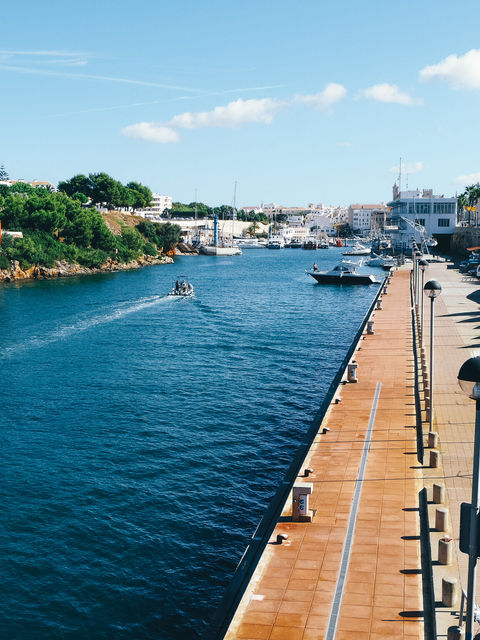
Another rainy January day, another memory of a pleasant sunlit coastal town some place hot. Or warm, at least. This time we were talking about Menorca’s old capital, the delightful port of Ciutadella, situated on the island’s western coast facing Majorca, whose mountains are plain to see from the mouth of the fjord-like harbour.
In fact you catch a ferry over to Alcudia in Mallorca if the mood takes you. But why leave Ciutadella? Strolling around the myriad streets which rise from the inland end of the busy harbour is a treat, thanks partly to the excellent tapas we enjoyed in bars surrounding the ancient working market in the heart of this historic town.


We found some particularly good little places in and around the market. The small square with its arcades has a central area where fresh fish is sold and this is surrounded by small stands under attractive old arcades.


Tapas and the Local "Tardeo"
Nowhere is this slow, sustainable philosophy more delicious than at the vibrant Mercat Municipal on Plaça de la Llibertat. Gathering under the shade of historic stone arcades, the local tapas bars serve up a rapid, incredibly fresh masterclass in island gastronomy using catches brought straight from the fishing boats that morning. Here, the menu speaks entirely in the Menorcan vernacular: salty slices of artisan Mahón cheese, plates of fresh red mullet, and rich sobrassada sausage drizzled with wild island honey. If you visit during the quieter months, you can immerse yourself in the authentic local tradition of the Tardeo—a lively social custom where locals turn the late afternoon into a prolonged, joyful ritual of sharing drinks, storytelling, and exceptional market-stamped tapas.

It was the Arabs who introduced a who new cuisine to the island many centuries ago with ingredients such as rice, almonds, oranges and lemons, and spices like saffron. In addition, Menorca, has now been established as a UNESCO Biosphere Reserve, partly because it boasts some of the best produce of the Balearics which makes the cuisine varied and utterly unique.
The Catalan Gothic Centrepiece
At the spiritual and architectural heart of the old town stands the Cathedral of Santa Maria de Ciutadella, an awe-inspiring 14th-century temple built from the island's signature golden marés sandstone.

Commissioned by King Alfonso III following the Catalan conquest, this striking landmark was constructed directly over the foundations of Medina Minurka's main Moorish mosque—cleverly repurposing the ancient minaret into the base of the current church bell tower. Though it suffered severe damage during the tragic Ottoman siege of 1558, its massive single-nave vault still rises beautifully over 22 metres high, filling with an ethereal, warm glow whenever the afternoon Mediterranean sun streams through its grand central rose window.


Ciutadella was founded by the Carthaginians, and became the seat of a bishop in the 4th century. After being governed by the Moors for several centuries, Ciutadella was recaptured during the “reconquista” by men serving Alfonso III and became part of the Crown of Aragon.
During the Middle Ages, Ciutadella became an important central Mediterranean trading port. In 1558, a powerful Turkish Armada of 140 ships and 15,000 soldiers, put the town under siege for eight days entered and decimated the place. The town was defended by only a few hundred men. All of Ciutadella's 3,099 inhabitants who survived the siege were taken as slaves together with other inhabitants of surrounding villages. In total, 3,452 residents were sold into slavery in the slave markets of Istanbul.

The Gastronomic Tapestry & The Biosphere
The Tapas Trails of the Mercat MunicipalThe real pulse of local life can be felt at the Mercat Municipal (the central market) on Plaça de la Llibertat. Here, under the shade of centuries-old stone arcades, the vibrant market stalls present a daily masterclass in island gastronomy. It is a sensory feast of bright citrus fruit, local cured meats, and stalls piled high with shimmering local catches like red mullet and Mediterranean prawns. Grab a stool at one of the tiny, bustling tapas bars tucked inside the arcades to order Caldereta de Langosta (the island's iconic spiny lobster stew) or classic tapas showcasing traditional Menorcan sausage (sobrassada) drizzled with local honey. Menorca's Sustainable SoulThis exceptional culinary variety is no accident. The entire island of Menorca is designated as a protected UNESCO Biosphere Reserve, a title it has held for decades. This environmental shield strictly regulates development, ensuring that traditional farming, pristine coastlines, and ancient food systems remain entirely unmarred by mass tourism. The result is a hyper-local, completely unique Balearic food culture where the ingredients on your plate have travelled mere miles from a sustainable field or a local fishing boat.
The Blueprint for Slow Travel
This enduring preservation of history perfectly reflects Menorca's broader identity as a world-leading sanctuary for "slow travel". Decades ago, the entire island secured a protective mantle as a UNESCO Biosphere Reserve, a crucial designation that strictly curtails aggressive commercial development and massive hotel complexes. Because the local authorities choose conservation over mass tourism, the island moves at a wonderfully unhurried, human pace. It is a place where ancient stone paths are kept completely intact, traditional farming methods are actively shielded, and travellers are gently encouraged to slow down, explore on foot, and savour the quiet detail of a deeply authentic community


Frequently Asked Questions
1. Where is Ciutadella located and how do you get there?
Ciutadella is situated on the far western coast of Menorca, directly facing the neighboring island of Mallorca. You can easily reach it by car or local bus from the airport in Mahón, or take a scenic vehicle ferry directly across the channel from Alcúdia in Mallorca.
2. What is the difference between Ciutadella and Mahón?
While Mahón is Menorca's modern administrative capital and features one of the world's largest natural harbors, Ciutadella is the historic, aristocratic, and religious heart of the island. Ciutadella is characterized by its narrow, fjord-like port, its golden sandstone palaces, and its deep Moorish and medieval roots.
3. What historic events shaped the town of Ciutadella?
Founded by the Carthaginians, the town was heavily influenced by centuries of Moorish rule before being reclaimed during the Reconquista by King Alfonso III. Its most tragic historical milestone occurred in 1558, when a massive Turkish Armada decimated the heavily outnumbered town, leading to the entire surviving population of over 3,400 residents being captured and sold into slavery in Istanbul.
4. What should I try at the central market in Ciutadella?
The working fish market is famous for its exceptionally fresh seafood tapas. Be sure to sample traditional Balearic dishes featuring saffron, almonds, or citrus, alongside the island's famous artisan Mahón-Menorca cheese—a semi-hard, slightly salty cheese completely unique to the island's sea-wind pastures.


