
Dulverton and the River Barle: A Short Circular Walk from Exmoor's Capital

At this time of year I like to find walks that sit happily side by side with that most onerous of duties – the Christmas shopping. Call me a killjoy, but I'm just no good at it. It's not the bewildering choice or the crippling expense; it is simply that pressurised present-buying is one modern pastime I could very happily do without. The very idea of a massive mall where they play endless, teeth-jarring Christmas musak is enough to send me screaming to the hills.

What we need is a pleasant, old-fashioned country town with an interesting array of small and slightly eccentric shops (a good second-hand bookshop is a must) and an excellent pub or inn for lunch. Most important of all, though, are the immediate surroundings. They should be attractive, of course, but they must be instantly reachable on foot in case a sudden wave of anti-shopping delirium sets in.
Dulverton, capital of Exmoor, fits the bill with great aplomb. You can put ticks against all of the above – and as for walks straight from the door, few towns in the West Country can boast as many.
A short Dulverton circular walk
This one is a three-and-a-half-mile circular route: not too long to put you off your stride, but with views and hilltops aplenty to blow away the Rudolph-the-Red-Nose blues. There's parking in the town, and the Exmoor National Park centre in Fore Street will help you get your bearings – though you won't need much in the way of orienteering back-up, as the way is simplicity itself.
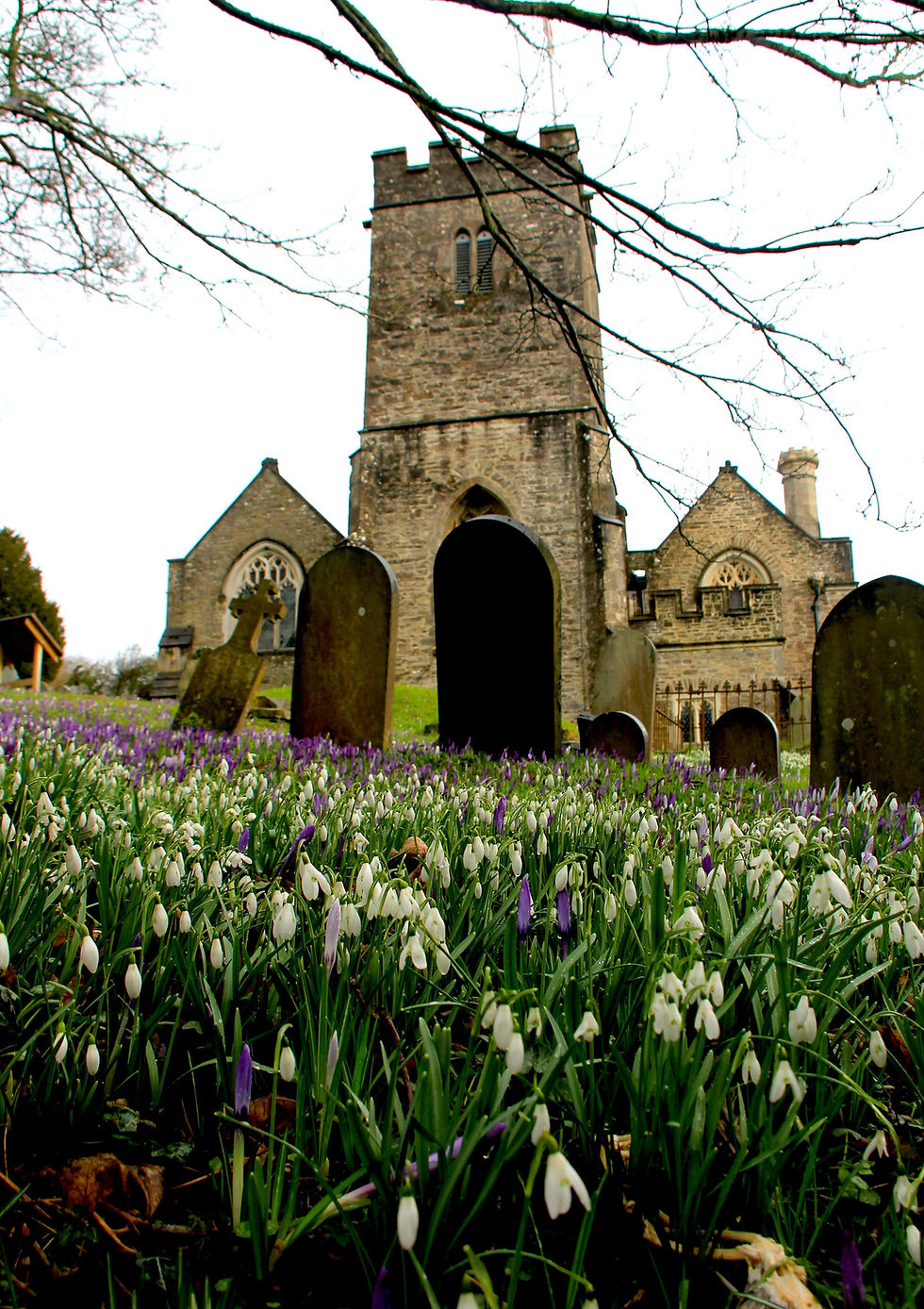
All Saints church and the climb to Court Down
Look up the main street and you'll see the church. All Saints is as finely situated a house of worship as you'll find anywhere in the region, dominating the town and presumably its mortal souls. It was more imposing still before a rather drastic Victorian rebuilding in the mid-19th century, which swept away its gallery, box pews and medieval screen. You might still spot the stained glass given by Sir George Williams, founder of the YMCA, who was born at nearby Ashway Farm.
You must climb through the picturesque churchyard to begin this walk. Follow the little alleyway to the right of the church and climb the lane past the old infant school, and you'll find yourself on a rough old track that winds and wends its way across the hills towards Winsford. It's one of those ancient packhorse ways that evolved over centuries for hooves and the odd two-wheeled cart – which is why I've always been wary of the four-wheel-drives and trail bikes that like to churn them into mud.
At the top of the long climb out of Dulverton you reach the higher slopes of Court Down. Follow the track along the hill until you reach a junction where a path signposted to Marsh Bridge drops downhill to the left. In wet weather a good pair of gaiters is worth its weight in gold here – when the mud is bad people are tempted to wear wellies, but they're no good for a proper hike.
Down Loosehall Lane to Marsh Bridge
Down Loosehall Lane we go until we see the rushing River Barle through the trees. Here the lane swings a touch to the right and leads us to the rather ornate metal span of Marsh Bridge. The bridge itself is probably 18th century, but in the 1860s its central pier was removed and the iron span put in – it's a listed structure today, and a fine one.
The last time I came this way the rain fell, and I'd have said it was nice weather for ducks had I not met a canoeist instead. He was parking his old van by the river and explained he'd left his slender craft up at Tarr Steps so that he could walk back up to it and then paddle down, enjoying the rapids. "Are you mad?" I asked, pointing at the boiling anger of the stream. "Not at all," he replied, smiling from under his helmet. "Perfect conditions. It'll take an hour or more to walk back upstream, but only ten minutes to canoe back down."
Exmoor has changed since I grew up on its lonely flanks. On a rainy midweek morning in winter you wouldn't once have seen a soul, let alone a man in a technicolour wetsuit shooting raging rapids in a tiny craft.
Back to Dulverton beside the Barle
Cross Marsh Bridge and stroll up the lane for a few hundred yards before turning left through a farmyard. Here the footpath crosses a field to the woods, where it rejoins the river, and the two march in tandem back to Dulverton. It's a splendid, wooded, waterside stretch which brings you out close to the town bridge – the medieval, five-arched Barle Bridge – which you cross to regain the main street and all those Christmas shops.
Actually, I dipped into a local hostelry instead, and was reminded of the passage in Lorna Doone where John Ridd and John Fry stop at a Dulverton inn: "And now John Fry strode into the hostel, with the air and grace of a short-legged man, and shouted as loud as if he was calling sheep upon Exmoor: 'Hot mootton pasty, for twoo trarv'lers, at number vaive, in vaive minnits! Dish un up in the tin with the grahvy, same as I hardered last Tuesday.'"
Dulverton circular walk: fact file
Start: Dulverton town centre, where there's parking.
Route: up through All Saints churchyard and along Court Down, down Loosehall Lane to Marsh Bridge, then back to Dulverton through the woods beside the River Barle.
Distance and going: three to four miles; fairly easy going but muddy in places, with one long climb out of the town.
Map: OS Explorer OL9, Exmoor.
Food and drink: plenty of choice in Dulverton.
More Exmoor walks to try


