Porto Santo: The Secret Portuguese Island That Even Madeira Wants to Keep Quiet

Updated: Sep 7
Here’s a rarity. A sunshine destination that - despite sandy beaches and a comparatively short flying time from the UK - has not been discovered by sun-worshipping hordes from Northern Europe.

Why not? It’s a question I’ve been asking since I first learned about the existence of Porto Santo. Most places with good beaches, reachable from northern Europe within just a morning or afternoon’s flight, became tourism magnets years ago - and, being a near neighbour of Madeira, this small but delightful island is on every pilot’s map and it has a giant runway capable of taking long-haul jets.

Porto Santo Fact File: Essential Travel Info
Where is Porto Santo?
A Portuguese island in the Madeira archipelago, situated in the North Atlantic roughly 43 km (27 miles) northeast of Madeira.
How to Get There:
By Ferry (Porto Santo Line): The Lobo Marinho car passenger ferry runs daily from Funchal, Madeira. The crossing takes approximately 2 hours 15 minutes each way, making day trips or multi-day stays very easy.
By Air: Daily 15-minute inter-island flights run from Funchal (FNC) to Porto Santo Airport (PXO) via Binter Canarias, alongside seasonal direct charter flights from the UK and European hubs.
Famous For:
A 9 km (nearly 6 miles) stretch of continuous golden, therapeutic sand rich in minerals, quiet walking trails (Pico de Ana Ferreira, Pico do Castelo), fresh Atlantic seafood, and Christopher Columbus's historic former home.
Getting Around:
Taxis, local public buses, e-bike rentals, and small hire cars make navigating the compact island straightforward.
Planning a trip to Porto Santo?
Porto Santo has everything from beachfront resorts and boutique hotels to self-catering apartments just steps from its famous golden sands.

A Comparative Secret: Why Isn't Porto Santo Crammed with Sun-Seekers?
So why isn’t it crammed with sun-seekers? The only way to find out was to go there myself, and I did just that earlier this month. And I still find myself asking why this nine mile long island (five miles wide - total area 16 square miles) is a comparative secret? Neighbouring Madeira gets around 2.5 million tourists a year, but Porto Santo only attracts around a twentieth of that number.
One answer is that the quarter-million people who live on Madeira seem to want to keep the isle as a secret vacation destination of their own. Porto Santo is where the Madeirans go on holiday. If it’s remaining visitors do not come from next door, then most of them arrive from the Portuguese mainland.

So this delightful interesting and pleasant isle - which enjoys equable weather (sunny, but not too hot) throughout most of the year - remains for the most part undiscovered. Which, alone, is enough to attract someone like me and, I bet, many readers of this newspaper. No boozy pubs blasting loud music, no kiss-me-quick-hats hiding human lobsters from the sun.
Sorry if that sounds snobbish, but an old countryman like me is bound to prefer somewhere quiet for his vacations. I also like somewhere that offers a bit of authenticity and interest.

A World Removed from Its Dramatic Big Brother
If you stand on the eastern cliffs of Madeira on a clear Atlantic afternoon, you can just about make out a low smudge on the northern horizon. That is Porto Santo. It sits a mere 27 miles away, yet it is a world entirely removed from its dramatic, jagged, subtropical big brother. Where Madeira is all soaring peaks, dripping levadas, and sheer volcanic cliffs dropping into a moody sea, Porto Santo is windswept, not as mountainous, and arid.

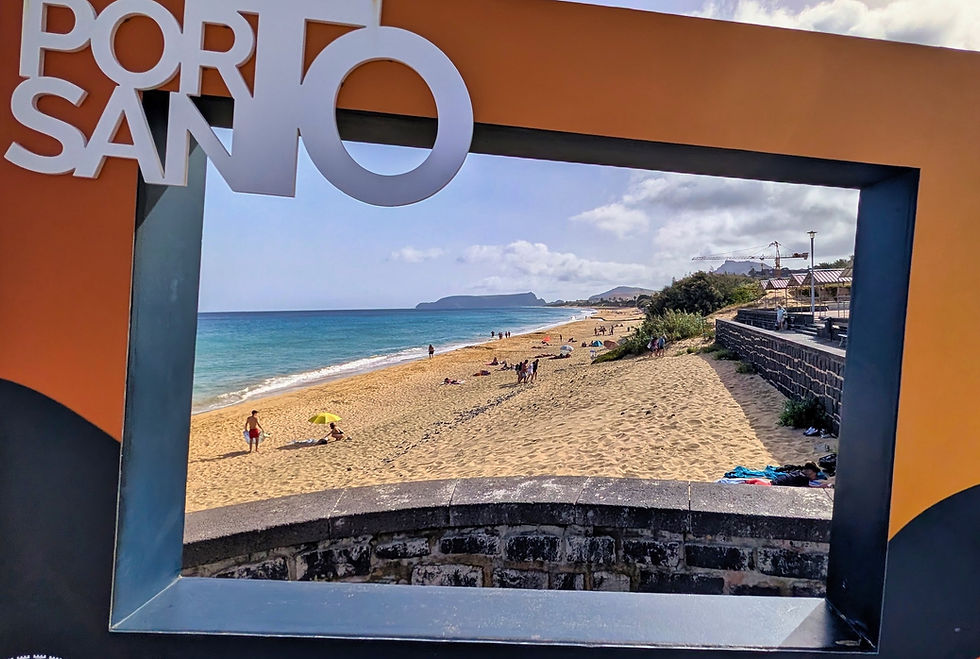
Its real crowning glory - the thing that makes most Madeirans look north with eager anticipation - is the beach. Just one beach, actually. However, it is almost six miles long - that’s nine kilometres of unbroken, soft, golden sand. That is what persuades thousands of Madeira’s to hop on the ferry every weekend.
Apart from a few black boulder coves, Madeira doesn’t have much in the way of beaches. They love Porto Santo’s grand strand so much they even bury themselves in the sands in the belief they have therapeutic mineral properties.
We took the quick quarter-of-an-hour flight from Funchal to Porto Santo. Looking out the window of the small plane, you could instantly see the difference between the two islands. Madeira is, for the most part, wonderfully green - a vertiginous island full of trees, ferns, vineyards, orchards and ferns - while Porto Santo appears to be yellow and parched.
In some ways it looks more like one of the Canary Isles, 300 miles to the southeast. Arid, no trees. It does have mountains - sharp-pointed uplands that are really just hills compared to Madeira’s much higher peaks. And there’s that giant beach stretching along most of the island’s south coast, complete with its comparatively modest handful of large family hotels. At one end sits the one and only town Vila Baleira - a pleasant quiet little place…

Vila Baleira: A Sleepy Atlantic Outpost with Portuguese Charm
Take a stroll through its streets and the town feels less like a bustling regional hub and more like a sleepy, whitewashed Algarve fishing village that somehow drifted into the Atlantic. Everything radiates outward from the Largo do Pelourinho, a handsome palm-fringed central square where a few old boys sit on shaded stone benches watching the world go by.
Looking for somewhere to stay?
Vila Baleira is the ideal base for exploring the island, with most hotels, restaurants and cafés within easy walking distance.
You can walk from one side of town to the other in the time it takes to finish a beer. The architecture is a nod to the Portuguese past - low-slung, white walls, terracotta tiled roofs, and volcanic black basalt trim framing the windows and doorways. The buildings are solid, grounded, built to withstand the salty Atlantic winds that sweep across the hills.
Long, long before it became renowned for its beach, Porto Santo was playing its part in the opening chapter of Portugal’s great Age of Discovery. In 1418, two sea captains, João Gonçalves Zarco and Tristão Vaz Teixeira, were blown off course by a ferocious Atlantic storm. Just as they thought the ocean would swallow them without trace, they spotted the island. In devout gratitude, they named it Porto Santo - the Holy Harbour.
However, human habitation proved to be a hard slog. The isle did not have the rich soils or abundant water supplies that explorers found in Madeira - and things became considerably worse when early settlers foolishly released rabbits. They promptly ate almost all the native vegetation.
Quick Guide to Porto Santo
Paste this structured highlight box near the top of your post (under your opening paragraph):
Highlight | What to Expect | Top Tip for Visitors |
The 9km Golden Beach | Soft, mineral-rich biogenic sand stretching along warm turquoise waters. | Walk down to Ponta da Calheta at the southern tip for dramatic coastal views. |
Vila Baleira | The island's quiet main town featuring whitewashed streets, palm gardens, and local cafes. | Visit the Casa de Cristóvão Colombo, where Columbus lived in the 1480s. |
Pico de Ana Ferreira | Striking geological formation featuring massive hexagonal basalt "organ pipes". | Great for a quick photo stop or short hike up to the caves. |
Getting There | 2.5-hour scenic ferry ride (Lobo Marinho) or 15-minute hop-flight from Funchal, Madeira. | Take the morning ferry from Funchal and rent an electric bike or scooter on arrival. |
Seeking Authenticity at the Casa de Salão Museum
To learn about all this we visited Casa de Salão, a small privately run museum dedicated to preserving the island’s traditional way of life, located in the mountainous empty north-eastern corner of the island. It was here that we discovered just how hard must have been.
Housed in a beautifully restored example of a typical “salão” (farmhouse), it showcases the story of island agriculture and fishing and offers visitors a fascinating glimpse into this outpost’s difficult past. From it we could see the terraces going up impossibly steep mountainsides where they once grew cereals used to make the famous Bolo do Caco - the soft, flat, round and delicious bread still sold in both Madeira and Porto Santo.

I was far more impressed with this modest but effective, free-to-enter, one-man operated museum, than I was by the posh, well-funded, Christopher Columbus Museum in town. Authenticity is everything. You can chuck money or EU funding at any kind of presentation you want, but if it fails to tell the real underlying story, then it’s just so much show and bumph.
As its name suggests, the far better known town museum relates to a very famous past-resident. A young, ambitious chart-maker named Christopher Columbus turned up in the late 1470s, married Filipa Moniz Perestrelo - the daughter of the island’s first governor - and settled for a time in Vila Baleira. It was here, staring out at the Atlantic horizons and studying strange debris washed ashore by the western currents, that he consolidated theories that would eventually launch him toward the New World.

Casa de Colombo museum is located in the sturdy stone house where Columbus lived and a visit does allow you to sense the isolation and the immense ocean horizons that must have fuelled his theories about what lay across the water.
We called at the end of the day - and afterwards discovered that when evening falls, the town doesn’t jump into action as so many seaside resorts do, so much as gently rolls over. A handful of unpretentious seafood restaurants and beachside cafes turn on their lights and serve what is basically Portuguese cuisine. It’s the kind of town where the grandest daily event is watching the sun slip below the horizon.

Where to Stay and How to Explore the Island
Our temporary Porto Santo home was the Columbus Hotel, part of The Navigator Collection, situated a couple of miles southwest along the beach from Vila Baleira.

A large, stylish, family-based retreat, the hotel offers all-inclusive comfort, spacious rooms, swimming pools and spa facilities - and provides an ideal base from which to explore the island.
It was from The Columbus that Nuno Santes La picked us up several times for tours of the island. Nuno works for the specialist tour company, Lazermar, and I would recommend calling on his expertise if you ever visit. A local man, Nuno was able to take us to hidden parts of the island - such as the small-but-perfectly-formed Quinta Das Palmeiras - a miniature bird zoo and botanical garden that is a green oasis in the centre of the island’s arid landscape.

Home to parrots, macaws and other exotic birds, the place has been the lifelong dream of Carlos Afonso, who has spent years transforming barren ground into a green, watery, flourishing and utterly surprising sanctuary.

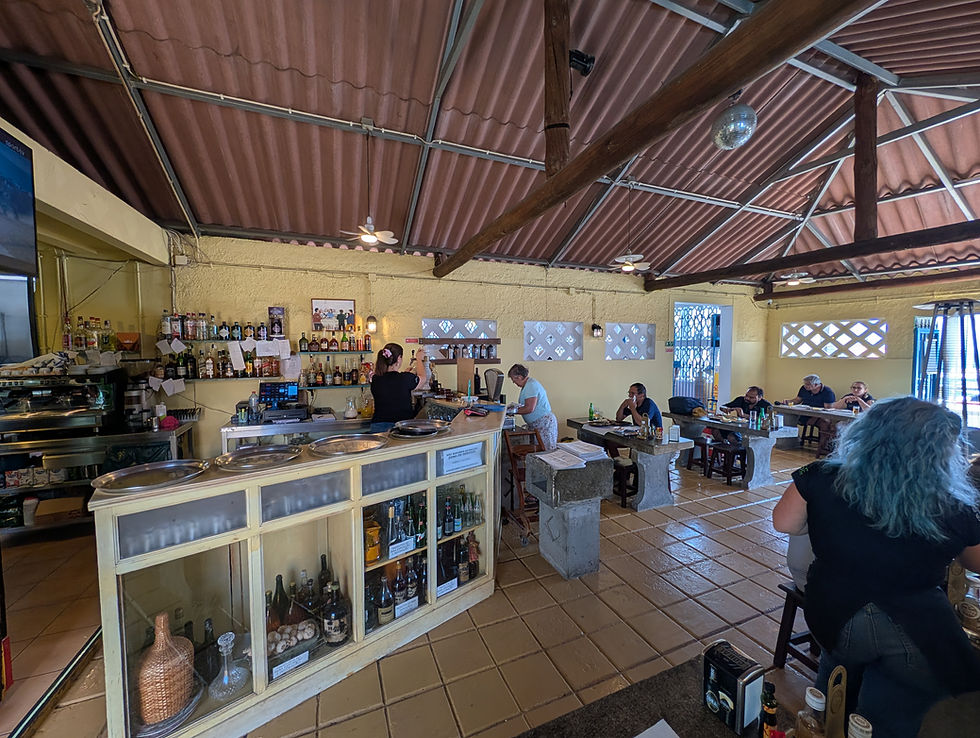
As well as taking us to various moutain-tops and hidden coves, Nuno also pointed us towards the excellent Mercado Velho, a small, basic, but hugely popular (with locals), restaurant right in the heart of town, where I enjoyed one of the best seafood dishes I’ve had in a long while.

I’ll conclude by saying that this is an island that feels like a throwback to the Mediterranean of 40 years ago. A place of sleepy squares, wind-battered wooden windmills, and a pace of life so slow it makes stately Madeira look positively frantic.

SIDEBAR: The Rota do Atum (Tuna Route Festival)
The Rota do Atum - or Tuna Route Festival - is Porto Santo’s vibrant, early-June celebration of the Atlantic’s greatest silver bounty. A four-day gastronomic event that transforms the sleepy island into a high-end culinary hub where local maritime heritage meets contemporary haute cuisine…
The festival is a mix of education, eating, competition, and late-night celebration. Mornings and afternoons are dedicated to the serious business of fish craft, featuring live demonstrations of massive bluefin tuna butchery, alongside masterclasses on sustainability and the art of using the fish’s by-products to reduce waste.

International chefs are invited to run workshops covering everything from traditional Madeiran recipes to innovative ‘tuna brunches’. Every year, a guest country is honoured (it was Vietnam this year) as a way of introducing exotic global techniques to the local catch. (Visit https://ilhapeixe.pt/en/noticias/rota-do-atum-festival)
Fact File & Travel Information
For more information on what to see and do in Madeira and its neighbouring island, Porto Santo, visit: https://visitmadeira.com
Madeira is easily accessible from across the UK, with direct flights from Bristol, Birmingham and Bournemouth among others, as well as London Gatwick and Stansted.
Martin uses Holiday Extras, the market leader in UK airport parking, hotels, lounges, and transfers – in 2025 its customers saved an average of £200 per trip by booking their airport parking in advance. Plus with Flextras, if you need to cancel or amend you can without charge. Six days’ Meet & Greet Valet Parking at Bristol Airport is available for £204.50 based on arrival on 01/07/2026. For more information and to book, HolidayExtras.com or call 0800 316 5678.
Ready to discover Porto Santo?
If you're looking for a quieter alternative to Madeira, compare today's prices for hotels, apartments and beach resorts before you travel.