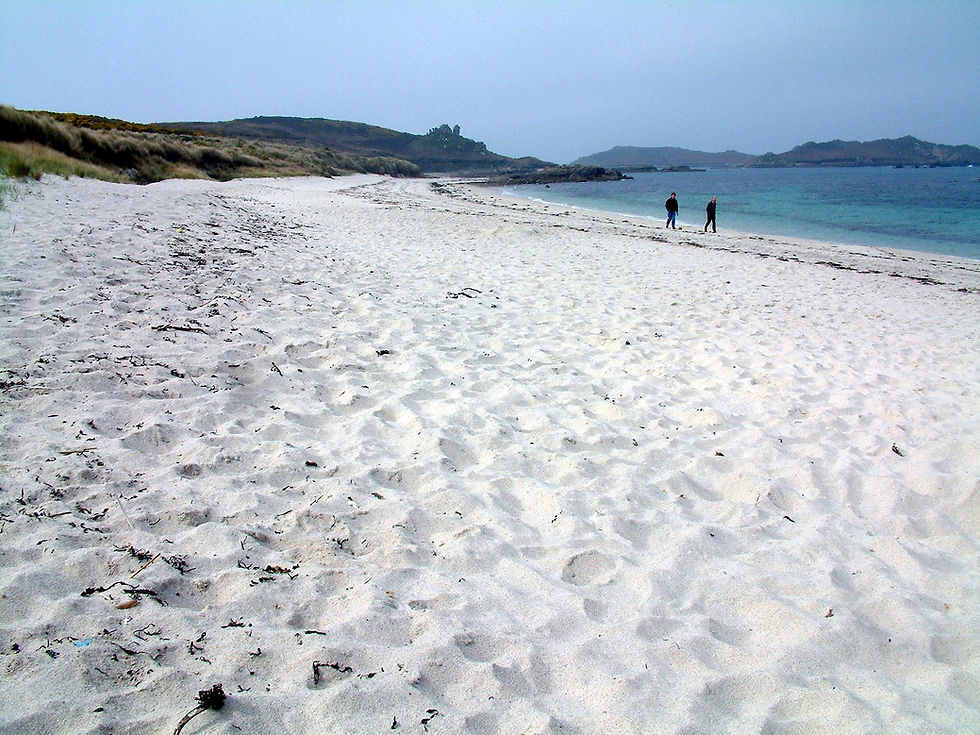
Wild Pear Beach, North Devon: Walking to Great Hangman and Little Hangman

Updated: Jul 2
Hidden on the wild northern edge of Exmoor National Park, Wild Pear Beach lies beneath the towering cliffs of Great Hangman, England's highest sea cliff.
Wild Pear Beach is one of North Devon's best-kept secrets. Hidden beneath the towering cliffs of Great Hangman and Little Hangman on the spectacular Exmoor coast, it offers adventurous walkers dramatic scenery, fascinating wildlife and one of the wildest stretches of the South West Coast Path.

Wild Pear Beach in Exmoor National Park
Here's a visit to twin hills that have every good reason to appear in any West Country listing of great eminences – indeed one has a place in the altitudinous record books as we will reveal later – but sometimes you go to a place simply because it has some hold over you. You see it - perhaps from a car window, perhaps in the distance as you walk - and it haunts you and so you must go there and exorcise the vague, indeterminate obsession that has been lurking in your dreams.
IF YOU ENJOY THIS POST CHECK OUT OUR EXMOOR WALKS PAGE
Such a place, for me, is the Great Hangman, which looms above Combe Martin like a mountain by the sea. If you climb west out of England’s longest village towards Ilfracombe and look back over your shoulder you will be treated to a fine view of it – and also of it’s slightly smaller brother, The Little Hangman, not to mention romantically named Wild Pear Beach.

They are all the sort of places that beg to be explored.
How do you get to Wild Pear Beach?
I went to Combe Martin on a cold end-of-winter day to climb the mighty peaks - and, believe me, they do seem pretty mighty when the wind is whipping in off the Atlantic like a knife.
The little North Devon resort at the foot of the Hangmen (if I can use the plural term to describe them both) was completely and utterly empty. It was difficult to imagine that Combe Martin was once regarded as a port. The last commercial cargoes were landed in the 1930's and, before that, largish boats were actually built there.

To reach the Hangmen from the resort you must climb east, up past
Lester Point, and head east along Lester Cliff. Far below is Wild Pear Beach. If you like your strands empty of folk, then this is the place for you. Even on the hottest balmiest summer days you’ll only find a few hardy souls down there under the looming mass of the Little Hangman. The demure among you might like to note that the majority of these lonesome beach-lovers will be nudists.
Quick Guide
📍 Location: Near Combe Martin, North Devon
🥾 Walk length: Varies according to route
⭐ Difficulty: Moderate to strenuous
🌊 Best for: Coastal scenery, photography, wildlife
🐕 Dog friendly: Yes (check seasonal restrictions)
⛰ Highest point: Great Hangman
Check out this post on the West Country's Best Beaches
Walking to Great Hangman and Little Hangman
I do not know why The Hangmen were given their somewhat gruesome appellation. I have never seen a hangman, and never wish to, but I cannot imagine that even the biggest, fattest, executioner ever looked in the least bit like either of these magnificent hills.
There is nothing little about Little Hangman. It's a great big chunk of a thing that lords it over Combe Martin like a miniature Matterhorn. To be precise, it's lofty top measures an impressive 715 feet (218 metres). And that is impressive when there's nothing between it and the waves that lap at the mighty, cavern-riddled, skirts below.
I had a friend, the late Kestor Webb, who made it his business to explore and to map all those caves, and for years I've been attempting to summon up enough courage to ask him for a guided tour. Approaching those vast caverns needs a great deal of skill, local knowledge and an iron nerve - and I am sadly lacking in all three.

Why Wild Pear Beach is One of Devon's Best Secret Beaches
North Devon's spectacular cliff base zone is in a world all of its own. It is a strange, daunting and magical place accessible only to a handful of local experts whose visits are aided by a good deal of professional equipment. Do not, under any circumstance, be tempted to go clambering down there on your own.
The Story of the German U-Boats
The best and safest way to see it is by boat. I once travelled along here with Ilfracombe boatman Alan Kift who is a great expert on the otherwise secret zone under the Hangmen hills.
“You can’t really see this area any other way but by boat,” Mr Kift told me as we cruised close-in under the mighty twin hills. “My interpretation has been to call it The Hidden Edge of Exmoor. I’ve walked most of it and you can’t see much from the land side.”

Alan was right. Even the cliff-hugging coast path up at the top affords few vantage points of the boulder beaches far below, because the great hills fall away in increasingly steep slopes so there’s very little opportunity to peer directly over the edge.
Which is probably why the local Home Guard failed to spot the German U-boats which used to occasionally visit this remote coastline during the Second World War. It’s a story that has been told me several times by different people, including Mr Kift.

Apparently the U-boats were always well stocked with diesel, but were forever facing shortages of freshwater - by filling up from Exmoor’s isolated waterfalls the German skippers avoided having to make the dangerous trip back to mainland Europe.
“I know it’s a fact they used to call in here because I met the son of one U-boat captains,” Mr Kift told me. “He was called Wolfgang and he used to bring groups over from Germany for several years. They’d come for a boat trip and he was the one who told me he wanted to see the waterfall at Sherrycombe (tucked under The Great Hangman).


“When I asked him why, he told me his dad used to go there in the war to get fresh water. I’ve done a bit of research on all this and I’ve got all the numbers of the U-boats that used to do it at home somewhere.”
Take a look at these walks which include a fabulous hike close to Combe Martin
Way, way, up from the waves, the summit of the not so diminutive Little Hangman offers stunning views to the west. A climb up here at sunset would be well worth the effort, though you'd have to watch your step on the way back down as the light faded...
The Great Hangman is exactly 328 feet (100 metres) higher than its little brother and the path slowly ascends to it high above Rawn's Rocks, which you can see when the tide is low, and Blackstone Beach - a strand frequented by no humans save, perhaps, for Mr Webb and his climbing friends.

The Great Hangman is a big hunched dome of a hill with no real obvious peak or summit - if you are walking up there and have any doubt as to the whereabouts of the top, a cairn marks the spot.
And if you are wondering why I should have chosen these two coastal hills for inclusion in this series, I do have one excuse that comes from the record books - apart from their amazing vertiginous seaborne drama, despite their gruesome name - these hills boast the most sensational cliffs you will ever see.
Indeed, it is a little known but true fact that The Great Hangman plays host to the tallest sea-cliff in England, a mighty Alpine thing which measures 800 feet (244 m) from windy tip to watery toe.
Go up to that cairn at the very top of the hill and you will see that it has an altitude of 1,043 feet (318 m) making it the highest point along the entire 630-mile South West Coast Path.
You don’t need an excuse to fall in love with hills, but it’s always good to have the odd superlative to make your climb all the more worthwhile.

Frequently Asked Questions about Wild Pear Beach and Great Hangman
Where is Wild Pear Beach?
Wild Pear Beach is a secluded cove on the dramatic Exmoor coast within Exmoor National Park, between Combe Martin and Heddon's Mouth in North Devon. It lies beneath the towering cliffs of Great Hangman and Little Hangman and is only accessible on foot.
How do you get to Wild Pear Beach?
The beach is reached via footpaths from the South West Coast Path. The walk involves steep descents and climbs, making it more suitable for reasonably fit walkers wearing sturdy footwear. There is no direct road access.
Is Wild Pear Beach suitable for families?
Wild Pear Beach is best suited to experienced walkers and adventurous families with older children. The steep coastal paths and lack of facilities mean it is not ideal for pushchairs or anyone with limited mobility.
How difficult is the walk to Great Hangman?
The walk to Great Hangman is considered moderate to strenuous because of the steep climbs and descents typical of the Exmoor coastline. However, the panoramic views across the Bristol Channel and along the rugged coast make the effort well worthwhile.
Why is Great Hangman famous?
At 318 metres (1,043 feet), Great Hangman is recognised as the highest sea cliff in mainland England. It forms one of the most spectacular sections of the South West Coast Path and offers breathtaking views over Exmoor National Park and the North Devon coast.
Can you swim at Wild Pear Beach?
Swimming is possible in calm conditions, but visitors should exercise great care. There are no lifeguards, the beach is remote, and sea conditions can change quickly. Always check the tide and weather before entering the water.
Are dogs allowed on Wild Pear Beach?
Dogs are generally welcome on Wild Pear Beach and the surrounding coastal paths. Owners should keep dogs under close control, especially during the bird nesting season and when livestock are grazing on nearby farmland.
What is the best time to visit Wild Pear Beach?
Wild Pear Beach is beautiful throughout the year, but late spring, summer and early autumn usually offer the best walking conditions. Early mornings and evenings provide wonderful light for photography, while spring brings colourful wildflowers to the Exmoor cliffs.