Wild Food Foraging: Field to Plate Secrets from the Experts

Updated: Jul 13

Quite a few people have been contacting me lately to ask about the art of foraging for wild food. It is a fascinating subject that captures the imagination of anyone who loves good food, but it is an avenue of culinary exploration that requires a bit of know-how before you step out into the fields and hedgerows.
I am fortunate in this respect for two reasons. Not only do I live deep in the West Country countryside, where nature’s larder wakes up fast with the changing seasons, but over my decades as a journalist, I’ve been lucky enough to head out into the wild with some of the region's top chefs and professional foragers.
On one memorable coastal trek, I joined forces with a highly talented executive chef who had recently traded the intense, fast-paced pressure of central London kitchens for the rich bounty of the South West coast.
His reaction to the move stayed with me: “I spent over 25 years working in central London where I was getting ingredients that were two or three days old—here I am getting stuff that’s two or three hours old.”
That is the magic of foraging. It bypasses the entire industrial food supply chain, offering a freshness and intensity of flavour that money simply cannot buy.
And, by the way, in case you think this is an elitist sport only applicable to those who live out in the sticks, then please note than almost 15 million people in the UK live in highly rural areas…
I am fortunate in this respect for two reasons… Not only do I live deep in the countryside which is waking up fast in this wonderful spring weather, but I’ve also interviewed quite a few top chefs down the years and have been lucky enough to go out wild-food foraging with them…
One of those chefs was the talented Allister Bishop, who used to be head chef at a hotel near Salcombe…

Good chefs like to use first-class ingredients that are as fresh as can be, so imagine what it must be like working in a vast city far from fields, seas, rivers, moorlands or anywhere else that provides edible produce. Then imagine such a chef being set free of the urban jungle to work on a beautiful coast surrounded by verdant countryside rich in fresh ingredients.
Or, to put it into the words of Allister: “I spent over 25 years working in central London where I was getting ingredients that were two or three days old - here I am getting stuff that’s two or three hours old.”

I first met Allister back in the winter when he was still reeling with joy after a year spent at the idyllically situated hotel in South Devon. He told me then something about his career and about how delighted he was to be living and working in an area where he was surrounded by the finest fresh ingredients imaginable.
Allister held executive chef positions at places like Harrods and The Meridian in Piccadilly, so he is a man who knows what he is doing when it comes to pots, pans and the things you put in them.

Meeting a Professional Forager
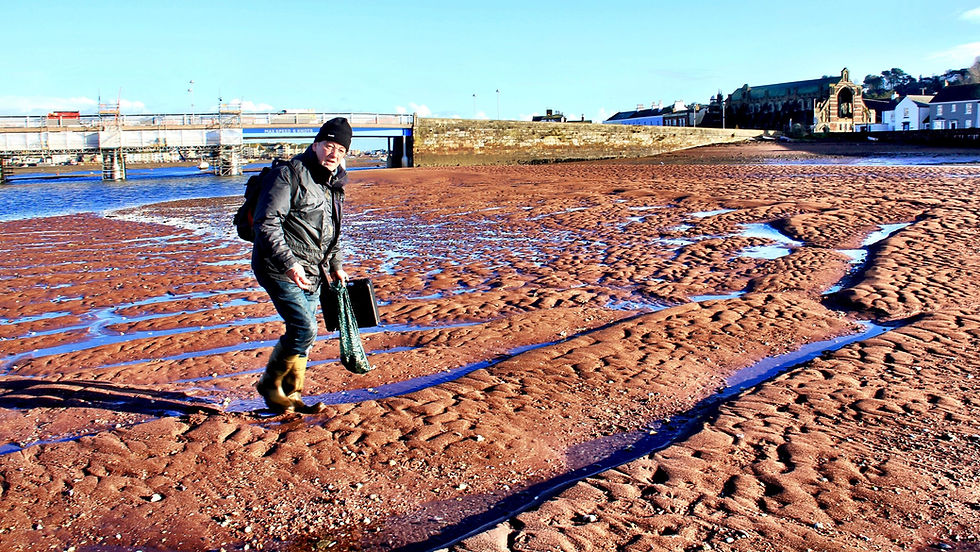
To ensure we didn't pick anything that might land us in trouble, we were joined by Simon Richardson, a professional forager who has spent years supplying high-end kitchens with wild herbs and sea vegetables.
Simon spends his days traversing coastal paths, estuaries, and private estates, hunting for plants that many regular walkers would simply dismiss as common weeds. Yet, in the hands of a skilled chef, these wild ingredients become the stars of the plate.
Ingredients like sea-purslane, sea-aster, sea-arrowgrass, rock samphire, and goosefoot have become incredibly trendy in modern British gastronomy. And there is one simple reason for their rise to fame: they are utterly delicious.
Why we British do not have a stronger, mainstream culinary tradition of eating such things remains a mystery to me—just as I am puzzled as to why we’ve never fully taken to incorporating free, plentiful, and safe-to-eat seaweeds into our daily diets. Whatever the reason, the wild food harvest is finally being taken seriously, which is wonderful news for those of us who love to explore new flavours.

The Golden Rules of the Hedgerow
However, when it comes to wild harvesting, there are two golden rules that every aspiring forager must live by. First, a great many wild plants can make you incredibly ill—or worse—so absolute certainty in identification is paramount. Second, you must know how to forage sustainably so that you never damage the local ecosystem.
“There has been a huge increase in interest in foraged food, but there are distinct dangers,” Simon warned as we examined an estuary bank. “Wild watercress, for example, loves growing alongside hemlock and water dropwort—both of which are potentially deadly. It’s all about building proper, deep knowledge before you start harvesting.”
As we walked towards a forgotten corner of salt marsh, the conversation turned back to the kitchen. The consensus among top chefs is clear: when you are working with ingredients this fresh and naturally flavourful, the key is simplicity. There is absolutely no need to over-complicate the dish or over-season the food. You simply respect the ingredient and let the natural salinity and crunch of the wild coast do the talking.

Reconnecting with the Land
Chefs drift across different kitchens over the years, but the fundamental connection between the land, the sea, and the plate remains unchanged. Foraging isn't just about finding a free snack; it’s about slow food, sustainability, and training your eye to see the landscape in an entirely new way.
The common stinging nettle, often cursed by gardeners, makes a vibrant, velvety soup that rivals any cultivated spinach. The wild garlic that blankets our woodlands in spring offers a delicate, pungent punch that transforms a simple risotto.
Nature provides an astonishingly rich menu if you only know where to look. So the next time you take a stroll along a coastal path or through a quiet country lane, keep your eyes open. You might just be walking past the finest meal of the season.
"Being out of the kitchen and seeing where the food is coming from is inspirational,” said Allister as we picked sea-purslane amid the saltings. “It also inspires the rest of the team, because a kitchen is not a one man show. Some chefs think it is, but I know I’m only as good as the rest of the team. Trying new ideas like working with these ingredients helps a lot.
“If the customer goes away happy trying a new experience - like eating sea-purslane or sea-aster that you certainly wouldn’t get in Asda or Lidl - that can only benefit us and also the local economy. It makes us more unique in what we are doing.
“I’ve seen this industry change so much over the last 30 years,” he continued as we drove to a South Hams beach in search of sea-kale. “Everything used to come in nice vac-packed bags and was so clinical. Now we get stuff with a bit of dirt on it and we wash it - but it’s all about real flavour.”

Next we went to Marlborough in the hills just behind the hotel to visit butcher Alex Brazier who has a flock of Devon Close Wool sheep which Allister often uses in lamb dishes. “It’s good meat because it takes that little bit longer to grow,” said Alex. “You are getting a little bit more fat, a lot more flavour. The sheep do very well here - there is a mild climate so they put on a good weight.”

To reiterate the warning…. Do be VERY CAREFUL if and when you go out foraging for wild food. We all know what a stinging nettle is (and as I’ve said before, they are good to eat) but establishing whether or not that plant in the stream is wild watercress is another matter altogether. Much more difficult - if in doubt do not pick. THE NHS already has enough to do without clueless risk-takers joining the queue.
Allister Bishop’s Devon lamb rump, Salcombe crab soufflé, minted pea & wild nettle puree, potato & seaweed croquette

I realise this is quite a complex recipe, but it might give you inspiration and of course you can always try making it once the world has returned to some semblance or normality…
4 lamb rumps
4 garlic cloves, cracked
2 sprigs of wild sorrel
2 sprigs of rosemary, plus extra for cooking the rumps
100ml of olive oil
2 tbsp of pomace oil
Marinade the lamb rumps for 24 hours in olive oil, crushed garlic cloves, sorrel, rosemary
Minted Pea & nettle purée
10g of shallots, very finely diced
10g chopped mint
2 x sprigs nettle tops washed throughly
1 tbsp of oil
200g of fresh garden peas
4g of salt
100ml of milk
Sweat shallots in oil until soft but not coloured. Add garden peas, nettle, salt and milk and simmer for 8 minutes. Drain milk into a jug and pour peas, nettles and mint into a blender. Blitz until ultra smooth adding enough of the milk to make a thickish purée. After blending, cool quickly as the colour will begin to fade.
Croquette
200g potatoes, quartered and turned into a dry mash potato
1 shallot, minced
100g of fresh dulce/ sea lettuce
15g of parsley, finely chopped
1 tsp rapeseed oil
150g of plain flour
3 large eggs, beaten
200g of panko breadcrumbs
oil, for frying
salt and fresh ground black pepper
Chop seaweed into a bowl, and fold in mash potato, lemon zest, chopped parsley and seasoning. Divide mix into even pieces and roll into balls with your hands. Place in fridge for 15 minutes to firm up. To coat the fritters place flour, beaten eggs and breadcrumbs in 3 bowls, seasoning with salt and pepper. Dip chilled croquettes first in flour, then eggs, then breadcrumbs. Return to fridge to chill for a few minutes.
Soufflé
150g of fresh white crab meat
300g of spinach
150 ml milk
33g of flour
30g of butter
1/2 tsp mustard
1/2 tsp ground nutmeg
53g of mature cheddar, grated
5 eggs, separated
16g of Parmesan, grated
1 pinch of salt
1 pinch of pepper
Place the white crab meat into a bowl. Heat oil in a frying pan, add the spinach, so that it wilts. Remove and drain. Grease inside of the metal rings, place onto a greased baking tray. Divide spinach into 4 rings.
Bring flour, 115ml milk, butter, mustard and ground nutmeg to the boil, whisking continuously. Turn down heat, simmer for 2 minutes, remove from the heat. Add to a mixing bowl and whisk in 37g of grated cheddar until it melts.
Using a handheld electric whisk, whisk egg whites to the hard peak stage, add egg yolks and mix. Add crab and mix, fold in egg whites. Divide mix into the metal rings. Place in an oven set to 180°C for 12 minutes.
Combine the remaining cheddar and Parmesan in a bowl. Remove from the oven and place the grated cheddar and Parmesan on top. Allow the soufflés to cool. With a sharp knife, gently go round inside of the ring to remove.
Sauce
20g of shallots
50ml of dry white wine
1 bay leaf
200ml of brown chicken stock
20g of butter
salt and pepper
Remove some fat from lamb roasting tray and heat in small pan. Add shallots and leave to sweat until lightly browned, then deglaze with wine. Add bay leaf and simmer until reduced and pan is almost dry. Then, add chicken stock and reduce by 2/3, whisking in butter and checking seasoning.
To assemble
Place a roasting pan over a high heat and add the olive oil. Season lamb and seal until lightly golden brown all over. Transfer to oven and roast for 8 - 12 minutes, remove and rest. Slice and arrange.
Arrange the reheated puree, croquette and soufflé next to the lamb, drizzle with the sauce, garnish with foraged herbs and shelled peas.

Frequently Asked Questions (FAQs)
Is it legal to forage for wild food in the UK?
Generally, under UK common law, you are allowed to forage for the "Four Fs"—fruit, foliage, fungi, and flowers—for personal consumption from public land or rights of way. However, it is illegal to uproot any wild plant without the landowner's explicit permission, and foraging is strictly prohibited in specific protected areas like SSSIs (Sites of Special Scientific Interest). Always forage responsibly and leave plenty behind.
What are the easiest wild ingredients for beginners to identify?
For beginners in the UK, wild garlic (ramsons) in the spring and blackberries or elderberries in the autumn are excellent starting points because they are highly distinctive and have few dangerous lookalikes. Dandelion greens and young stinging nettles are also incredibly common and easy to identify safely.
How can I tell the difference between edible plants and toxic lookalikes?
Never eat any wild plant unless you are one hundred percent certain of its identity. Use multiple reputable field guides, look at cross-referencing features (such as stem structure, leaf patterns, and smell), and when in doubt, leave it out. Joining a guided foraging walk with an expert is the safest way to build your confidence and knowledge.