
Exmoor Walks: Lynton & Lynmouth Circular Walk via Valley of Rocks and Cliff Railway

Updated: Jul 8
There are many wonderful Exmoor walks, but few can match the sheer drama of this circular route from Lynton and Lynmouth. Beginning beside the harbour before climbing to the famous Valley of Rocks, this walk combines towering sea cliffs, Victorian engineering, literary history and some of the finest coastal scenery in England. If you're only planning one walk on Exmoor, make it this one.
Why Lynton and Lynmouth Offer One of Exmoor's Best Walks
Lynton and Lynmouth enjoy the most spectacular panoramas in England. It's no exaggeration; I have trawled mentally through every burg I know and cannot think of any town or village that compares with the sheer drama of this perpendicular place.

Starting the Walk from Lynmouth
Anyone who has ridden on the famous Lyn Cliff Railway will know what I mean. Stand on the outer platform of the ascending car and it's the nearest thing to taking off in a helicopter you can experience without leaving the ground.
This walk forms part of my complete Exmoor Walking Guide.
The higher you go, the more grandiose the whole scene becomes, which is not surprising really given that the tallest cliffs in England are just across the bay. Taking a ride on the railway would be the easy way to start this walk having strolled down the riverside to the sea from the bus stop – but we thought we’d better get in a bit of exercise after sitting on the top of the bus so walked up the zigzag path which begins just to the left of the funicular.
I warn you, the Victorians didn't call the place Little Switzerland for nothing. This is a real climb that takes you very steeply up 500 feet. Close to the top, just as you are about to enter Lynton, you will see that the coast path sets off to the west and there’s a sign pointing along it to the Valley of Rocks – and this is where we are headed.

Walking Through the Valley of Rocks
I do know a number of people who tremble at the mere thought of walks that boast an altitudinous aspect – if you are one of these vertigo sufferers, then this part of the route is not for you. There’s nothing dangerous or arduous about it, but the hillside does plunge rather alarmingly towards the sea way, way, beneath. The local wild goats don’t seem to mind the savage slopes, but can be seen calmly munching down along the precipices with the same equanimity the average sheep shows in the average flat field.

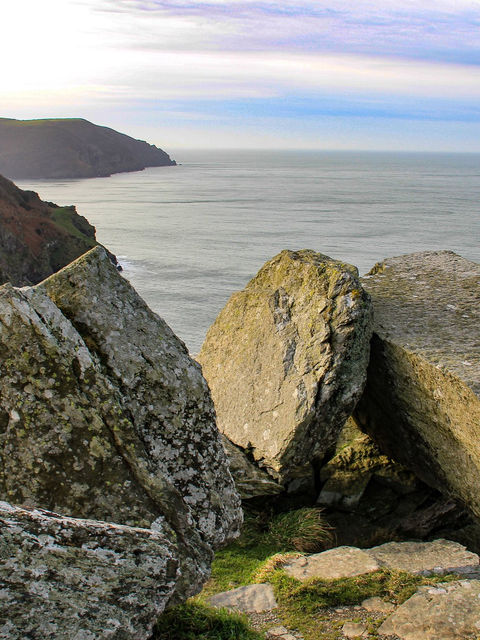
But never mind the drop, enjoy the absolutely amazing views that stretch west along the vertiginous coast instead. These are some of the best coastal views in England. After about a mile and a half of this maritime/alpine mix, the path finds a vast opening in the slopes which introduces it to the famous Valley of Rocks.
The poet Coleridge loved it here and referred to the “commotion of the elements” and both William and sister Dorothy Wordsworth joined him, naming it “The Valley of Stones”. R.D. Blackmore made it the setting for Mother Melldrum’s cave in Lorna Doone, but it’s Robert Southey’s description I like best - he called the place: “The palace of pre-Adamite kings” and said it contained “the very bones and skeleton of the earth.” Indeed, he went to claim the Lynton and Lynmouth area to be “The finest spot that I ever saw” with the exception of Cintra in Italy.
Walk Details
Distance: approximately 5 miles
Time: 2½–3 hours
Difficulty: Moderate
Terrain: Coast path, woodland paths, town streets and some steep climbs
Parking: Lynton or Lynmouth car parks
Dogs: Suitable but keep leads handy near livestock and goats
Best season: All year

Just inland from the coast path there’s the nation’s most dramatically placed traffic roundabout, situated dead in the centre of the Valley of Rocks – and from there it was a simple matter of turning left and walking up past the nation’s most dramatically situated cricket pitch to the west end of Lynton.

On the way we doffed our caps to Mother Melldrum who, for all I know, still lurks up in the rocks of the Devil’s Cheese-ring. It’s the stack of vertical rock that sits a quarter way up the cleave. If you take a detour up to it you find it’s deceptively massive, but manages to be dwarfed by the general scale of the valley.

Returning Through Victorian Lynton
But we had a bus to catch and made our way up to the east end of the cleave which then leads you directly into Lynton’s main street. At the top of Lee Road live the Poor Clares. How poor they are I do not know, but the nuns have a large and dignified looking convent which is occasionally open to the public.
Continuing down the main-street you pass the imposing town hall with its happy mixture of architectural styles. Gothic, neo-Tudor and art nouveau all combine to make the wonderful old place look like something dreamed up in some baroque fantasy by Sir Arthur Conan-Doyle. Actually Sir Arthur officially opened the place just over 100 years ago and in a way his man Sherlock Holmes paid for it. The building was funded by Sir George Newnes, part of whose wealth came from publishing Conan-Doyle's stories.
CHECK OUT SOUTH WEST COAST PATH HIKES HERE

Continuing again along the main-street we come to Church Hill past the vast Valley of Rocks Hotel. Adjacent to this there’s the church and graveyard where there’s a seat commemorating the life of the mellifluously named Manners Nightingale.
North Walk Hill passes between the graveyard and the hotel and leads to the zigzag paths that descend to Lynmouth. You cross the railway twice before regaining the seafront where you can dawdle, if you’ve time, and admire the Rhenish Tower on the old stone quay.

You might also take a turn around the display in the Flood Memorial Hall and take a look at the photographs of the infamous Flood Disaster that almost completely destroyed this community 56 years ago.
Frequently Asked Questions
Is the Lynton and Lynmouth walk suitable for beginners?
Yes. Although there are some steep climbs between Lynmouth and Lynton, the paths are well maintained and the route is manageable for anyone with a reasonable level of fitness.
How long is the Lynton and Lynmouth circular walk?
Allow around 2½ to 3 hours to complete the circular walk at a leisurely pace, with plenty of time to enjoy the views.
Can I use the Cliff Railway instead of climbing?
Yes. The famous water-powered Lynton & Lynmouth Cliff Railway provides an enjoyable alternative to the steep zigzag footpath and is an attraction in its own right.
Are there cafés and pubs along the route?
Yes. Both Lynton and Lynmouth have an excellent choice of cafés, tea rooms and traditional pubs, making this an ideal walk for combining spectacular scenery with lunch or cream tea.
What makes the Valley of Rocks so special?
The Valley of Rocks is one of Exmoor's most iconic landscapes, famous for its towering rock formations, wild goats and breathtaking views across the Bristol Channel. It has inspired writers including Coleridge, Wordsworth and R. D. Blackmore.
When is the best time to visit?
Spring and autumn offer wonderful walking conditions, while clear summer evenings provide spectacular sunsets over the sea. Winter brings dramatic skies and far fewer visitors.


