
How to Escape the Summer Crowds in South West England

August is in full swing, and this year uncertainty and unfavourable exchange rates could mean that the West Country peninsula becomes busier than ever with visitors attempting to find respite from an increasingly worrying world.

Forget city-breaks and trendy downtown destinations—wild, unspoilt, quiet, empty places are what’s needed.
There’s been a plethora of books and guides published in recent years singing the virtues of going to wild places and including everything from wild swimming to tree-hugging—but which are the best places in which to chill out in South West England?
One guide describes the region as being full of… “Storm-battered headlands, hidden waterfalls, tumbledown cottages, the ruins of haunted chapels deep in forgotten woods, mediaeval Green Men, old mines and quarries being recaptured by nature, rusting sea-forts tottering on sandbanks…”
Not a bad overview. But there seems to be a more general perception that the “quaint little Westcountry” is a place where folk go on holiday, have a cream tea and maybe swallow a crab sandwich in some overly commercialised fishing village, before going back to their caravans or guest-houses.
Even when people are looking for green leafy voids, oceanic vastness or moorland emptiness on the national stage, we get overlooked or forgotten.

Secret Walks in Somerset: The Brendons, Levels, and Quantocks
I live in the Brendon Hills—the eastern limb of Exmoor—which I know through my extensive walking researches to be the least visited range of uplands anywhere south of The Pennines. Fine by me, but visitors miss out on the amazing walks and panoramas that the escarpment can offer without the risk of ever seeing another tourist in sight.

If you were to walk on wild and lofty Bird’s Hill high above the West Somerset village of Monksilver, for example, there’s little chance that you would see another living soul—be it summer or winter. In fact, before the Coleridge Way long-distance trail was inaugurated to skirt the hill, you could have spent years up there without seeing another human being.
Much the same could be said about the vast amphitheatre of valleys two miles west that surround the remote hamlet of Comberow.

Again, you are highly unlikely to meet anyone.
There’s another vast Somerset location which joins the Brendons in luring very, very few tourists at all. The Somerset Levels offer some of the best “get-away-from-it-all” venues anywhere in England. There are fantastic walking routes, cycleways or even canoeing possibilities which will see you being the only person in the vast empty landscape.
Filled with charming, unspoilt villages that play host to quiet pubs, the Levels are ideal for anyone who likes gentle walks or cycle rides with no gradients—but who also likes to see loads of wildlife and plant-life. It can’t be beaten for its enormous flocks of birds—or hosts of butterflies for that matter.
(CHECK OUT OUR SOMERSET WALKS PAGE HERE)

For a real landscape treat, visit the National Trust’s Burrow Mump, right in the heart of the Levels. Enigmatic, lonely—this is a steep island in a sea of green flatness which occasionally turns blue when the Levels flood. Stand by the ruined church on the summit and you can gaze down at the place where King Alfred burned the cakes.
The edges of the Levels also offer some amazing locations in which to escape the madding crowd. Try the fabulous Polden Way, for example—its six short miles which take you along the ridge to the east of the Levels offer some of the best hiking panoramas in the West Country.
Escape the High-Summer Crowds in Somerset
Check live availability for quiet B&Bs, countryside cottages, and historic inns across the Somerset Levels and Exmoor escarpment using our interactive accommodation finder:

Quiet Spots Across East & South Devon
Down into Devon, there’s the lovely Blackdown Hills Area of Outstanding Natural Beauty—which must be one of the least visited AONB areas in England. Again, it’s an area full of charming villages and endless rights-of-way where you’ll hardly ever see another person.
On the Blackdown Hills, Castle Neroche is the vantage point—the lynch-pin—that casts its dark and historic eye over just about all of the troublesome borderlands which used to divide Wessex from the West Country proper.
Up here you are walking along the ramparts of the old Norman fort, and pretty spectacular ramparts they are. Apart from the breath-taking views, the very slopes of the Norman workings are astonishing enough with near vertical drops plunging 80 feet down into the forest.

You can look across at another AONB from here—and a stroll along Quantock’s airy heights where the wind never stops whispering among the pale deciduous grasses and where the panoramas come in wide-screen mode, is one of the most peaceful things you could ever do.
Few places inspire such an innate and elemental sense that seems to tell you that here, in the cups of the coombes, lies the very bosom of the English countryside.
Perhaps it is the homely redness of the sandstone, maybe it is the very shape of those superb curves that contour every glade and headland: it is hard to say exactly how or why the hills score so many points on the wilderness front.
Go up Bicknoller Coombe to the big empty ridge for some of the best, loneliest, moments the Quantocks have to offer.

Remote Exmoor: Wild Valleys and Empty Acres
Moving west again, Exmoor does, of course, boast some of the emptiest, least visited acres in all of England.
The great ravine between Kitnor Heath and Codsend Moors just south of Dunkery seems to be a no-go zone for humans. On the numerous occasions I’ve walked there since boyhood, I have never seen a single person there.
There are a lot of ravens. And deer. Then there are the partridges making their strange, almost exotic, chirring noises in the riverine abyss deep below Codsend. A few sheep bleating, a few larks ascending. No sound of man. The deer moving imperceptibly through the bracken, a group of Exmoor ponies way on the horizon, a few cattle minding their own business. And not much else at all.
(CHECK OUT OUR EXMOOR WALKS PAGE HERE)

Then there’s Larbarrow, Southern England’s answer to the African savannah or the Russian steppes. The vast hinterland that rises to the north of the young River Exe is a primeval landscape which has more or less been untouched by the hand of man. Stand in its midst and the only straight line of man’s making you may see is an airliner’s vapour trail. Everything else will be as nature intended.
This is the England where great herds of big wild animals would have once roamed unmolested. And this is where you can roam pretty much unmolested to this day.

Coastal Seclusion & Hidden Forests
Down in East Devon, Aylesbeare Common is a place which still retains a sense of wilderness. It’s a rare chunk of ancient heathland that plays home to the largest number of butterfly species to be found in any RSPB reserve. Incredible really, to be just a few miles outside Exeter and into such a great swathe of nature-rich wilderness…

Exactly the same could be said for Ashclyst Forest. It is just a mile or two off the M5, yet the National Trust owned forest boasts a sense of concealment. It breathes privacy and seclusion.
Ashclyst is a mixed woodland and you get the distinct feeling, walking out of earshot of the modern world, that this is how much of England used to be.
Golden Cap might be one of the most highly protected places in the region, being a key point of the Jurassic Coast World Heritage Site, and yet its lofty summit still exudes wilderness, as does much of the National Trust’s Golden Cap estate.
Rare snakes, lizards, butterflies and birds all haunt the area, but it’s the stupendous views that give you the sense of lofty isolation. From Golden Cap you can look down across the gargantuan landslides that mark this coast—past a million dinosaur fossils to Charmouth, and on again along half of the Jurassic Park.

You only have to climb the Haldon Hill range just south of Exeter to know that there’s plenty of awesome countryside where you can go to feel immersed in nature. Yes, these hills do have two major roads running through them—but walk out to lofty Obelisk Plantation, stroll through Gilpin’s Bottom or wander through Deadman’s Coombe out to Whiteway Wood and you will know you are somewhere very lonesome and lovely indeed.
Beyond lie the South Hams, and here again there are wild empty spaces to enjoy. The area might be one of the region’s more well-to-do zones—most barns may have been converted into posh residential hideaways—but there are plenty of lonesome corners nevertheless.
Even near urban Torbay you can discover a sense of solitude almost as profound and deep as that to be enjoyed on the heights of distant Dartmoor.
Seeking Solitude in Devon in High Summer?
Bypass the jammed coastal resorts and drop anchor in the quiet heart of the county. From remote Dartmoor edge inns to secretive B&Bs hidden in the Blackdown Hills and Central Devon, find peaceful bases off the beaten track.

Hidden Coast of Devon
Walk the coast path south over Long Sands, down to Scabbacombe Sands, then up to the great headland which borrows the tiny cove’s name and you will enjoy some of the best open countryside that 630-mile right of way has to offer. And yet you will be just two miles from the streets of Brixham and three from the restaurants of Dartmouth.
Sail south a dozen miles and things get even wilder. The coast south of Hallsands running out to Start Point is one of the most undomesticated sections of the entire South West littoral - a terrain known as coastal heath dips steeply to the sea in places where once, long ago, crofters used to scratch a living in a few tiny fields.
(CHECK OUT OUR DEVON WALKS PAGE HERE)
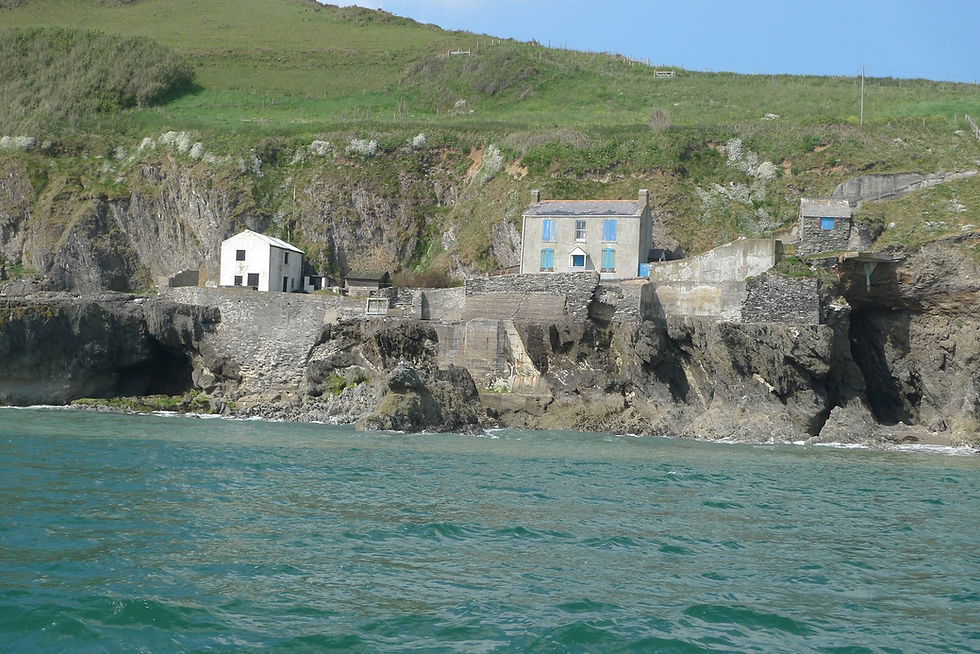
Now none but gulls and walkers go there—and much the same can be said for the amazing coastal strip around the corner along the beautiful section between Start and Prawle Points.
And this southerly wilderness doesn’t finish here. Past Prawle there is one of the most scenic stretches of coastline to be enjoyed anywhere in England. The amazing, empty, magical section between Prawle and the Salcombe estuary might seem obsessed with porky names (there’s Gammon Head, Pig’s Nose and Ham Stone) but no place in the country could be further from thoughts of a pig sty.

Central Devon: England's Bermuda Triangle
I’ll admit we’re in the rather busy South Hams here—if real emptiness and quietude is what you want you might like to try a great swathe of central Devon which could be described as England’s Bermuda Triangle. Hardly anyone ever seems to go there. The triangle that stretches west from Crediton and Tiverton even has a hamlet called Nomansland smack in the middle of it which seems to bear out the notion.
Go somewhere like the area north of Chawleigh and walk in the scenic Little Dart Valley and you will see what I mean. This has nothing to do with the region’s other River Dart—but it is just as lovely in its own remote and silent way.

Not far away, still out in the middle of nowhere, Eggesford is a splendid place in which to take a stroll. “Despite the lack of habitation in the area all trains stop at Eggesford Station because the local landowner made that a condition of releasing the land to build the railway which opened in 1854.”
So says a local walks leaflet which also says that Thomas Hardy once alighted here in 1885 and described the scenery as “lovely” and the great house as “handsome”. Nothing much has changed.
Far to the north again, someone ought to write a book about the enigmatic hinterland which lies between the A39 and the jagged Atlantic coast after the road turns left at Clovelly and heads south for Bude.

This is “wrecker” country where dangerous denizens once haunted the coast helping themselves to whatever the sea washed up—where, later, Parson Hawker tamed them into helping stricken sailors or at least picking up the 'gobbets'—which were human bits and pieces left over from the storm.

But it boasts more than coastal savagery. The visitor looking for wilderness is drawn into deep, secretive valleys that lead down to those frightening, razor cliffs. They will find bluebell woods hiding from the cruel sea, dizzying waterfalls and hidden hamlets snug in quiet coombes.
High above all this the Tamar is born, and if you follow this south you’ll come to some very empty places indeed. Take Cookworthy Moor to name but one. It’s impossible to imagine now, as you stroll along a muddy track in the big gloomy forest somewhere out on the bleak clay-lands of Tamar country—now known as Ruby Country—but once upon a time hordes of happy holidaymakers would rattle on trains through this lonesome place on their way to the Cornish coast.
Further downstream the Tamar becomes surrounded by higher and higher hills which are the first risings and eminences of Bodmin Moor and Dartmoor.

Dartmoor & Bodmin Moor Wilderness Walks
Where could be wilder than Dartmoor? In England you’d have to go a long way north to find a landscape that’s emptier and less mucked about with by mankind.
One location I’d choose to represent a wilder, more peaceful Britain would be Tavy Cleave and beyond. Nowhere I know in this peninsula is wilder or more empty—the roaring river cuts through the rocky ravine and there have been times when I’ve thought the place has looked more Andean or Himalayan than something from homely Devonshire.
(CHECK OUT OUR CORNWALL WALKS PAGE HERE)

I’d also recommend the headwaters of the East Dart River—walking up there from Postbridge is like striding into Conrad’s novel Heart of Darkness. Then there’s Taw Head, which is plonk in the centre of Dartmoor’s northern vastness. It is as middle-of-nowhere-ish as you get in this peninsula.
Now we can cross the Tamar into Cornwall in search of a bit of peace and quiet…
A Cornish press photographer once growled to me: “I don’t know how I do my job in July and August—half the county is one big traffic jam.”
No one who’s ever been west of the Tamar during high summer will have any argument with this statement, but that’s not to say the place isn’t rich in wild places…

Escaping High Summer Crowds in Cornwall
It’s often said that South East Cornwall is the county’s forgotten corner—and it is true to say that often the tourists pass right on by in their hurry to head west.
The coastline from Cawsand out to Rame Head is wonderfully wild and scenic—indeed, it is hard to imagine you are just a few miles from Plymouth, the 11th biggest city in England.
Rame Head is a magnificent affair and to reach it you must climb countless steps to the top of an oceanic knoll. Here stands the ruined 14th century Chapel of St Michael—it may be drafty, but apparently the local church comes out here once a year for a full-blown service.
The wind never stops whispering among the wild lichen gardens of the holy eaves, and from the chapel's gaping southerly window you can see the Eddystone Lighthouse being vertical and brave out there in the great disc-world of the sea.
Beating the High-Summer Traffic in Cornwall?
You don't need to get stuck in coastal gridlock to enjoy the far West. Discover quiet B&Bs, granite moorland cottages, and tucked-away village inns across South East Cornwall, Bodmin Moor, and the far reaches of West Penwith.

One of the least wild places along this part of the littoral is Polperro, which is not surprising as it’s one of the region's prettiest ports. But just to the west of Tourist Central you will discover one of the most beautiful and dramatic stretches of coastline we have.
The South West Coast Path does its usual trick of undulating here—it goes up, and it goes down—past Nealand Point and Colors Cove, beyond Blackybale Point and Penslake Cove.
Now let’s head inland directly north to the roof of Cornwall. Minions is Cornwall's topmost village—at least, in altitudinous terms. There isn't much else up there but a pub, a tea-room and the most extraordinary views—and there is all of Bodmin Moor stretching off in the general direction of the Atlantic Ocean.

You cannot walk an inch on these lonely plains without bumping into the past. If it's not the prehistoric stone circles, then it's the clutter left by tin-streamers, copper miners and quarrymen who knocked seven bells out of the moors. Few places in the region are as torn up and generally mucked about with as this once productive corner—now there’s no one save the odd walker.

I could add just about all Bodmin Moor to the West Country empty-place listings, as it is the region’s least visited stand-alone upland.
Now let’s go south—a long way south—as far, in fact, as you can go without getting your feet wet. The remarkable Lizard peninsula deserves an article of its own when it comes to empty places. Not all the Lizard, of course—some parts get very busy indeed. But if I was pushed into naming just one spot where gulls go to be lonely on the cape, then it would be Black Head, the mighty headland that guards the eastern shores at the end of Chynhalls Cliff near Coverack.

Travelling towards the sunset, a great deal of West Penwith can be wild and empty even on the busiest of days. Stick a granite finger into a mighty ocean and that’s the windswept result you’re bound to get. I won’t mention the various “secret” coves I know tucked under the north Penwith Moors, because the last time I did, some readers complained I was putting up a flag that would make them secret no more…
The best thing about West Penwith is the ability to explore and discover secret empty places of your own… But just as a hint I’ll tell you that the walk to Zawn Gamper—a cove in the very far west—will introduce you to a very empty zone indeed. Along the way you will be introduced to wild and people-less headlands like Rosemodress Cliffs, Carn Barges, Gazell, Tol Toft and Tater-du.

This is only the most fleeting of round-ups. It would be easy to go into far greater detail and name the exact locations of many of the West Country’s lovely wild and empty zones. But A) we haven’t room—you’d need an entire book, or two… and B) there is something to be said for the people who complained last time I named specific beaches in Cornwall. By telling people about them, we could be guilty of helping to spoil them.
Which is why this article has given just a taster of the places where you can go to escape the madding crowds this August.

Frequently Asked Questions
Where can I go to avoid crowds in Devon during summer?
While coastal towns like Salcombe and Torbay get busy in August, central Devon—often dubbed "England's Bermuda Triangle" between Crediton and Tiverton—remains wonderfully quiet. The Little Dart Valley, Eggesford Forest, and the clay-lands of Ruby Country near the Tamar offer peaceful, crowd-free walking.
What are the least visited hills in Somerset?
The Brendon Hills, forming the eastern limb of Exmoor, are among the least visited uplands south of the Pennines. Walks over Bird's Hill above Monksilver or through the valley amphitheatres surrounding Comberow offer wide panoramas with almost no other walkers in sight.
Can you find quiet coastal walks in Cornwall in peak season?
Yes. While popular fishing villages and surfing beaches can be packed in July and August, quieter stretches include the coastline between Start Point and Prawle Point, Rame Head in South East Cornwall, and the remote coastal headlands along the far western tip of West Penwith.
Is Exmoor quiet in August?
Exmoor contains some of the emptiest acres in southern England. Deep valleys like the ravine between Kitnor Heath and Codsend Moors, or the vast open savannah-like hinterland around Larbarrow, remain serene and virtually untouched by peak summer tourism.


