
Little Switzerland: The Dramatic Highs and Lows of Lynton and Lynmouth

Updated: Jul 17

If anyone was ever to compile a list of Very Special Places in the West Country, then the combined communities of Lynton and Lynmouth would have to come near the top. For the pure drama of the landscape, there are few locations in England that can beat this vertiginous corner of the coast.
Pass the Lyn River ravine just beneath the pub at Countisbury on the A39 heading west, and you are suddenly confronted with one of the most stunning panoramas to be seen anywhere in the country. There, more than 1000 feet below you, is the curve of Lynmouth Bay, and from this vantage point you can see how the twin-communities sit almost like items on a bookshelf or a bunk-bed.
IF YOU ENJOY THS POST CHECK OUT OUR EXMOOR PAGE

Because everything is on the vertical in this landscape. The mighty hills of Exmoor seem reluctant to give way to the ocean until the very last minute - at Countisbury you are still high up on the plateau but from this corner you can see how the Lyn Rivers have cleaved what is almost a gorge between you and those two communities. There’s Lynmouth way down at the bottom on the shoreline and, perched almost vertically above it there’s Lynton some 400 feet above, huddled on its shelf surrounded by yet more hills.

The Birth of 'Little Switzerland'
No wonder the area around Lynton and Lynmouth was given the appellation Little Switzerland back in Victorian times when the first tourists came adventuring west by stagecoach. The Romantic poets Coleridge, Wordsworth, Southey, Hazlitt and Shelley are often named as the world’s first tourists - they went for long country walks purely to admire the scenery – a thing not often done in the late 18th and early 19th centuries. The place they loved to reach by foot and explore was this dramatic coast. Shelley even chose to spend his honeymoon here in 1812.

After the poets, other tourists began to arrive aboard stagecoaches with wonderful names like Katerfelty, Lorna Doone, Red Deer, Benita and Tally Ho (the Minehead-Lynmouth service ran as late as 1921). Then the Bristol Channel pleasure steamers began to call and, in 1898, the Lynton-Barnstaple Railway opened and the day-trippers began to arrive en-masse.
Tourism became a buzzword and it was around this time that some bright spark marketing consultant coined the phrase Little Switzerland in an attempt to lure yet more trippers.
The area no longer needs marketing consultants or quaint nicknames. It’s still relatively remote and difficult to reach, but when I visit nowadays (which I do often) I rarely find the place empty.
A Welcome Renewal at The Crown
Good news, then, that a lovely old inn up in Lynton has recently seen a completion to extensive renovations which have converted it into a very desirable hostelry offering 21st century food and accommodation. The Crown reopened this spring following a thoughtful restoration, unveiling new and improved bedrooms alongside refreshed bar, restaurant and terrace spaces. Overseen by owners, St Austell Brewery the project restored ten older rooms and introduced five new superior and deluxe rooms to the inn, “blending traditional character with a brighter, more contemporary feel,” according to a spokesman for the brewery.

It does just that. I called in for lunch the other day and liked the way in which the refurbishment has been sympathetic, retaining much-loved features from yesteryear - including the collection of iconic Mick Cawston artworks displayed throughout the pub. He was a talented artist who was living locally before his untimely death in 2006.

To quote one source on the internet: “Mick was a master of atmosphere. His countryside scenes - whether of foxes, deer, hares, or the quiet corners of rural Britain - carry a soulfulness that reflects his own relationship with the natural world. You can sense in every brushstroke that he wasn’t just observing nature; he was part of it.”

The writer concludes: “Every now and then, an artist comes along whose work doesn’t just hang on a wall - it lives in the hearts of the people who see it. For so many animal lovers, dog owners, countryside wanderers, and art collectors, Mick Cawston was one of those rare talents.”

So the renovations at the Crown were carried out around Mick’s work. “We couldn’t possibly have done anything else,” duty manageress, Emily Francis, told me as we admired the late Mr Cawston’s artworks which were painted directly onto the wall of the bar.
“If anything happened to these, it would be a crime - no one would dare paint over them,” decreed Emily. “People love the paintings here in the bar and come especially to see them. He had a little studio just up the road and they say he painted them to pay off his bar bill.”
We were able to admire Mick’s large wall paintings of musicians playing in-situ in the bar, wild Exmoor ponies, portraits of dogs and foxes wearing Victorian hats and various brilliant sketches of lurchers and other long-dogs, while eating a splendid lunch.

Food sits at the heart of The Crown’s new offering, with menus built around a field-to-fork ethos and local ingredients. There’s also a terrace where cocktails and ice creams, including signature knickerbocker glories are served.
In short, I’d say The Crown, one of more than 120 leased and tenanted pubs in St Austell Brewery’s South West estate, is ideally placed for walkers, holidaymakers and for those simply wanting a relaxed coastal stay.

Fantasy Architecture and the Valley of Rocks
I certainly enjoyed our sunny afternoon at Lynton last week, exploring both the town and the Valley of Rocks just along the road. Our first port of call was the imposing town hall with its extraordinary mixture of architectural styles. Gothic, neo-Tudor and art nouveau all combine to make the wonderful old place look like something dreamed up in some baroque fantasy by Sir Arthur Conan-Doyle. Actually Sir Arthur officially opened the place on August 15, 1900 and, in a way, his man Sherlock Holmes paid for it. The building was funded by Sir George Newnes, part of whose wealth came from publishing Conan-Doyle’s stories.

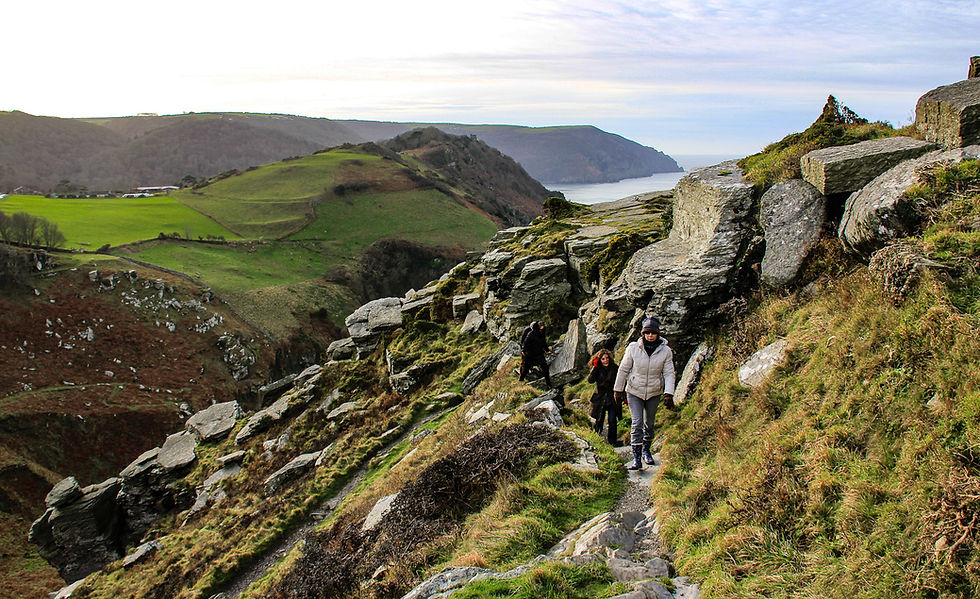
To the right of the town hall there’s a footpath which takes you west out to the Valley of Rocks - and it does so on the dramatic, perpendicular, seaward side of the hill. I don’t think I’m overdoing it if I advise sufferers of vertigo to avoid this path, although it is paved and quite safe.

It eventually enters the Valley of Rocks at the place where the great defile spills into the sea. The gorge is peculiar in that it has no watercourse and it runs parallel to the shore, rather than directly towards it. The theory is that it was once the main valley of the Lyn Rivers when the sea level was a good deal higher than it is now. The waves and river waters eroded the softer sandstones in the valley and gave an easier route of egress which is the one that now forms the valley down at Lynmouth.
Directly in front of us stands dramatic Castle Rock - and a detour up this craggy pyramid is compulsory in my opinion. At the top you can see the jagged hole in the rocks that is known as the White Lady – but only because the outline could look like an old fashioned female in a bonnet, if you ignore the over-stated breasts.
Opposite the valley, inland, we can see the Devil’s Cheese-ring – a tall rock-stack that may or may not have been home to legendary Mother Meldrum.
IF YOU'VE ENJOYED THIS POST CHECK OUT OUR OTHER LOCATIONS IN DEVON

For those who are feeling fit there is a route up, up and up past the rock-stack to the footpath which runs along the very brink of the slope called South Cleave. By turning left along this path you can make your way back to the heart of Lynton. Those who do not fancy the extra, near vertical, 300 foot climb can simply walk back up the bottom of the Valley of Rocks, passing the famously picturesque cricket pitch as they go. Passing also, a pleasant looking tea-room and gardens…

Echoes of History
Back in Lynton we strolled down a small thoroughfare called Blackmore’s Path, which took us out onto Sinai Hill. A biblical sounding street named after a rock called Mount Sinai, which used to be a favourite viewpoint hereabouts. Where it is now and why it was named after a Middle Eastern height, I have no idea.

A quick plug here for the excellent Lyn and Exmoor Museum which is in adjacent Market Street… It is presently closed for a major refurbishment, but is one of the best small town museums in Devon and I look forward to its reopening.
If Lynton has an actual centre then it is Church Hill, with its shops on the left as you walk up, and St Mary’s church and the vast Valley of Rocks Hotel on your right. Bertrand Russell apparently stayed in one of the rooms with his wife Dora in 1924, although I can find no mention of what he thought of his visit to this most dramatic of English resorts.
North Walk Hill passes between the graveyard and the hotel and leads to the zig-zag path that takes us back down to Lynmouth - or, of course, you can take the famous funicular railway which I have always thought must have been the nearest things the Victorians ever experienced to flying in a helicopter. It both takes off and descends vertically, and is a grand and spectacular way of admiring the vast, vertiginous panorama of Lynmouth Bay.
Visitor Information:
For more information on The Crown at Lynton visit: www.thecrownlynton.co.uk
Rooms start from: £90 per night (room only), based on two sharing a petite double room.

Frequently Asked Questions
Why are Lynton and Lynmouth called 'Little Switzerland'?
The nickname was coined in the late 19th century by tourism marketers to describe the area's dramatic, vertical landscape, steep gorges, and Alpine-style beauty. The label originally grew out of the deep appreciation early Romantic poets like Wordsworth and Coleridge had for the rugged, vertiginous Exmoor coast.
What is the difference between Lynton and Lynmouth?
While they are closely linked twin communities, they sit at completely different elevations. Lynmouth sits right at sea level along the shoreline where the Lyn River meets the sea. Lynton sits perched directly above it, roughly 400 feet up on a dramatic cliff shelf.
How do you travel between Lynton and Lynmouth?
Visitors can walk between the two towns using a steep, scenic zig-zag cliff path. Alternatively, you can ride the famous historic water-powered funicular Cliff Railway, which travels vertically up and down the cliffside, offering sweeping views of Lynmouth Bay.
What is the Valley of Rocks and how do you get there?
The Valley of Rocks is a dramatic, dry river valley running parallel to the coast just west of Lynton. It is famous for its striking geology, wild goats, and craggy rock formations like Castle Rock. It can be reached via a spectacular paved cliffpath that walks out from just to the right of Lynton Town Hall.
Who funded the Lynton Town Hall and what is its literary connection?
Lynton Town Hall was funded by the wealthy publisher Sir George Newnes and was officially opened by Sir Arthur Conan Doyle on August 15, 1900. Because Newnes made a significant portion of his fortune publishing the famous Sherlock Holmes stories in The Strand Magazine, locals often joke that Sherlock Holmes indirectly paid for the building.
Where can you see Mick Cawston’s artwork in Lynton?
A wonderful collection of original paintings and sketches by the late rural artist Mick Cawston is on permanent display inside The Crown pub in Lynton. Several of his large countryside and animal scenes were painted directly onto the pub's bar walls, and the inn's recent major refurbishment was carefully designed to protect and highlight them.


