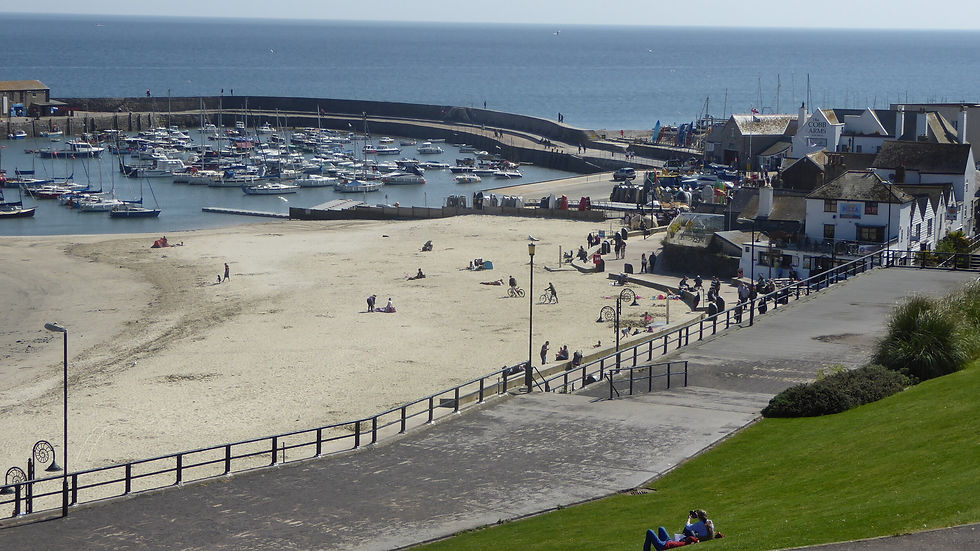
Lyme Regis and West Dorset: walks, beaches, history and the Jurassic Coast


There are places which you visit and there are places which gradually get under your skin.
Lyme Regis on the Jurassic Coast in West Dorset belongs firmly in the second category.
I have been coming here for years, sometimes on journalistic duty, sometimes to walk, sometimes to eat, sometimes to go fishing and occasionally simply because I happened to be passing and decided that the sea looked too inviting to ignore.
And the more I discover about Lyme and the countryside around it, the more I realise that this is not simply a seaside town. It is a sort of geographical hinge.
To the west lie the great hills and combes of Devon, with Beer, Branscombe, Seaton and the extraordinary Undercliff stretching away towards Axmouth. Inland, the high green ridges of Dorset roll towards Beaminster, Pilsdon Pen and Lambert’s Castle. To the east are Charmouth, Golden Cap and the great landslipping coastline which eventually leads towards Bridport and beyond.
And underneath the lot is geology which is forever up to something. The cliffs fall down. Hillsides move. Streams change direction. Fossils emerge from the beach. Paths disappear into the sea.
It is, in other words, exactly my sort of place.

Lyme Regis: the seaside town where nothing is quite as it seems
Lyme has a slightly curious habit of appearing to be one thing while actually being something entirely different.
Take the famous Cobb.
It looks as though it has been standing there since the beginning of time, which is not far wrong: there are records of the structure dating back to 1294. Its great curved wall was designed by people who understood waves rather better than most modern engineers, while the older stones were laid upright to give the structure additional strength.

And yet The Cobb has also been a film set, a fishing harbour, a working port and the backdrop to countless family holidays.
You may even think you have seen Meryl Streep standing out there in a storm in The French Lieutenant’s Woman. You haven't. Well, you have – sort of.

I once asked a local about it and received the sort of answer that illustrates the particular humour of Lyme Regis rather well. Depending on who you believe, the figure out there was an art director, a local fireman or somebody else entirely dressed as the famous actress.
This is Lyme: nothing is quite as it seems.
The same applies to the beach. Much of the attractive sand and shingle that now makes the seafront such a pleasant place to sit is there because of a massive programme of coastal engineering. Lyme has spent centuries fighting a battle with the sea and, rather more alarmingly, with the unstable land beneath its feet.
The town's cliffs are made up of layers of materials which have an unfortunate tendency to slide over one another. Add rain, gravity and a sea that is constantly nibbling away at the bottom of the cliffs and you have a landscape which is never entirely certain where it is going to be tomorrow.
This is one reason I love walking around here.
You are not simply walking through scenery. You are walking through a landscape in the process of becoming something else.

The Cobb, fishing and the taste of Lyme Bay
There is another Lyme which exists beyond the holiday brochures.
It is the working seaside town.
I once spent a wonderful day going mackerel fishing out of the harbour with the late photographer Richard Austin and local skipper Harry May. The idea was wonderfully simple: go out to sea, catch some fish and bring them back for lunch.
The boats were full of holidaymakers, many of whom regarded the annual mackerel trip as an essential part of their visit. Harry told me that some families had been coming back for years. And I can understand why.

There is something deeply satisfying about catching your own lunch, particularly when that lunch is a mackerel which was swimming around Lyme Bay a few minutes earlier.
We eventually took our fish to Monmouth Beach, gutted them standing knee-deep in the sea and put them over a barbecue.
Fresh mackerel needs very little interference. A squeeze of lemon, perhaps some salt and pepper – and a hot barbecue. That is about it.
You can read the full story of that extraordinary day in my article Mackerel Fishing in Devon.

Walking from Lyme Regis
If you come here with walking boots rather than buckets and spades, you are entering a much larger world.
One of my favourite things about this part of Dorset and Devon is the way the coast and countryside fit together.
You can leave Lyme Regis and, within a surprisingly short distance, be climbing through ancient countryside, crossing high ridges, looking down upon landslips or wandering through villages which seem to belong to another century.
There are plenty of possibilities.
One of the most obvious is the walk towards Charmouth, although anyone following old walking material needs to be careful because the coast is continually changing and sections of the old route have disappeared through erosion.
I discovered that the hard way.

A map I was carrying showed a perfectly respectable path. Unfortunately, the land upon which the path had once existed had decided to become seabed.
The result was one of those walks which began as a pleasant outing and ended with my phoning the photographer who had recommended it and asking him to come and rescue us.
My more recent guide to Jurassic Coast Walks: 5 Great Routes in Dorset and East Devon contains the current version of this story, along with other walks around Golden Cap, Charmouth and the surrounding coast.
The important thing here is to follow current signs and diversions rather than relying on an old map or an old newspaper article. The cliffs don't read newspapers.
Golden Cap and the great West Dorset landscape
Walk east from Lyme and eventually you encounter Golden Cap, the great golden-topped hill which rises above the Jurassic Coast.
It is the highest point on the English south coast and one of those places where the geography suddenly makes sense.

From the heights you can look back towards Lyme Regis, across the immense broken landscape of the Jurassic Coast and inland towards the great Dorset ridges.
Golden Cap is not an easy little stroll from sea level. It is a proper climb.
But this is high country with a difference. You don't have to spend your entire day staring at the next stile. Once you gain height, enormous panoramas open out across Dorset.
The landscape around here is also a wonderful illustration of the fact that the Jurassic Coast is not a static geological exhibit.
It moves.
The undercliffs are essentially great natural landslides which have become colonised by trees, shrubs and wildlife. In places the cliffs look almost like giant green steps descending towards the sea.
You can read more about this extraordinary coastline in my Jurassic Coast Walks guide.

The great Dorset ridges
The countryside immediately inland from Lyme is equally rewarding.
One of the finest walks I have ever done as a newspaper walking writer took me across the great ridge country between Beaminster and Lyme Regis.
I walked with my old friend, the poet James Crowden, and poet Catherine Simmonds, and for much of the day it felt as though I had somehow wandered into a landscape populated by poets living and dead.
This is the Wessex Ridgeway country: Gerrard's Hill, Lewesdon Hill, Pilsdon Pen, Lambert's Castle and the green valleys which eventually funnel you towards Lyme.
It is big walking country.
You climb a hill and discover another hill beyond it. You cross a ridge and find another ridge waiting in the distance. Eventually the whole thing begins to make sense as a giant geographical jigsaw.

I wrote about that long journey in The Great Dorset Ridge Walk.
I have also written more recently about the way Dorset's chalk ridges and literary associations became woven into my own rather peculiar childhood relationship with the county in Exploring Dorset: A Journey Through Chalk Ridges and Literary Landscapes.
Lambert's Castle and the world behind Lyme
One of my favourite walks in the area takes you up to Lambert's Castle, high above Marshwood Vale.
There is an Iron Age hill fort up there, magnificent views across Dorset and a fascinating history which includes an old racecourse and the remarkable semaphore communication system which once linked Plymouth and London.
But my reason for going there was literary.

I had been rereading Geoffrey Household's Rogue Male, the wonderful 1930s thriller in which an English sportsman goes to ground after attempting to assassinate a Hitler-like European dictator.
Robert Macfarlane had written about trying to identify the landscape which inspired the book, and so my poet friend James Crowden and I set off to explore it.
The walk took us around Lambert's Castle and Coney's Castle, with the English Channel appearing between the ridges.
It is a particularly good example of what I like about walking around this part of Dorset.
You can set off looking for a literary landscape and come home having discovered Iron Age archaeology, Napoleonic communications, old fairs, enormous views and a couple of castles.
My full Lambert's Castle Hill walk is here on the site.
Charmouth and the restless Jurassic Coast
Just east of Lyme lies Charmouth, one of the most famous fossil-hunting beaches in Britain.
But I am always slightly wary of describing this coast as though it were a museum.
It isn't. It is alive.

The cliffs are constantly eroding and the sea is continually revealing things which have been hidden for roughly 195 million years.
On one visit I went walking from Charmouth and climbed towards the great landslip at Cain's Folly. From above, the scale of the collapse is extraordinary. Trees have taken root in the new landscape and what was once a solid hillside has become a sort of secret green valley.
The geology is responsible for much of the character of the coast.
Porous rocks sit above impervious clays and shales. Rain gets in, weight increases and eventually gravity wins.
The result is an undercliff.
And the result of the undercliff is one of the most unusual coastal landscapes in Britain.
You can see much of this country on my Charmouth circular walk, which takes in Chardown Hill and Stonebarrow as well as the coast.

West of Lyme: Beer, Branscombe and the Undercliff
Turn west rather than east and you enter a very different world.
The coastline between Lyme Regis and Axmouth is one of the great walking landscapes of southern England.
Branscombe is particularly beautiful.
I once set off from Branscombe Mouth intending to make a substantial circular walk through the Undercliff, Beer and around Beer Head. Even if you only have time for a shortened version, the Undercliff is worth experiencing.
It is a strange place.

A great mother-cliff has partially collapsed towards the sea and a second landscape has grown up between the two. Trees, shrubs and plants flourish in this humid, sheltered world.
It wasn't always wilderness.
People once farmed these slopes, growing early potatoes, broad beans, strawberries, daffodils, crocuses and tulips in the frost-free south-facing plots.
Seaweed was carried up from the beach by donkey and used as fertiliser.
It is difficult to imagine such an agricultural landscape when you walk through the jungle-like Undercliff today.
But that's another reason this coast is so fascinating: landscapes change, and sometimes the old one survives only in stories.
Seaton, Axmouth and the River Axe
Further west lies Seaton, where the great natural drama of the coast gives way to the watery landscape of the Axe estuary.
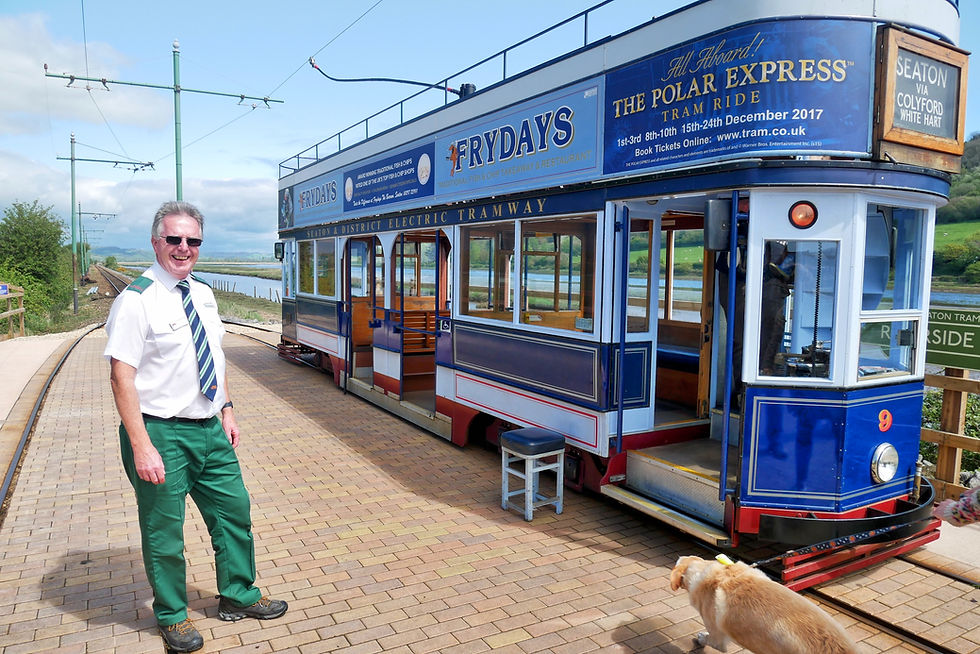
There are nature reserves, wetlands and the famous Seaton–Colyton Electric Tramway.
I once walked from Seaton through the wetlands to Colyford with the local nature reserves manager James Chubb. We crossed boardwalks, looked into bird hides and explored the remarkable habitats around Black Hole Marsh before catching the tram back towards the coast.
It is a gentler walk than many of the cliff-top routes around Lyme, but it reveals another side of East Devon.
And then there is Axmouth.
Today it looks like a tiny harbour, but once it was a significant port. Roman connections, Viking battles, royal armies and centuries of maritime trade have all passed through this narrow valley.
The modern harbour remains an intriguing little place, squeezed between river, shingle and cliff. It is one of those places where you have to use your imagination.

And then there is Beer...
Beer deserves its own visit.
It is one of my favourite little seaside places and has the unusual ability to appear vaguely Mediterranean when approached through the trees from the coast path.
I once walked there from Shute via Colyton and the Seaton tramway, accompanied by my glamorous step-daughter.

We arrived in Beer hungry. Fortunately there was a café by the beach. It was November.
We sat outside in shirt sleeves. My companion described the whole experience as “stunningly, surprisingly British”.
I couldn't really argue.
A corner of the West Country that keeps changing
That, really, is what draws me back to Lyme Regis and the surrounding country.
It is not simply the famous things.
Not just The Cobb.

Not just fossils.
Not just the Jurassic Coast.
Not just Golden Cap.
It is the way everything connects.
The fishing town connects to the fossil beaches. The fossil beaches connect to the landslips. The landslips connect to the geology. The geology connects to the hills. The hills connect to Hardy, Household and the poets. The valleys connect to old ports and fishing villages.
And the footpaths connect the lot. Some of them, admittedly, disappear. But there are always others.

So this page is intended as a starting point for exploring the area through my own collection of walks, features and stories.
I've spent decades wandering around this corner of the West Country and still find new pieces of the jigsaw.
Perhaps that's the real attraction of Lyme Regis and West Dorset. You never quite finish discovering it.