
Newquay beyond the surf: beaches, harbour, The Gannel and a stay at The Headland

Newquay is one of the finest seaside resorts to be found in Britain. There, I've said it.
Its beaches are first-class, its surf is extraordinary and its vast tourism offering, for the most part, runs like a well-oiled machine. It even has one of the most pleasant little harbours on Cornwall's north coast.

So it is perhaps no surprise that, when I was writing a series about the great West Country seaside resorts, Newquay had to be included. And yet for years I had rather misunderstood the place.
I regarded Newquay as a town of enormous beaches backed by cliffs and topped by the most remarkable jumble of B&Bs, hotels and sundry other bits and pieces of anarchic architecture to be found anywhere along Europe's northern coast.
A place where the planners had apparently said: "To hell with it, build what you like."
A resort seemingly more attuned to its amusement arcades than anything that might sniff of the sea.

I was wrong. Newquay is all about its seaside. Like all the resorts in that old series, the coast – and nothing but the coast – is its finest feature.
I was reminded of that when I surfed Fistral Beach in my own pretty useless middle-aged way. It was one of those wonderfully daft experiences in which you spend most of your time being thrown around by the Atlantic and yet enjoy every single, white-foamed, washing-machine moment of it. And afterwards I went looking for another side of Newquay.

The Newquay that sits below the hill
There is a curious divide in the town. Up on the main streets you find the shops, bars, restaurants, hotels and all the things associated with a major holiday resort.
Down at the harbour, it feels like another place altogether.
For years I have regarded Newquay Harbour as one of the best-kept secrets on Cornwall's north coast. Local fishermen I have known, including Phil Trebilcock, have always made the same point: there are still people who come to Newquay without realising that it has a harbour at all. That seems almost impossible.

But spend a little time down there and you begin to understand what they mean.
The harbour is tucked below the town, and the views open out along the coast towards Trevose Head, Watergate Bay and Bedruthan Steps. As Phil once put it to me, you are looking at a wonderful natural amphitheatre.
There is also an extraordinary piece of Newquay history hidden beneath the town.
The steep tunnel leading down towards the harbour was excavated by St Dennis miners for the Newquay Harbour Railway, which opened in 1849. Almost all trace of that railway has disappeared, but the tunnel remains.
When I visited, it was being used by Newquay Gig Rowing Club to store its historic boats.
Phil was particularly keen that visitors should see more of this side of Newquay. He talked about the old gigs, the harbour and the coastline, but also about places that most visitors never get around to seeing – Trenance Gardens, the boating lake and, above all, The Gannel.

He was right. Because The Gannel is where Newquay really begins to surprise you.
The Gannel: the Newquay that never was
The Gannel is Newquay's own little estuary, flowing into the sea just south of the town.
There were various schemes over the years to dam, reclaim or develop parts of the area so that Newquay could expand across the dunes.
Imagine the horrors that might have gone up had that happened.
Fortunately, The Gannel survived.
As a result, just a few hundred yards south of the centre of one of Cornwall's busiest holiday resorts, there is a wonderfully undeveloped stretch of coast, dunes, estuary and countryside.
The National Trust owns much of the surrounding land, helping to protect it from the sort of development that has altered so much of the coast elsewhere.
And this brings me to one of my favourite walks in the Newquay area.

Holywell Bay and Kelsey Head
The walk starts a few miles south of Newquay at Holywell, near the National Trust car park.
It is a surprisingly beautiful corner of Cornwall and a useful reminder that the Newquay coastline is considerably more varied than Fistral Beach and the town's famous surf breaks.
From the car park I made my way down towards Holywell Bay.
I had never properly explored the beach before and, having reached it, decided to walk along the sand rather than immediately join the coast path. I'm glad I did.
North Cornwall — Tregardock
If you enjoy this wilder side of North Cornwall, I've also written about a spectacular walk around Tregardock Beach, another of the coast's less-visited corners.

Holywell is one of those beaches that makes you wonder why somewhere so spectacular is not better known. The great sweep of golden sand is framed by high dunes and cliffs, while Carter's Rocks sit out towards Penhale Point.
More than 70 years ago, Cornish writer JRA Hockin described it as possibly the sweetest bay in England. I wouldn't argue with him.
There is also Holywell Cave in the cliffs to the north, although this is not somewhere to wander into casually. The steps are slippery and the National Trust advises caution. Certainly it should never be approached on a rising tide.
Instead, I headed up through the dunes to regain the coast path.
This is quite a climb.
The dunes are enormous and the marram grass is fragile, so it is important to stick to the established paths and wooden steps where provided.
Then the landscape opens out again as the path heads north towards Kelsey Head.
CHECK OUT OUR DEDICATED CORNWALL WALKS PAGE HERE
Ancient Cornwall at Kelsey Head
Kelsey Head is one of those places where the modern holiday coast suddenly gives way to something much older. The headland contains three ancient enclosures, their banks and walls still visible among the grass.

At the end of the headland are the remains of an ancient cliff castle. It is easy to see why such a place was chosen for defence, perched above the Atlantic with cliffs providing a natural barrier.
But whenever I encounter these old cliff castles I have the same thought: What happened when the water ran out?
Just offshore is The Chick, a small rocky island, while the surrounding grassland and cliffs provide a rich habitat for wildlife.
On my walk I saw a stoat loping through the flowers.
The number of rabbit holes suggested that it wasn't short of work.
Polly Joke – or Porth Joke
Walking back along the north-east side of Kelsey Head brings you to one of the area's loveliest little beaches. Its proper name is Porth Joke. But nobody seems to call it that.
Locals call it Polly Joke.
I have never been entirely sure why, although the "Joke" element is apparently related to the same Cornish root as "chough", the red-legged Cornish cliff bird.
From here the route heads inland through the valley before climbing towards Cubert Common. And once again the landscape changes.
There is a long tradition of claiming that the grasslands around here produced the sweetest mutton in England. JRA Hockin suggested the area's rich vegetation might have been responsible, while another theory was that sheep acquired their distinctive flavour from eating the tiny slugs and snails that lived among the turf-covered sandhills.
I rather liked the idea. Unfortunately, I was unable to test it.

The return to Holywell
From Cubert Common the walk returns over the ridge, past the northern edge of the golf course and down towards Holywell. It is an easy hike, but what makes it special is the variety.
Beach. Dunes. Ancient earthworks. Clifftops. Wild flowers. An estuary.
And all of it within a few miles of one of Britain's best-known seaside resorts.
That is the Newquay I have come to appreciate.
SEE OUR SPECIAL PAGE DEDICATED TO THE SOUTH WEST COAST PATH
And then there is The Headland
There is another reason I think this part of Cornwall makes such a good base for exploring.
The Headland. I have stayed at The Headland a couple of times and, rather oddly, I can't find the piece I wrote about it. Perhaps it is buried somewhere among the many thousands of words I have produced over the years.
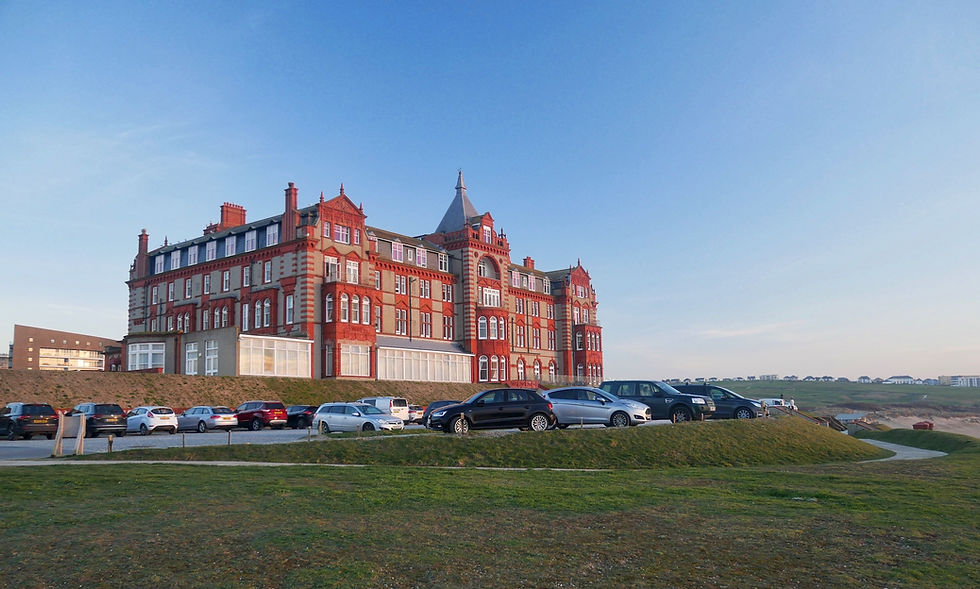
But perhaps that is no bad thing. It gives me an excuse to mention it here, because The Headland fits perfectly into this story.
The great Victorian hotel stands on Towan Headland directly above Fistral Beach. It was built between 1897 and 1900 and is now Grade II listed.
It is one of those buildings that has become part of the landscape.
You see it from Fistral. You see it from the coast path.
And when you look back towards Newquay from the surrounding headlands, its big Victorian bulk helps make sense of the town's history as a fashionable seaside resort.
The hotel has had quite a history.
Its beginnings were controversial, with local fishermen and farmers objecting strongly to the development of the Towan Headland. There were even violent protests and fires during construction before the hotel eventually opened its doors to guests in 1900.
It subsequently became one of Cornwall's great destination hotels, suffered a long period of decline and was rescued in 1979 when John and Carolyn Armstrong bought it.
Since then it has undergone a remarkable transformation.
Today it combines the grand Victorian building with a much more relaxed version of luxury. There are 86 bedrooms, the Headland Spa and AquaClub, and several restaurants, including Ugly Butterfly by Adam Handling.
And the location remains the great attraction. The hotel is about half a mile from the centre of Newquay and sits immediately beside Fistral Beach. For someone interested in walking, that is particularly useful.

Then, after a day's walking, you have the slightly ridiculous luxury of returning to a grand Victorian hotel perched above one of Cornwall's finest surfing beaches.
I've done it.
And I can recommend the combination.
The Headland also understands that not everyone staying in a five-star hotel wants to spend their entire holiday sitting in a lounge.
Its current offering includes a five-bubble spa, AquaClub and several dining options, while the hotel itself describes its approach as "five-star Cornwall, not formal".
That seems about right to me.
You can dress up and eat well if you want to. Or you can come back from a walk with salt in your hair and sand on your boots.

What about Newquay's reputation?
Which brings me back to the old question. What about the stag and hen parties? What about the drunken nights and the rather noisy reputation that has followed Newquay around for years?
Well, yes.
Newquay has had that side to it. But when I was researching my original article, the people I spoke to in the harbour were already telling me that it represented only a small part of the town.
Phil Trebilcock put it rather neatly. "Newquay is not about stag and hen parties – you always get the minority spoiling it for the rest."
Another harbour character, Roger Spurrel, told me that the harbour was effectively a different world from the top of the hill.
Fisherman Martin Gilbert, who had lived in Newquay for almost half a century, said much the same thing.
"This is a different world down here," he told me.

I think that is still the best way of understanding Newquay.
Don't judge the whole town by what happens on one street on one Saturday night in August.
Come here and explore it. Walk the beaches. Go down to the harbour. Find The Gannel. Head out to Holywell and Kelsey Head. Look at the ancient cliffs and the flowers growing among the dunes.
And, if you want to make a proper break of it, stay somewhere that allows you to experience the coast rather than simply the town.
The Headland is one obvious choice. Because ultimately Newquay isn't really about the bars, the shops or even the surf industry. It is about the sea.
And when you get away from the obvious bits, you discover that there is a remarkable amount of it.
WALK FACT FILE
Route: Holywell – Holywell Bay – Kelsey Head – Polly Joke/Porth Joke – Cubert Common – Holywell
Distance: About 3 miles
Going: Easy, although there are steep sections through the dunes
Map: Ordnance Survey Explorer 104 – Redruth & St Agnes
Starting point: National Trust car park at Holywell
Best time: Spring is particularly good for the wild flowers, although the walk is rewarding throughout the year.
Take care: Keep to established paths through the dunes to protect the marram grass. Holywell Cave should not be approached on a rising tide and the slippery steps require particular care.

WHERE TO STAY
The Headland, Newquay
For a walking break, The Headland is unusually well placed: above Fistral Beach, around half a mile from central Newquay and within easy reach of the harbour, The Gannel and the wider north Cornwall coast.
I've stayed here a couple of times and it remains one of those Cornish hotels where the setting is almost impossible to beat.
It is not the cheapest place to stay in Newquay, but if you want somewhere special from which to explore this stretch of coast, it is difficult to imagine a better-positioned base.

FAQ
What is there to do in Newquay besides surfing?
Newquay has much more to offer than surfing, including its harbour, coastal walks, The Gannel estuary, Fistral Beach, Holywell Bay and the countryside around Kelsey Head and Polly Joke.
Where is the best place to walk near Newquay?
The coastline around Holywell Bay, Kelsey Head and Polly Joke provides an especially scenic walk close to Newquay, with beaches, dunes, cliffs, wild flowers and ancient coastal fortifications.
Is Holywell Bay near Newquay?
Yes. Holywell Bay is only a few miles south of Newquay and provides access to a particularly beautiful section of the north Cornwall coast.
What is The Gannel in Newquay?
The Gannel is the tidal estuary immediately south of Newquay. It is an important natural landscape that has helped prevent the coastal development of the area and provides some of the quieter scenery close to the town.
Where is The Headland Hotel in Newquay?
The Headland Hotel stands on Towan Headland above Fistral Beach, within walking distance of central Newquay. Its position makes it particularly convenient for exploring the surrounding coast.
Is Newquay good for a walking holiday?
Yes. Although Newquay is famous for surfing and its beaches, it is also a useful base for exploring the north Cornwall coast, with coastal paths leading towards the harbour, The Gannel, Pentire and the wider coastline.
Is Newquay worth visiting?
Yes. Beyond its busy summer reputation, Newquay has superb beaches, dramatic coastline, a historic harbour and access to some remarkably unspoilt countryside and coastal walking.
Fowey
Newquay isn't the only Cornish seaside town that makes a good base for walking. I've also explored the remarkable coastline around Fowey, including the classic circular walk taking in Bodinnick, Pont Pill, Lantic Bay and Polruan.


