
Lithuania's Amber Coast: A Coolcation on the Baltic Shore

Updated: Aug 10

There’ll be many readers who do not like heatwaves. I could never understand this when I was young, but now… The heat can be too much for a bloke who’s pushing 70.
A lot of people agree - witness the rise and rise of the “coolcation”. The word had not been invented at the start of this decade, but now it’s one of the most searched-for travel topics and, given the way the plant seems to be warming, it is a trend that’s set to continue.
I was certainly glad of the opportunity to take a “coolcation” recently, having been invited to spend a few days in Lithuania. And I enjoyed every minute of it, despite my initial reaction that an ex-Soviet-bloc country might be a drab and dreary, lacklustre sort of place.
How wrong I was! Within minutes of landing at tiny Palanga Airport, we found ourselves in what I could only describe as a kind of Scandinavian Switzerland. By which I mean: posh!
Sleek apartment buildings and modern architecture seemed to dominate the forested seaside town - we didn’t spot any of those depressing high-rise housing blocks the Soviets used to build in all their towns. The cars were all better and newer than the ones on our roads - and the roads themselves were devoid of potholes!

As for the drab and dreary Communist style food I’d been dreading… We never saw any of that. Indeed, I’d say Lithuania fed me some of the best grub I’ve had in a while - and at a very reasonable price.
So what was I doing in this neck of the Baltic woods? Well, the folk who run tourism in Lithuania are keen to tell the world about their Amber Coast - and a very pleasant, interesting and unusual part of the Scandinavian littoral it is too.

First Impressions of Palanga: Seaside Resorts & Botanical Parks
As I say, our introduction to Lithuania began at Palanga - a location easily reached on cheap flights from the UK - and a place that instantly shattered every preconceived notion I’d harboured about post-Soviet Baltic states.
We were whisked away from the airport straight to a lunch that instantly told me my fears of “Communist food” were unfounded. Instead of the grey, uninspired cabbage-and-potato mash I had secretly braced myself for, I was treated to prime examples of modern European culinary flair. The ingredients were fresh, the presentation immaculate, and the flavours crisp. My very first meal in Lithuania was a simple prawn salad, but it was a magnificent example of its kind.

Refuelled and feeling a little foolish about my earlier anxieties, we were taken on a walking tour of Palanga. This forested seaside town owes its elegance to the Tiškevičiai counts, a visionary family of Polish-Lithuanian nobility who transformed a fishing village into a high-society resort during the 19th century. They built a grand neo-Renaissance palace, but their true gift to the town was the surrounding Palanga Botanical Park. Designed by the famous French landscape architect Édouard André, the park is a masterpiece. It’s now a public space, but felt more like an aristocratic estate, where manicured lawns weave seamlessly through dense pine forests that march down to the Baltic shore.

We had a fascinating half-hour in the Amber Museum housed inside the counts’ old palace - a dazzling collection of prehistoric resin containing everything from ancient twigs to preserved insects.
A Baltic breeze began to pick up, providing the kind of “coolcation” climate I had been expecting, as we strolled around the elegant seafront area and called at the Palanga Resort Museum - a curious old villa, also owned by the Tiškevičiai counts.
We stayed at a large and popular (filled with Lithuanians and Poles) spa hotel which provided us with a magnificent dinner and a hearty breakfast that featured everything from local cheeses to fresh pastries. So we we’re well set-up for our day out in Klaipėda, Lithuania’s only seaport.
Exploring Klaipėda: Old Town & The Castle Museum

Historically known as Memel, the city has a distinct German flavour, having spent centuries under Prussian rule. Our guided stroll through the Old Town revealed a grid of cobbled streets lined with 19th-century timber-framed buildings (Fachwerk). Rising from the historic ramparts where the Danė River meets the lagoon, Klaipėda’s newly restored Castle Museum complex blends medieval ruins with striking modern architecture. Actually, we were among the first visitors to this newly opened museum and we were astounded by the place - it must have cost millions of Euro to build.

Housed within underground bastions and pristine new pavilions, the museum utilises cutting-edge holograms, massive projection zones, and thousands of archaeological artefacts to bring the old 13th-century Memelburg fortress vividly back to life.
The town is a place that feels deeply connected to the sea, a theme that carried through to another superb lunch at a town-centre restaurant where local fish was the undisputed star of the show. We also visited the Švyturys Brewery - a large city-centre outfit that hosts guided tours and makes very very good beers.
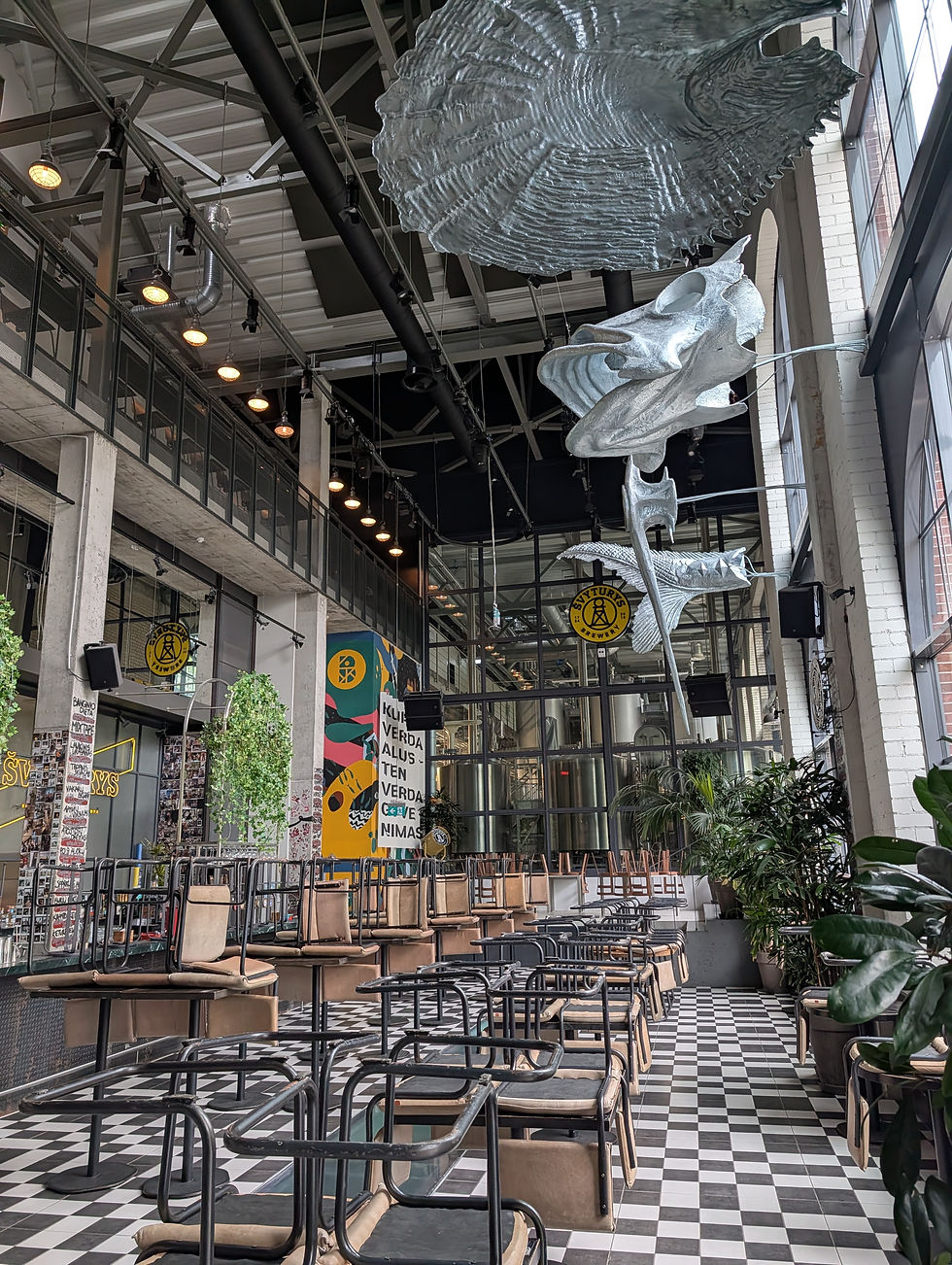
The Curonian Spit: Lithuania's Natural Wonder
In the afternoon we caught the ferry across the lagoon to the Curonian Spit - and this second half of our trip was, to me, the great highlight of our Lithuanian tour.

You need to look at a map to begin to understand the lay of the land and sea in these parts, because the four-minute ferry crossing does not do the geography justice.
The Curonian Spit is a 61-mile-long, narrow ribbon of sand dunes - extending north to south and dividing the Baltic with the inland Curonian Lagoon. It is shared between Lithuania and Russia’s Kaliningrad Oblast region, which straddles the southern half of the spit. Since the Ukrainian war this strange sea-bound border has been closed - huge watchtowers loom over pine woods and dunes and the place has a distinct Cold War feel to it.

The Spit is, without exaggeration, one of the most remarkable landscapes I have ever come across. As we drove south long it, our guide regaled us with local folklore - tales of giants who supposedly scooped up the sand in their aprons to form the peninsula to protect the fishermen from the wrath of Baltic storms.

To witness the drama of this UNESCO World Heritage site, we met a park ranger at the Nagliai Spit Nature Reserve. Walking along the boardwalks through the ‘Dead Dunes’, you could be forgiven for thinking you’d stepped onto another planet. Huge, shifting hills of pale sand, sculpted by the Baltic winds, have slowly marched across the landscape over the centuries, burying entire villages beneath them. It is stark, beautiful, and utterly silent place.

The Curonian Spit & Nida: Sand Dunes, Land-Yachting & Lagoon Views
By late afternoon, we reached Nida, the largest settlement on the Lithuanian side of the spit. Here, the local architecture changes again - the town is famous for its brightly painted wooden fishermen’s houses, decorated with intricate weather vanes. But we weren’t just here to admire the woodwork. At the old Nida Airfield, we were introduced to the exhilarating sport of ‘blokart’ (land-yacht) sailing.

I wasn’t sure how my joints would take to being strapped into a three-wheeled buggy just inches off the tarmac, but the moment the wind caught the sail and I tore down the runway, any hesitation vanished. It was thrilling, and my little yacht was remarkably easy to control. I loved it.
It was just a couple of minutes’ drive to the lovely Prie Marių Nida guesthouse, located on the inland shore of the spit. From here we could get an idea of just how vast the Curonian Lagoon is - and the next day were were to find out by crossing in a a fast boat. The journey took 40 very bumpy minutes.

But first we were able to enjoy our evening stay at this handsome, well kept little guesthouse, run by a lovely and welcoming family.

We were also treated to an excellent dinner of traditional Lithuanian dishes at the Nerija viešbutis restoranas - reckoned to be one of the best eateries in the region. I can vouch that it is, especially seeing that, at my request, our banquet included one of Lithuania’s national dishes… The famous pink soup, šaltibarščiai, is a refreshing cold beetroot broth - vibrant in colour and flavour - made with shredded beetroot, kefir or buttermilk, crisp cucumbers, and fresh dill. It is one of those dishes where the sum is greater than its parts. A perfect hot-weather dish.

Wildlife in the Nemunas Delta
The next morning we were aboard the speedboat for a tour across the lagoon to the Nemunas Delta - a labyrinth of rivers, canals, and vast wetlands that acts as a vital highway for millions of migratory birds.
We watched huge flocks of waterfowl take flight as sea-eagles and harriers flitted here and there above the endless reed-beds.

Our voyage brought us to the Ventė Cape Ornithological Station, one of the oldest bird-trapping and ringing stations in Europe, established back in 1929. We were treated to a bird-ringing demonstration by the resident scientist, who handled various small birds with astonishing speed and care.

For lunch, we stopped at a family-run establishment called Mėlynasis Karpis (The Blue Carp), located in the heart of the fishery region.

Needless to say, the main ingredients are taken straight from the ponds. My sturgeon steak was one of the best bits of fish I’ve ever tasted, which is saying something.

And what’s the best thing to do after a large and delicious lunch? Head for a raised bog, of course. The Aukštumala Raised Bog is one of the most famous of its kind in the world, having been the first to be scientifically studied and written about in endless research papers. A boardwalk allows you to walk right into the heart of this ecosystem of mosses, stunted pine trees, and dark pools without getting your boots muddy. A truly ancient environment, that looks exactly as it did thousands of years ago.

History, Wellness and a Final Surprise
Our final afternoon took us inland to Kretinga, a town steeped in religious history. We were welcomed with coffee and traditional desserts before embarking on a tour entitled “The Secrets of the Monastery”. A bit gruesome in places, but fascinating if you like vast old churches and monasteries.
We spent our final night at the nearby Atostogų parkas (Holiday Park) wellness centre, where I happily soaked away the miles in their geothermal mineral water pools - the perfect antidote for a travel writer who had spent the last three days walking dunes, sailing land-yachts, and exploring bogs.
Lithuania didn’t just surprise me - it completely changed my understanding of that part of the world. The eastern Baltic is a truly fascinating place. For anyone looking to escape the oppressive heat of southern Europe for a sophisticated, green, and thoroughly “posh” northern getaway, the Amber Coast offers an easy-to-reach, hassle-free option.

Fact File
Lithuania Tourism: Lithuania Travel Official Tourism Site
CityBee Car Sharing: CityBee Lithuania
Lithuanian Railways: LTG Link Train Tickets
Curonian Spit Ferry Information: Smiltynė Ferry Timetables
The region has one national park (Curonian Spit) as well as two regional parks: the Nemunas Delta Regional Park and the Seaside Regional Park. The region is also part of the EuroVelo cycling network, with EuroVelo 10 (Baltic Sea Cycle Route) passing through the coastal area.
Martin flew from Stansted and stayed at the Hampton by Hilton before his early-morning flight. Holiday Extras is the market leader in UK airport parking, hotels, lounges and transfers.
For current prices and bookings visit:

Frequently Asked Questions: Planning a Coolcation on Lithuania's Baltic Coast
What is the best month for a 'coolcation' on Lithuania’s Amber Coast?
June through August offers warm daylight and fresh Baltic sea breezes, with daytime temperatures usually hovering pleasantly between 18°C and 23°C—ideal for outdoor activities without oppressive heatwaves.
How do you get to Palanga and the Curonian Spit from the UK?
Direct flights operate from UK airports (including London Stansted) directly into Palanga Airport. From Palanga, Klaipėda and the Curonian Spit ferry are less than a 30-minute drive or bus journey.
Where should you stay when visiting the Curonian Spit?
Nida is the main hub on the Lithuanian side of the spit, featuring traditional timber guesthouses along the Curonian Lagoon. Palanga offers larger spa hotels and coastal resort accommodation.


