
Secret Seasides: Six Months Exploring the West Country Coast

Six months, 29 coastal locations and some extraordinary discoveries: Martin Hesp recalls the Secret Seasides series that took him to some of the West Country's quietest and most remarkable shores.

Who doesn't like to be beside the seaside?
Who doesn't like to be beside the seaside?
If the feedback my Secret Seasides newspaper series received over six months is anything to go by, very few people indeed.
In more than 12 years of writing major series for the newspaper, Secret Seasides ran for the longest period of time and was probably one of the most popular.
That doesn't surprise me.
People love the coast. They like being on beaches. And a series of articles setting out to discover hidden coves, little-visited bays and silent shorelines was always going to have something going for it.
What did surprise me was just how hidden, little-visited and silent many of these wondrous places were.
Over the six months I visited 29 different Secret Seaside locations, travelling around Devon, Cornwall, Somerset and the Isles of Scilly in search of beaches and coastal places that somehow remained remarkably quiet.
I should think the number of people I counted collectively, across every hidden shore, would have failed to fill a double-decker bus.

The secret of the empty beach
Part of the reason may have been the weather.
We began the series in the middle of what turned out to be a miserable summer. The much-hoped-for Indian summer failed to materialise in autumn, and the beaches we visited remained remarkably empty.
And you don't really expect to find remote beaches filled with the madding crowds in winter.
Nevertheless, I have always believed that the old national park observation that most people venture no further than a few hundred metres from their cars contains more than a grain of truth.
There is something slightly extraordinary about it. The West Country possesses some of the finest coastline in Britain, yet many visitors never see more than the easiest-to-reach section.
Does that sadden me? nFrom a purely selfish perspective, not a single jot.
Indeed, I am only too happy to have the West Country's fabulous coastal jewels all to myself.
But it does sadden me from another perspective because I don't particularly like the idea of coming from a nation that can't be bothered to get off its collective backside.
Of course, not everyone enjoys good health or is fit enough to go clambering down to remote, boulder-strewn beaches.
And one particularly heart-warming thing about working on a series like this was that you tended to receive lovely letters from older readers who once, a very long time ago, were doing all the clambering and climbing necessary.
For them, a series like this seemed to act like a blast of fresh air beamed directly at their comfy armchair.

Sometimes the secret beach is just one cove away
What I couldn't understand was why so few people ventured beyond an overcrowded beach in midsummer.
In many cases, pure seaside bliss lies just one cove away from teeming, swarming hell – and yet not a soul bothers to stroll over the headland to make the discovery.
One of the best examples was Ayrmer Cove in South Devon.
On one of the few hot days of that summer, I visited the little beach in the South Hams, set at the end of a lovely valley away from the madding crowd.
But not that far away.
One beach to the east there is Challaborough, at the foot of a mighty caravan park, and one beach east of that again is Bigbury.
Both were packed on the day I was there.
Ayrmer Cove had just a dozen people enjoying its secret wonders.
The local National Trust ranger told me that was about the most you would ever see down there.
That, in a nutshell, was the spirit of Secret Seasides. You didn't necessarily have to travel further. You simply had to walk a little further.

Lansallos: a secret beach in the shadow of Polperro
Much the same could be said for a South Cornish beach which I introduced in the original series like this:
“Compared to the crowded streets of nearby Polperro or Fowey, Lansallos is perhaps the supreme advertisement for the spirit of this series.”
Lansallos has the complete kit of secret-seaside parts.
There is an extremely pleasant beach, a lonely hamlet and a deep and ancient path leading down towards the sea.
And yet this beautiful little corner of the Cornish coast can feel remarkably untouched.
That is despite being close to two of Cornwall's most famous destinations.
The lesson was becoming clear. The most rewarding coastal discoveries weren't necessarily the ones furthest from civilisation.
Sometimes they were the ones sitting surprisingly close to it.

Salcombe Regis Mouth: it's a long way down
The secret seaside way, way under the hamlet of Salcombe Regis was another example of this "close to crowded civilisation" genre.
It lies only about a mile east of ever-popular Sidmouth.
But compared with the last two examples, we were getting down to the nitty-gritty as to why such places remain on their lonesome.
It's an awful long way down to Salcombe Regis Mouth. Which means that it is an even tougher slog back up. There is no other choice, other than to arrive by boat.
And this, dear readers, is why the few negative comments about the series were water off a duck's back to me.
A few letters complained that we were telling the world about special places that should remain hidden and therefore empty.
I wouldn't worry too much. Most of the beaches we featured were difficult to reach.
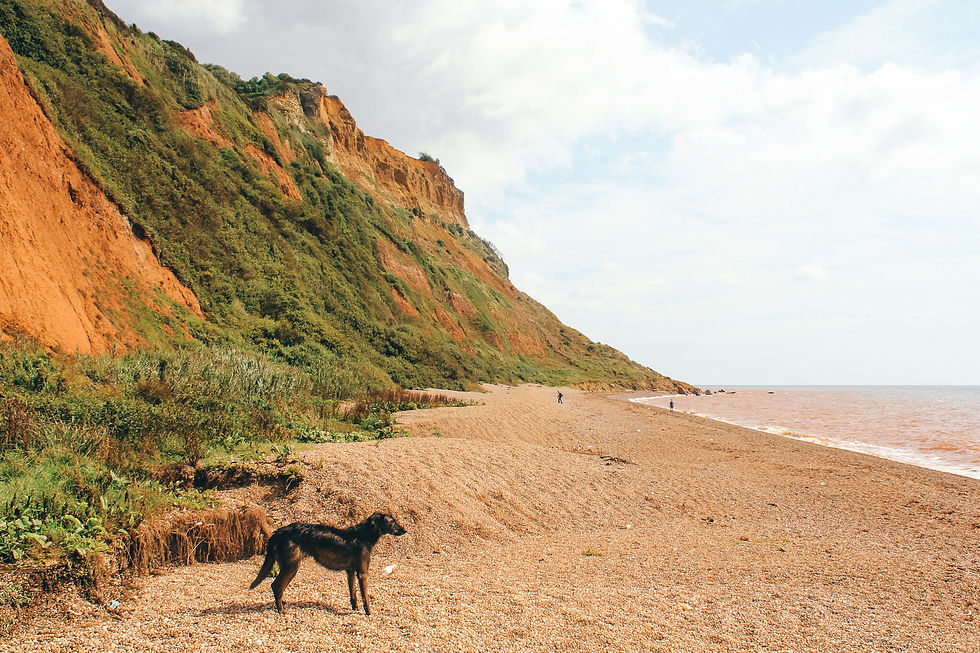
When reaching the beach becomes an adventure
Some places were difficult in the extreme. Selworthy Sands, hidden behind Porlock Bay's Hurlestone Point on the Exmoor coast, was one such place.
It became one of the most intriguing stories of the series.
Readers wanted to know how I had reached the dangerous strand, and I received all manner of letters and emails asking about the route.
In the interests of health and safety – which is something I am rarely interested in – I declined to give exact details. Guilt is something I rarely suffer from, but even I draw the line when it comes to recommending dangerous places.
By all means admire the secret Gull's Hole and the extraordinary coastline around Hurlestone Point.
But don't assume that because somebody has managed to reach a remote beach, it is necessarily sensible for everyone else to follow.

The West Country coast has its hazards.
Cliffs, tides, steep slopes and slippery paths don't care how enthusiastic you are.
And that was one of the things I became increasingly conscious of during the series: a secret beach is not necessarily a beach that should be treated as an ordinary beach.
Sometimes the journey is part of the adventure.
Sometimes the journey is the warning.
The extraordinary islands of Scilly
Other Secret Seasides were not dangerous to reach. Just damned difficult.
That was certainly the case with some of the amazing beaches I visited on the uninhabited islands of the Isles of Scilly.
Samson was one of the most memorable.
Nowadays the island is uninhabited, but it once had its own community.
Its lonely Landing Beach, which I featured during the series, was once an important link between the islanders and the outside world.
Standing there today, it is difficult to imagine the activity that once took place on those shores.
There is something particularly haunting about deserted island settlements.
The buildings remain. The paths remain. The beaches remain. But the people have gone.

Nowadays the Isles of Scilly remain one of the most extraordinary places to explore around the British coast, with their mixture of inhabited and uninhabited islands, beaches, rocky shores and maritime history.
For current information about visiting the islands, see the official Visit Isles of Scilly website.
When a secret beach was once a busy industrial site
In a way, mention of Samson brings me on to another subject that surprised me during the writing of the series.
Many of our truly secret, silent beaches were once very busy places.
Carleon Cove, a small indentation just a couple of bays north of ever-busy Cadgwith on the Lizard, offers one of the best examples. Today it is a peaceful Cornish cove. But the nearby Poltesco Valley was once central to the British serpentine industry.
Justin Whitehouse, the National Trust's head ranger on the Lizard, explained to me how the industry developed after Queen Victoria and Prince Albert became associated with serpentine during the nineteenth century.
For those who don't know it, serpentine is a metamorphic rock laced with dark green veins and dotted here and there with reds and whites.
“At the time there was just a small industry going on,” Justin told me. “But suddenly it had royal approval and everybody wanted serpentine.”
As a result, a factory sprouted up in the valley. There would have been large stone-cutting equipment because huge boulders were moved there, strung above the river on aerial launders. They were cut, shaped and polished. So why did it all disappear?
According to the story Justin told me, Queen Victoria went on holiday to Italy and encountered marble – and suddenly marble was in vogue. Nobody wanted the old-fashioned serpentine any more. It's probably a good job that happened.
If the industry had continued, this peaceful valley could have become a very different place.

The forgotten industries of the West Country coast
The same could be said for the shale-oil industry that at one time promised to transform parts of the West Somerset coast, or the fertiliser trade that turned dozens of remote and inaccessible coves in North Cornwall and Devon into busy little harbours.
This is one of the things I love about walking around the West Country.
A coastline that appears completely wild can suddenly reveal the remains of a former industry. A ruined building. An old track. A quarry. A mine.
A harbour that seems far too small and inaccessible to have ever been busy.
Then you start imagining what the place must have been like when boats were arriving, men were working and goods were being carried up and down the cliffs.
For those of us who like our natural coastlines quiet and best left to the gulls, the historic disappearance of such industries has been a saviour and salvation.
But that doesn't mean we can't enjoy seeing the relics and trying to imagine what once went on in these Secret Seasides where now nothing and nobody moves at all.

Wild Pear Beach and the ghosts of old mining
Go to amazing Wild Pear Beach near Combe Martin, for example, and it is difficult not to feel the ghostly presence of the silver miners of old.
The North Devon coast around Combe Martin and Exmoor is spectacular enough without its history.
But once you know that people were once working the minerals beneath this extraordinary landscape, the place takes on another dimension.
What you tend to end up thinking is:
Crikey, what a crazy place to have worked in. It must have been so dangerous and gruelling.
Then you think:
And how lucky I am that I can come to this lonesome beach of my own free will and relish in its beauty and grandeur without having to worry about another soul.
That thought occurred to me repeatedly during the six months of Secret Seasides.
And it remains one of the great pleasures of exploring the West Country coast.

Why I loved the Secret Seasides series
Looking back, I think what made Secret Seasides work was that it wasn't really a search for beaches.
It was a search for stories.
A beach might be beautiful, but that wasn't always enough. The really memorable places had something else.
Perhaps there was an old industry. Perhaps a vanished community. Perhaps a smugglers' path. Perhaps a difficult descent. Perhaps a remarkable piece of geology. Or perhaps the place was simply astonishingly quiet despite being within sight of somewhere packed with visitors.
That was the real fascination.
The West Country coast is not just a collection of beaches. It is a vast historical landscape running around the edge of Devon, Cornwall, Somerset and Dorset, with Exmoor and the Isles of Scilly adding their own extraordinary chapters.
And the best way to discover it is often to slow down. Walk. Look. Listen. And wonder what happened there before you arrived.

The South West Coast Path and the search for quieter shores
For anyone wanting to explore this coastline for themselves, the South West Coast Path is the obvious place to begin.
The route follows the coastline around the South West, running from Minehead in Somerset through Devon and Cornwall and onwards around Dorset to Poole Harbour.
It is one of Britain's great long-distance walking routes, but you don't have to tackle anything like the entire path.
Some of the best coastal adventures are short walks leading to one particular cove, headland or beach.
And that is one reason I have written so many coastal walks over the years.
You can find current route information, walking advice and maps on the official South West Coast Path Association website.
A final thought about secret places
There was a curious irony at the heart of Secret Seasides. I was writing about places precisely because they were quiet. And then I was telling thousands of newspaper readers about them.
Some readers thought that was a bad idea. I understood their argument.
There are certainly fragile coastal environments where too many visitors can cause damage, particularly around wildlife, nesting birds, dunes and sensitive habitats.
But I never saw Secret Seasides as an invitation to descend upon every remote cove in the West Country.
It was an invitation to look at the coastline differently.
To realise that the famous beach isn't necessarily the best beach. To understand that a footpath disappearing over a headland might lead somewhere extraordinary. To appreciate the history hidden in apparently empty landscapes.
And perhaps, above all, to remember that some of Britain's greatest adventures don't require a passport.
SEE OUR POST ABOUT THE NATIONAL TRUST'S AMAZING OPERATION NEPTUNE PROJECT

The West Country still has secrets
I visited 29 different coastal locations during those six months.
I certainly didn't discover every secret beach in Devon, Cornwall, Somerset or the Isles of Scilly. Far from it.
In fact, one of the great pleasures of writing about the West Country is that the moment you think you've seen most of it, somebody tells you about another cove, another forgotten path, another beach hidden beneath another headland.
And that is probably just as it should be.
The coast doesn't give up all its secrets at once. Some are waiting on the other side of the headland. Some are hidden at the bottom of a valley. Some are revealed only by the tide.
And some are best left as they are – quiet, difficult to reach and known principally to the gulls.
I certainly found myself thinking the same thing again and again during those six months:
How lucky I am that I can come to this lonesome beach of my own free will and simply enjoy its beauty and grandeur without having to worry about another soul.
I wrote at the time that it probably wouldn't be too long before the newspaper returned to the coast for another series.
I still wouldn't bet against it.
Because when it comes to the West Country coast, there is always another secret seaside waiting to be found.


